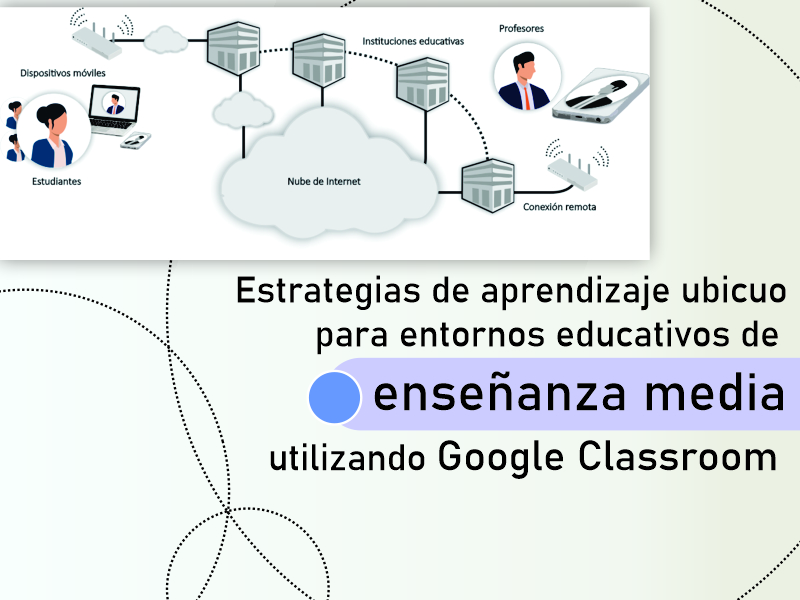
Estrategias de aprendizaje ubicuo para entornos educativos de enseñanza media utilizando Google Classroom
DOI:
https://doi.org/10.18779/ingenio.v8i2.943Palabras clave:
Competencias digitales, potenciar el aprendizaje, educación en entornos híbridos, tecnología educativa, herramientas digitales, enseñanza mediaResumen
El aprendizaje ubicuo ha demostrado ser efectivo en modalidades que requieren acceso continuo a contenidos curriculares. Este estudio propuso estrategias de aprendizaje ubicuo mediante Google Classroom en la enseñanza media, adoptando un enfoque empírico-analítico con análisis bibliométrico. Se llevó a cabo una actividad en la Escuela Particular de Idiomas “Aprende Alemán Jugando” en Guayaquil, Ecuador, con 100 estudiantes, centrada en la enseñanza de gramática alemana mediante Google Classroom. Los resultados indicaron que la planificación basada en estrategias de aprendizaje ubicuo obtuvo una aceptación superior al 90 %. Finalmente, la integración de Google Classroom en la enseñanza media optimizó estas estrategias y facilitó la virtualización de actividades presenciales. Este estudio contribuye al ámbito educativo al demostrar cómo las herramientas digitales fortalecen la enseñanza y se adaptan a los avances tecnológicos, generando nuevas oportunidades para la educación en entornos híbridos.
Descargas
Citas
R. Khlem, S. Kannappan, and P. Choudhury, “Coronavirus disease-2019: Challenges, opportunities, and benefits in India”, JOURNAL OF EDUCATION AND HEALTH PROMOTION, vol. 11, no. 1, 2022. [Online]. Available: https://doi.org/10.4103/jehp.jehp_1397_21
F. Jin, Z. Song, W. M. Cheung, C.-H. Lin, and T. Liu, “Technological affordances in teachers’ online professional learning communities: A systematic review”, Journal of Computer Assisted Learning, vol. 40, no. 3, pp. 1019–1039, dec. 2024. [Online]. Available: https://doi.org/10.1111/jcal.12935
N. F. Alias, and R. A. Razak, “Revolutionizing learning in the digital age: a systematic literature review of microlearning strategies”, Interactive Learning Environments, vol. 33, no. 1, pp. 1–21, apr. 2024. [Online]. Available: https://doi.org/10.1080/10494820.2024.2331638
A. Peramunugamage, U. W. Ratnayake, and S. P. Karunanayaka, “Systematic review on mobile collaborative learning for engineering education”, Journal of Computers in Education, vol. 10, no. 1, pp. 83–106, 2023. [Online]. Available: https://doi.org/10.1007/s40692-022-00223-1
Á. Flores Ortiz y A. García Martínezi, “Sistema de aprendizaje ubicuo en ambientes virtuales”, Rev. Cubana Edu. Superior, vol. 36, no. 2, pp. 27–37, may. 2017. [En línea]. Disponible en: http://scielo.sld.cu/pdf/rces/v36n2/rces03217.pdf
L. A. Cárdenas-Robledo y A. Peña-Ayala, “Ubiquitous learning: A systematic review”, Telematics and Informatics, vol. 35, no. 5, pp. 1097–1132, aug. 2018. [Online]. Available: https://doi.org/10.1016/j.tele.2018.01.009
L. A. Cárdenas-Robledo y A. Peña-Ayala, “Ubiquitous learning: A systematic review”, Telematics and Informatics, vol. 35, no. 5, pp. 1097–1132, aug. 2018. [Online]. Available: https://doi.org/10.1016/j.tele.2018.01.009
S. A. Aljawarneh, “Reviewing and exploring innovative ubiquitous learning tools in higher education”, Journal of Computing in Higher Education, vol. 32, no. 1, pp. 57–73, feb. 2020. [Online]. Available: https://doi.org/10.1007/s12528-019-09207-0
J. A. Kumar, B. Bervell, and S. Osman, “Google classroom: insights from Malaysian higher education students’ and instructors’ experiences”, Education and Information Technologies, vol. 25, no. 5, pp. 4175–4195, mar. 2020. [Online]. Available: https://doi.org/10.1007/s10639-020-10163-x
J. Rivadeneira, and E. Inga, “Interactive Peer Instruction Method Applied to Classroom Environments Considering a Learning Engineering Approach to Innovate the Teaching–Learning Process”, Education Sciences, vol. 13, no. 3, pp. 301, mar. 2023. [Online]. Available: https://doi.org/10.3390/educsci13030301.
J. Llerena-Izquierdo, and A. Valverde-Macias, “Google Classroom as a Blended Learning and M-learning Strategy for Training Representatives of the Student Federation of the Salesian Polytechnic University (Guayaquil, Ecuador)”, Advances in Intelligent Systems and Computing, vol. 1273 AISC, pp. 391–401, jul. 2021. [Online]. Available: https://doi.org/10.1007/978-3-030-59194-6_32
M. Isanoa-Sinche, and J. Llerena-Izquierdo, “Towards a Meaningful Experience on the Use of Digital Educational Resources and Media created at Ardora”, in 2023 IEEE Seventh Ecuador Technical Chapters Meeting (ECTM), 2023, pp. 1–5, nov. 2023. [Online]. Available: https://doi.org/10.1109/ETCM58927.2023.10308988
R. López-Chila, J. Llerena-Izquierdo, N. Sumba-Nacipucha, and J. Cueva-Estrada, “Artificial Intelligence in Higher Education: An Analysis of Existing Bibliometrics”, Education Sciences, vol. 14, no. 1, dec. 2023. [Online]. Available: https://doi.org/10.3390/educsci14010047
G. M. Ramírez Villegas, C. A. Collazos, and J. Díaz, “A Model to Measure U-Learning in Virtual Higher Education: U-CLX”, Applied Sciences, vol. 13, no. 2, jan. 2023. [Online]. Available: https://doi.org/10.3390/app13021091
A. Valverde-Macias, and J. Llerena-Izquierdo, “Google Classroom as a Mobile and Blended Learning Strategy for Salesian Groups Training”, in Communication, Smart Technologies and Innovation for Society, Á. Rocha, P. C. López-López, and J. P. Salgado-Guerrero, Eds., Singapore: Springer Singapore, 2022, pp. 97–106, sep. 2021. [Online]. Available: https://doi.org/10.1007/978-981-16-4126-8_10
H. El-Sofany, and S. El-Seould, “Implementing Effective Learning with Ubiquitous Learning Technology During Coronavirus Pandemic”, Computer Systems Science and Engineering, vol. 40, no. 1, pp. 389–404, aug. 2022. [Online]. Available: https://doi.org/10.32604/csse.2022.018619
M. S. Tabares, P. Vallejo, A. Montoya, and D. Correa, “A feedback model applied in a ubiquitous microlearning environment using SECA rules”, Journal of Computing in Higher Education, vol. 34, no. 2, pp. 462–488, feb. 2022. [Online]. Available: https://doi.org/10.1007/s12528-021-09306-x
G. A. Moreno López, D. Burgos, and J. A. Jiménez Builes, “A Ubiquitous Learning Model for Education and Training Processes Supported by TV Everywhere Platforms”, International Journal of Emerging Technologies in Learning (iJET), vol. 17, no. 11, pp. 128–145, jun. 2022. [Online]. Available: https://doi.org/10.3991/ijet.v17i11.30265
C. Srisuwan, and P. Panjaburee, “Implementation of flipped classroom with personalised ubiquitous learning support system to promote the university student performance of information literacy”, International Journal of Mobile Learning and Organisation, vol. 14, no. 3, pp. 398, 2020. [Online]. Available: https://doi.org/10.1504/IJMLO.2020.108200
K.-Y. Chin, K.-F. Lee, and Y.-L. Chen, “Effects of a Ubiquitous Guide-Learning System on Cultural Heritage Course Students’ Performance and Motivation”, IEEE Transactions on Learning Technologies, vol. 13, no. 1, pp. 52–62, jul. 2020. [Online]. Available: https://doi.org/10.1109/TLT.2019.2926267
W. Chiu, G. Liu, N. Barrett, M. Liaw, G. Hwang, and C. Lin, “Needs analysis-based design principles for constructing a context-aware English learning system”, Computer Assisted Language Learning, vol. 36, no. 1–2, pp. 176–204, jun. 2023. [Online]. Available: https://doi.org/10.1080/09588221.2021.1905666
L. G. Ferreira, J. L. V. Barbosa, J. C. Gluz, V. K. Matter, and D. N. F. Barbosa, “Using Learner Group Profiles for Content Recommendation in Ubiquitous Environments”, International Journal of Information and Communication Technology Education (IJICTE), vol. 16, no. 4, pp. 1–19, 2020. [Online]. Available: https://doi.org/10.4018/IJICTE.2020100101
T. Chen, “An Investigation and Analysis of College English Majors’ Autonomous Learning Ability in Ubiquitous Learning Environment”, Journal of Environmental and Public Health, vol. 2022, no. 1, p. 9103148, jul. 2022. [Online]. Available: https://doi.org/10.1155/2022/9103148
A. Agarwal, S. Sharma, V. Kumar, and M. Kaur, “Effect of E-learning on public health and environment during COVID-19 lockdown”, Big Data Mining and Analytics, vol. 4, no. 2, pp. 104–115, feb. 2021. [Online]. Available: https://doi.org/10.26599/BDMA.2020.9020014
G. J. Hwang, K. C. Li, and C. L. Lai, “Trends and strategies for conducting effective STEM research and applications: a mobile and ubiquitous learning perspective”, International Journal of Mobile Learning and Organisation, vol. 14, no. 2, p. 161, apr. 2020. [Online]. Available: https://doi.org/10.1504/IJMLO.2020.106166
L. Daniela, “Smart Pedagogy for Technology-Enhanced Learning”, in Didactics of Smart Pedagogy, Cham: Springer International Publishing, 2019, pp. 3–21. [Online]. Available: https://doi.org/10.1007/978-3-030-01551-0_1
Y. Walter, “Embracing the future of Artificial Intelligence in the classroom: the relevance of AI literacy, prompt engineering, and critical thinking in modern education”, International Journal of Educational Technology in Higher Education, vol. 21, no. 1, p. 15, feb. 2024. [Online]. Available: https://doi.org/10.1186/s41239-024-00448-3
I. M. Gómez-Trigueros, and C. Y. De Aldecoa, “The digital gender gap in teacher education: The TPACK framework for the 21st century”, European Journal of Investigation in Health, Psychology and Education, vol. 11, no. 4, pp. 1333–1349, oct. 2021. [Online]. Available: https://doi.org/10.3390/ejihpe11040097
G. S. Contreras, R. A. G. Lezcano, and E. J. L. Fernández, “Microlearning in physics teaching: An innovative proposal”, in Advancing STEM Education and Innovation in a Time of Distance Learning, IGI Global, 2022, pp. 139–149. [Online]. Available: https://doi.org/10.4018/978-1-6684-5053-6.ch007
T. D. Adjin-Tettey, D. Selormey, y H. A. Nkansah, “Ubiquitous Technologies and Learning: Exploring Perceived Academic Benefits of Social Media Among Undergraduate Students”, International Journal of Information and Communication Technology Education (IJICTE), vol. 18, no. 1, pp. 1–16, 2022. [Online]. Available: https://doi.org/10.4018/IJICTE.286758
N. Md. Sari, K. Y. Yin, Z. Zakariya, and R. Ismail, “User Acceptance of Google Classroom-Assisted Learning: The Case of Malaysian Form Six Economics Students”, International Journal of Learning, Teaching and Educational Research, vol. 21, no. 2, pp. 363–379, feb. 2022. [Online]. Available: https://doi.org/10.26803/ijlter.21.2.20
J. M. Santos, “Google Classroom: Beyond the traditional setting”, Problems of Education in the 21st Century, vol. 79, no. 4, pp. 626–639, Aug. 2021. [Online]. Available: https://doi.org/10.33225/pec/21.79.626.
M. Abuzant, M. Ghanem, A. Abd-Rabo, and W. Daher, “Quality of Using Google Classroom to Support the Learning Processes in the Automation and Programming Course”, International Journal of Emerging Technologies in Learning (iJET), vol. 16, no. 06 SE-Papers, pp. 72–87, mar. 2021. [Online]. Available: https://doi.org/10.3991/ijet.v16i06.18847.
P. Vallejo-Correa, J. Monsalve-Pulido, and M. Tabares-Betancur, “A systematic mapping review of context-aware analysis and its approach to mobile learning and ubiquitous learning processes”, Computer Science Review, vol. 39, p. 100335, 2021. [Online]. Available: https://doi.org/10.1016/j.cosrev.2020.100335
G.-J. Hwang, D. Zou, and J. Lin, “Effects of a multi-level concept mapping-based question-posing approach on students’ ubiquitous learning performance and perceptions”, Computers & Education, vol. 149, p. 103815, may. 2020. [Online]. Available: https://doi.org/10.1016/j.compedu.2020.103815
I. K. Suartama, P. Setyosari, S. Sulthoni, S. Ulfa, M. Yunus, and K. A. Sugiani, “Ubiquitous Learning vs. Electronic Learning: A Comparative Study on Learning Activeness and Learning Achievement of Students with Different Self-Regulated Learning,” International Journal of Emerging Technologies in Learning (iJET), vol. 16, no. 03, p. 36, feb. 2021. [Online]. Available: https://doi.org/10.3991/ijet.v16i03.14953
F. Jia, D. Sun, Q. Ma, and C.-K. Looi, “Developing an AI-Based Learning System for L2 Learners’ Authentic and Ubiquitous Learning in English Language”, Sustainability, vol. 14, no. 23, nov. 2022. [Online]. Available: https://doi.org/10.3390/su142315527
P. F. Novoa Castillo, R. F. Cancino Verde, Y. C. Uribe Hernández, L. L. Garro Aburto, and G. S. Mendez Ilizarbe, “El aprendizaje ubicuo en el proceso de enseñanza aprendizaje”, Revista Multi-Ensayos, pp. 2–8, feb. 2020. [Online]. Available: https://camjol.info/index.php/multiensayos/article/view/9331
B. Velázquez Gatica, and R. E. López Martínez, “Análisis crítico del concepto ‘aprendizaje ubicuo’ a través de la Cartografía Conceptual”, Revista de Educación a Distancia (RED), vol. 21, no. 66, apr. 2021. [Online]. Available: https://doi.org/10.6018/red.430841
B. Chang, “Student privacy issues in online learning environments,” Distance Education, vol. 42, no. 1, pp. 55–69, jan. 2021. [Online]. Available: https://doi.org/10.1080/01587919.2020.1869527
J. M. Kreeta Niemi, and A.-M. Poikkeus, “Opening up learning environments: liking school among students in reformed learning spaces”, Educational Review, vol. 76, no. 5, pp. 1–18, jul. 2022. [Online]. Available: https://doi.org/10.1080/00131911.2022.2098927
L. T. Nguyen et al., “How teachers manage their classroom in the digital learning environment – experiences from the University Smart Learning Project”, Heliyon, vol. 8, no. 10, p. e10817, oct. 2022. [Online]. Available: https://doi.org/10.1016/j.heliyon.2022.e10817
D. Oyserman, and A. Dawson, “Successful Learning Environments Support and Harness Students’ Identity-based Motivation: A Primer,” The Journal of Experimental Education, vol. 89, no. 3, pp. 508–522, jul. 2021. [Online]. Available: https://doi.org/10.1080/00220973.2021.1873091
P. Sharda, and M. K. Bajpai, “Online Learning and Teaching using Google Classroom during the COVID 19 Pandemic”, DESIDOC Journal of Library & Information Technology, vol. 41, no. 5 SE-Research Paper, aug. 2021. [Online]. Available: https://goo.su/gIRZlCb
V. Ekahitanond, “Perceived Efficacy of Google Classroom Usage in Varied English Courses”, International Journal of Emerging Technologies in Learning (iJET), vol. 17, no. 05 SE-Papers, pp. 266–280, mar. 2022. [Online]. Available: https://doi.org/10.3991/ijet.v17i05.22403
T. A. Hilal, A. A. Hilal, and H. A. Hilal, “Social Networking Applications: A Comparative Analysis for a Collaborative Learning through Google Classroom and Zoom”, Procedia Computer Science, vol. 210, pp. 61–69, 2022. [Online]. Available: https://doi.org/10.1016/j.procs.2022.10.120.
Suparjan, and N. Ismiyani, “Google Classroom Amidst COVID-19 Pandemic in Indonesian Elementary Schools: Teachers’ Perceptions and Motivation”, International Journal of Interactive Mobile Technologies (iJIM), vol. 16, no. 18 SE-Papers, pp. 133–148, oct. 2022. [Online]. Available: https://doi.org/10.3991/ijim.v16i18.32657
Publicado
Cómo citar
Número
Sección
Licencia
Derechos de autor 2025 Luis Deleg-Vera, Joe Llerena-Izquierdo

Esta obra está bajo una licencia internacional Creative Commons Atribución-NoComercial-CompartirIgual 4.0.
Acuerdo de licencia
Esta revista ofrece acceso gratuito a su contenido a través de su sitio web, siguiendo el principio de que hacer que la investigación esté disponible gratuitamente para el público apoya un mayor intercambio de conocimiento global.
El contenido web de la revista se distribuye bajo la licencia Atribución-NoComercial-CompartirIgual 4.0 Internacional.
Los autores podrán celebrar otros acuerdos de licencia no exclusivos para la distribución de la versión publicada de la obra, siempre que se reconozca la publicación inicial en esta revista. Se permite y recomienda que los autores publiquen sus trabajos en línea antes y durante el proceso de envío, lo que puede generar intercambios interesantes y aumentar las citas del trabajo publicado.