Uso de ChatGPT y sus implicaciones en la comunidad académica y científica: fallos, mal uso y retos
DOI:
https://doi.org/10.18779/ingenio.v8i2.1091Palabras clave:
Inteligencia artificial, plataforma digital, asistente conversacional, algoritmos de aprendizaje automáticoResumen
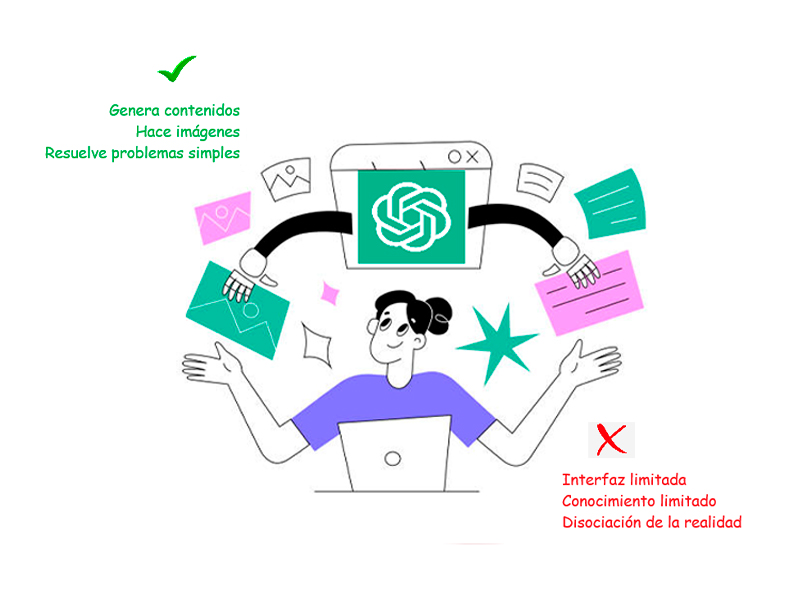
En el presente artículo se analizan de manera sistemática las principales ventajas y limitaciones del uso de la inteligencia artificial (IA) conversacional, específicamente ChatGPT, como herramienta de apoyo en la redacción de ensayos dentro del ámbito académico y científico. Asimismo, se abordó la resolución de problemas seleccionados en matemáticas y ciencias, con el objetivo de evaluar la eficacia de esta plataforma. Para ello, se diseñó y ejecutó un estudio de caso con enfoque sistemático, mediante el cual se recopilaron y analizaron datos generados por el chatbot. En el marco de este estudio, se redactaron ensayos sobre seis temáticas distintas, cuyas secciones introductorias fueron elaboradas utilizando ChatGPT. Paralelamente, se resolvieron seis problemas matemáticos que incluían temas como integrales, transformada Z, transformada de Laplace y ecuaciones diferenciales ordinarias. Además, se solicitó al modelo la definición y el procedimiento de cálculo de la tenacidad a la fractura de materiales. El análisis de los datos permitió concluir que ChatGPT es capaz de generar textos con una estructura gramaticalmente correcta y con coherencia sintáctica en un corto período de tiempo. Sin embargo, las introducciones generadas mostraron un contenido limitado, predominantemente basado en información general, sin alcanzar niveles de argumentación crítica. En cuanto a la resolución de problemas matemáticos, se observó que, en su estado actual, la plataforma presenta limitaciones significativas para abordar problemas complejos, lo cual evidencia la necesidad de mejoras sustanciales en su rendimiento para aplicaciones en el ámbito matemático.
Descargas
Citas
B. Gordijn y H. T. Have, "ChatGPT: evolution or revolution?," Med. Health Care Philos., vol. 26, pp. 1-2, 2023. [Online]. Available: https://doi.org/10.1007/s11019-023-10136-0
J. Dahmen, M. Kayaalp, M. Ollivier y A. Pareek, M. T. Hirschmann, J. Karlsson, P. W. Winkler, “Artificial intelligence bot ChatGPT in medical research: the potential game changer as a double-edged sword”, Knee Surg. Sports Trau, vol. 31, no. 4, pp. 1187–1189, 2023. [Online]. Available: https://doi.org/10.1007/s00167-023-07355-6
G. Grimaldi y B. Ehrler, "AI et al.: Machines Are About to Change Scientific Publishing Forever", ACS Energy Letters, vol. 8, no. 1, pp. 878-880, 2023. [Online]. Available: https://doi.org/10.1021/acsenergylett.2c02828
M. Dowling y B. Lucey, "ChatGPT for (Finance) research: The Bananarama Conjecture", Finance Res. Lett., vol. 53, pp. 103662-103668, 2023. [Online]. Available: https://doi.org/10.1016/j.frl.2023.103662
J. Chatterjee y N. Dethlefs, "This new conversational AI model can be your friend, philosopher, and guide ... and even your worst enemy," Patterns, vol. 4, no.1, pp. 100676-100678, 2023. [Online]. Available: https://doi.org/10.1016/j.patter.2022.100676
Welcome to the AI future?. Nat Astron, vol. 7, no. 1, pp. 1-4, 2023. [Online]. Available: https://doi.org/10.1038/s41550-023-01891-4
The AI writing on the wall. Nat Mach Intell, vol. 5, no. 1, pp. 1-5, 2023. [Online]. Available: https://doi.org/10.1038/s42256-023-00613-9
P. A. Rospigliosi, "Artificial intelligence in teaching and learning: what questions should we ask of ChatGPT?", Interactive Learning Environments, vol. 31, no. 1, pp. 1-3, 2023. [Online]. Available: https://doi.org/10.1080/10494820.2023.2180191
C. Stokel-Walker, "AI bot ChatGPT writes smart essays—Should professors worry?”, Nature, pp. 1-4, 2022. [Online]. Available: https://doi.org/10.1038/d41586-022-04397-7
S. Hammerstein, C. König, T. Dreisörner y A. Frey, "Effects of COVID-19-Related School Closures on Student Achievement-A Systematic Review", Front. Psychol., vol. 12, pp.1-10. 2021. [Online]. Available: https://doi.org/10.3389/fpsyg.2021.746289
S. Irais y A. Navarrete, "The ChatGPT artificial intelligence chat, language, and text generation tool has sparked concern and interest from the education sector”. [Online]. Available: https://goo.su/W5FUYx.
N. L. Borja-Hart, C. A. Spivey y C. M. George, "Use of virtual patient software to assess student confidence and ability in communication skills and virtual patient impression: A mixed-methods approach", Currents in Pharmacy Teaching and Learning, vol. 11, no. 7, pp. 710-718, 2019. [Online]. Available: https://doi:10.1016/j.cptl.2019.03.009
K. K. Fitzpatrick, A. Darcy y M. Vierhile, "Delivering Cognitive Behavior Therapy to Young Adults with Symptoms of Depression and Anxiety Using a Fully Automated Conversational Agent (Woebot): A Randomized Controlled Trial", JMIR Ment Health, vol. 4, no. 2, pp. e19-e23, 2017. [Online]. Available: https://doi:10.2196/mental.7785
E. Agyuz y M. Acikgoz, "Applications of Z-transform to Some Elemantary Functions in q- and (p,q)-Calculus", Turkish Journal of Analysis and Number Theory, vol. 4, no. 6, pp. 164-167, 2016. [Online]. Available: https://doi:10.12691/tjant-4-6-3
A. C. Grove, An Introduction to the Laplace Transform and the Z Transform. Salisbury, Wiltshire, UK, Prentice Hall, 1991.
W. J. Palm, System Dynamics. New York, USA, McGraw-Hill Higher Education, 2005.
D. G. Zill, A First Course in Differential Equations with Modeling Applications. Boston, MA, USA, Cengage Learning, 2017.
M. Alshater, "Exploring the Role of Artificial Intelligence in Enhancing Academic Performance: A Case Study of ChatGPT", 2022. [Online]. Available: http://dx.doi.org/10.2139/ssrn.4312358
S. O’Connor and ChatGpt, "Open artificial intelligence platforms in nursing education: Tools for academic progress or abuse?", Nurse Education in Practice, vol. 66, pp. 103537-103542, 2023. [Online]. Available: https://doi:10.1016/j.nepr.2022.103537
Publicado
Cómo citar
Número
Sección
Licencia
Derechos de autor 2025 Wilian J. Pech-Rodríguez, Eddie N. Armendáriz-Mireles, Carlos A. Calles-Arriaga, Enrique Rocha-Rangel

Esta obra está bajo una licencia internacional Creative Commons Atribución-NoComercial-CompartirIgual 4.0.
Acuerdo de licencia
Esta revista ofrece acceso gratuito a su contenido a través de su sitio web, siguiendo el principio de que hacer que la investigación esté disponible gratuitamente para el público apoya un mayor intercambio de conocimiento global.
El contenido web de la revista se distribuye bajo la licencia Atribución-NoComercial-CompartirIgual 4.0 Internacional.
Los autores podrán celebrar otros acuerdos de licencia no exclusivos para la distribución de la versión publicada de la obra, siempre que se reconozca la publicación inicial en esta revista. Se permite y recomienda que los autores publiquen sus trabajos en línea antes y durante el proceso de envío, lo que puede generar intercambios interesantes y aumentar las citas del trabajo publicado.