Estudio de redes HFC en contextos educativos
DOI:
https://doi.org/10.18779/ingenio.v8i1.923Palabras clave:
red HFC, investigación académica, red troncal, fibra óptica, infraestructura comunicaciónResumen
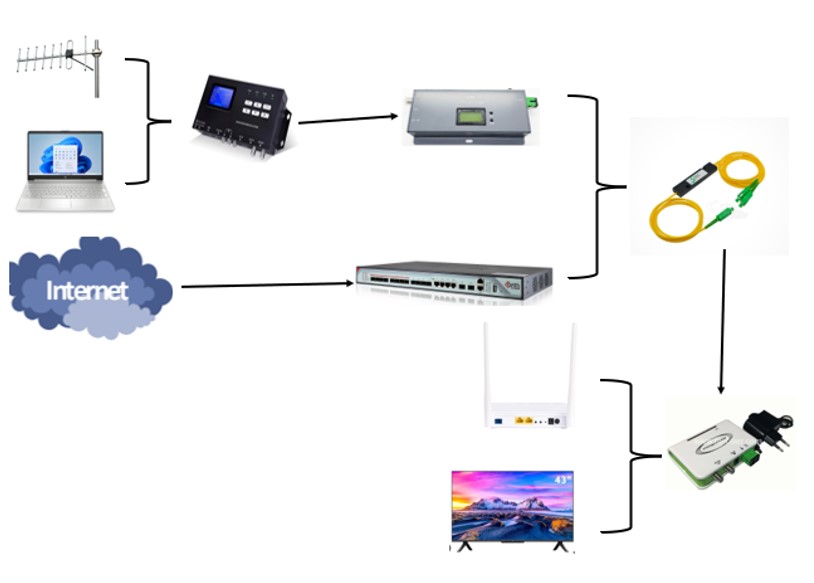
Este artículo presenta la propuesta de diseño de una red HFC (Fibra Híbrida-Coaxial) para los laboratorios de comunicaciones ópticas de una institución académica. Esta infraestructura combina fibra óptica y cable coaxial para garantizar una conectividad eficiente y robusta, especialmente adaptada a las necesidades de los laboratorios académicos y de investigación. El diseño incluye etapas clave como la planificación de la red troncal, la distribución óptica y la alimentación, priorizando el uso de fibra óptica para la transmisión de datos, garantizando un alto rendimiento y una capacidad adecuada para grandes volúmenes de datos. Este documento ofrece una visión completa del diseño de redes HFC, destacando cómo esta tecnología mejora la conectividad interna y facilita la colaboración y el intercambio de datos entre diferentes áreas académicas y de investigación.
Descargas
Citas
A. A. Grela, and E. J. Monzón, “Data transfer rates in HFC networks”, in 2020 IEEE Congreso Bienal de Argentina (ARGENCON), 2020. [Online]. Available: https://doi.org/10.1109/ARGENCON49523.2020.9505550
Z. Abdellaoui, Y. Dieudonne, and A. Aleya, “Design, implementation and evaluation of a Fiber To The Home (FTTH) access network based on a Giga Passive Optical Network GPON”, Array, vol. 10, p. 100058, mar. 2021. [Online]. Available: https://doi.org/10.1016/j.array.2021.100058
K. Park, K. Lee, S. Park, and H. Lee, “Telecommunication Node Clustering with Node Compatibility and Network Survivability Requirements”, Manage Science, vol. 46, no. 3, pp. 363–374, mar. 2000. [Online]. Available: https://doi.org/10.1287/mnsc.46.3.363.12066
X. Hu, and X. Gao, “An Attribute Relationship Clustering Algorithm for Telecom Customer Group Discovery”, in International Conference on Logistics, Informatics and Service Sciences (LISS), Springer, 2024. [Online]. Available: https://doi.org/10.1007/978-981-97-4045-1_2
Z. Du, R. Liu, N. Liu, and Y. Shao, “Spatial-based intelligent system for CATV network analysis,” in 2008 First International Conference on Intelligent Networks and Intelligent Systems, 2008, pp. 363–366. [Online]. Available: https://doi.org/10.1109/ICINIS.2008.179
W. Awalia, and A. B. Pantjawati, “Performance Simulation of Fiber to the Home (FTTH) Devices Based on Optisystem”, IOP Conference Series: Materials Science and Engineering, vol. 384, no. 1, p. 012051, 2018. [Online]. Available: https://doi.org/10.1088/1757-899X/384/1/012051
I. O. Khramov, R. I. Shaidullin, and O. A. Ryabushkin, “Curved Copper-Coated Optical Fiber Sensor for Precise Laser Power Measurements,” 2020 International Conference Laser Optics (ICLO), 2020. [Online]. Available: https://doi.org/10.1109/ICLO48556.2020.9285725
K. Borzycki, and T. Osuch, “Hollow-Core Optical Fibers for Telecommunications and Data Transmission,” Applied Sciences, vol. 13, no. 19, sep. 2023. [Online]. Available: https://doi.org/10.3390/app131910699
J. Bae, J. Song, S.-J. Ra, D.-J. Choi, and N. Hur, “A study on common phase rotation compensation for coaxial transmission systems in the HFC network,” in 2015 International Conference on Information and Communication Technology Convergence (ICTC), 2015, pp. 159–163. [Online]. Available: https://doi.org/10.1109/ICTC.2015.7354517
A. Bentaleb, A. C. Begen, and R. Zimmermann, “QoE-Aware Bandwidth Broker for HTTP Adaptive Streaming Flows in an SDN-Enabled HFC Network,” IEEE Transactions on Broadcasting, vol. 64, no. 2, pp. 575–589, 2018. [Online]. Available: https://doi.org/10.1109/TBC.2018.2816789
D. E. Sanchez M, J. A. Vega L, D. F. Rueda, and A. A. Rodriguez F, “Remote Monitoring of RF Amplifiers in HFC Networks: Voltage Drop Detection due to Power Blackouts,” in 2022 Congreso Internacional de Innovación y Tendencias en Ingeniería (CONIITI), 2022, pp. 1–6. [Online]. Available: https://doi.org/10.1109/CONIITI57704.2022.9953718
T. Benhavan, and K. Songwatana, “HFC network performance monitoring system using DOCSIS cable modem operation data in a 3 dimensional analysis,” in The 4th Joint International Conference on Information and Communication Technology, Electronic and Electrical Engineering (JICTEE), 2014, pp. 1–5. [Online]. Available: https://doi.org/10.1109/JICTEE.2014.6804074
M. Simakovic, and Z. Cica, “Detection and Localization of Failures in Hybrid Fiber–Coaxial Network Using Big Data Platform,” Electronics (Basel), vol. 10, no. 23, pp. 2906, 2021. [Online]. Available: https://doi.org/10.3390/electronics10232906
D. Soma et al., “Trans-Pacific class transmission over a standard cladding ultralow-loss 4-core fiber,” Optics Express, vol. 30, no. 6, pp. 9482, 2022. [Online]. Available: https://doi.org/10.1364/OE.453597
S. N. Milan, M. B. Ina, and Z. G. Cica, “Performance monitoring challenges in HFC networks,” in 2017 13th International Conference on Advanced Technologies, Systems and Services in Telecommunications (TELSIKS), 2017, pp. 385–388. [Online]. Available: https://doi.org/10.1109/TELSKS.2017.8246305
Z. Zhu, “Design green Hybrid Fiber-Coaxial networks: A traffic-aware and cooperative approach,” in 2012 IEEE International Conference on Communications (ICC), 2012, pp. 3165–3169. [Online]. Available: https://doi.org/10.1109/ICC.2012.6363640
B. Berscheid, and C. Howlett, “Full Duplex DOCSIS: Opportunities and Challenges”, IEEE Communications Magazine, vol. 57, no. 8, pp. 28–33, 2019. [Online]. Available: https://doi.org/10.1109/MCOM.2019.1800851
W. Coomans, H. Chow, and J. Maes, “Introducing Full Duplex in Hybrid Fiber Coaxial Networks,” IEEE Communications Standards Magazine, vol. 2, no. 1, pp. 74–79, 2018. [Online]. Available: https://doi.org/10.1109/MCOMSTD.2018.1700011
F. Effenberger, “Future Broadband Access Networks [Point of View],” Proceedings of the IEEE, vol. 104, no. 11, pp. 2078–2081, 2016. [Online]. Available: https://doi.org/10.1109/JPROC.2016.2612891
R. Strobel, and T. Hewavithana, “Power Spectrum Optimization for Capacity of the Extended Spectrum Hybrid Fiber Coax Network,” in ICASSP 2020 - 2020 IEEE International Conference on Acoustics, Speech and Signal Processing (ICASSP), 2020, pp. 5100–5104. [Online]. Available: https://doi.org/10.1109/ICASSP40776.2020.9054052
J. Tamayo, “Análisis de frecuencia de comunicaciones de emergencia con medios acuáticos utilizando equipos HF y VHF en la Isla San Cristóbal”, Tesis de grado, Universidad Politécnica Salesiana, Guayaquil, Ecuador, 2023 [Online]. Available: https://dspace.ups.edu.ec/handle/123456789/26352
Publicado
Cómo citar
Número
Sección
Licencia
Derechos de autor 2025 Holger Santillán, Elvis Apolinario, Sulay Gavilanez, David Cardenas

Esta obra está bajo una licencia internacional Creative Commons Atribución-NoComercial-CompartirIgual 4.0.
Acuerdo de licencia
Esta revista ofrece acceso gratuito a su contenido a través de su sitio web, siguiendo el principio de que hacer que la investigación esté disponible gratuitamente para el público apoya un mayor intercambio de conocimiento global.
El contenido web de la revista se distribuye bajo la licencia Atribución-NoComercial-CompartirIgual 4.0 Internacional.
Los autores podrán celebrar otros acuerdos de licencia no exclusivos para la distribución de la versión publicada de la obra, siempre que se reconozca la publicación inicial en esta revista. Se permite y recomienda que los autores publiquen sus trabajos en línea antes y durante el proceso de envío, lo que puede generar intercambios interesantes y aumentar las citas del trabajo publicado.