Gamificación: Evaluación del módulo aprenda a leer de la app Preescolar Montessori
DOI:
https://doi.org/10.18779/ingenio.v8i1.896Palabras clave:
tecnología, preescolar, gamificación, Montessori Preescolar, lecturaResumen
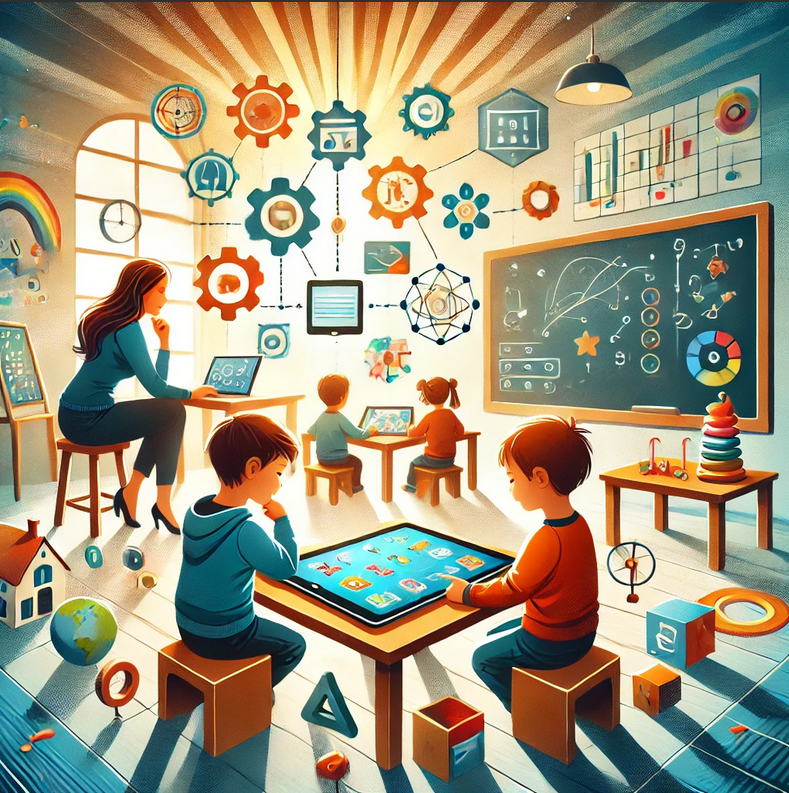
La integración de la tecnología en la educación preescolar es un tema relevante en la era moderna. Este estudio investiga las interfaces tecnológicas en este ámbito, con un enfoque en adaptarlas a las necesidades individuales de los estudiantes. Además, se explora cómo las herramientas de gamificación pueden mejorar la motivación y las habilidades de lectura y escritura en niños pequeños. El estudio adoptó un enfoque cuanti-cualitativo, comparando datos de niños de Santo Domingo de los Tsáchilas y Pichincha. Se analizó el impacto de la aplicación Montessori en la enseñanza de la lectura, con resultados variados entre las provincias. Aunque se observó una mejora general en las habilidades, hubo diferencias significativas entre los estudiantes y el rendimiento académico evidenciado. Se enfatiza la necesidad de adaptar las estrategias educativas a las necesidades individuales de cada estudiante para garantizar un desarrollo equitativo. Se distingue entre ludificación y gamificación, destacando el potencial de esta última para motivar y desarrollar habilidades. Además, se sugiere su integración en futuros programas educativos como una herramienta eficaz para enriquecer el proceso de aprendizaje.
Descargas
Citas
M. A. Al Mamun, G. Lawrie, and T. Wright, “Instructional design of scaffolded online learning modules for self-directed and inquiry-based learning environments”, Comput Educ, vol. 144, dec. 2020. [Online] Available: https://doi.org/10.1016/j.compedu.2019.103695
M. C. Ricoy, and C. Sánchez-Martínez, “Raising Ecological Awareness and Digital Literacy in Primary School Children through Gamification”, Int J Environ Res Public Health, vol. 19, no. 3, jan. 2022. [Online] Available: https://doi.org/10.3390/ijerph19031149
K. Fitton Davies, S. Clarke, R. Martins, J. R. Rudd, and M. Duncan, “The effect of a home-based, gamified stability skills intervention on 4-5-year-old children’s physical and cognitive outcomes: A pilot study,” Psychol Sport Exerc, vol. 73, jul. 2024. [Online] Available: https://doi.org/10.1016/j.psychsport.2024.102636
A. C. Sari, A. M. Fadillah, J. Jonathan, and M. R. D. Prabowo, “Interactive gamification learning media application for blind children using android smartphone in Indonesia”, Procedia Comput Sci, vol. 157, pp. 589–595, 2019. [Online] Available: https://doi.org/10.1016/j.procs.2019.09.018
M. A. Al Mamun, G. Lawrie, and T. Wright, “Instructional design of scaffolded online learning modules for self-directed and inquiry-based learning environments,” Comput Educ, vol. 144, jan. 2020. [Online] Available: https://doi.org/10.1016/j.compedu.2019.103695
A. Cattoni, F. Anderle, P. Venuti, and A. Pasqualotto, “How to improve reading and writing skills in primary schools: A comparison between gamification and pen-and-paper training”, Int J Child Comput Interact, vol. 39, mar. 2024. [Online] Available: https://doi.org/10.1016/j.ijcci.2024.100633
S. Feinauer, L. Schuller, I. Groh, L. Huestegge, and T. Petzoldt, “The potential of gamification for user education in partial and conditional driving automation: A driving simulator study”, Transp Res Part F Traffic Psychol Behav, vol. 90, pp. 252–268, oct. 2022. [Online] Available: https://doi.org/10.1016/J.TRF.2022.08.009
K. Nand, N. Baghaei, J. Casey, B. Barmada, F. Mehdipour, and H.-N. Liang, “Engaging children with educational content via Gamification”, Smart Learning Environments, vol. 6, pp. 1-15, jul. 2019. [Online] Available: https://doi.org/10.1186/s40561-019-0085-2
P. R. D. Ifigenia, M. A. Jaime, B. Julien, and P. G. J. Cesar, “Integration of gamification to assist literacy in children with special educational needs”, IEEE Global Engineering Education Conference, EDUCON, pp. 1949–1956, apr. 2018. [Online] Available: https://doi.org/10.1109/EDUCON.2018.8363474
X. Li, and S. K. W. Chu, “Exploring the effects of gamification pedagogy on children’s reading: A mixed-method study on academic performance, reading-related mentality and behaviors, and sustainability”, British Journal of Educational Technology, vol. 52, no. 1, pp. 160–178, dec. 2020. [Online] Available: https://doi.org/10.1111/bjet.13057
R. Lamrani, and E. H. Abdelwahed, “Game-based learning and gamification to improve skills in early years education”, Computer Science and Information Systems, vol. 17, no. 1, pp. 339–356, 2020. [Online] Available: https://doi.org/10.2298/CSIS190511043L
L. Aguiar-Castillo, L. Hernández-López, P. De Saá-Pérez, and R. Pérez-Jiménez, “Gamification as a motivation strategy for higher education students in tourism face-to-face learning”, J Hosp Leis Sport Tour Educ, vol. 27, nov. 2020. [Online] Available: https://doi.org/10.1016/J.JHLSTE.2020.100267
L. Britton, Jugar y aprender con el método Montessori, 1ª ed, España: Paidós Educación, 2017. [En línea]. Disponible en: https://goo.su/OHt7OuU
A. Kauppinen, and A. Iftikhar Choudhary, “Gamification in entrepreneurship education: A concrete application of Kahoot!”, The International Journal of Management Education, vol. 19, no. 3, nov. 2021. [Online] Available: https://doi.org/10.1016/J.IJME.2021.100563
D. Kayimbasioglu, B. Oktekin, and H. Haci, “Integration of Gamification Technology in Education”, Procedia Comput Sci, vol. 102, pp. 668–676, jan. 2016. [Online] Available: https://doi.org/10.1016/J.PROCS.2016.09.460
J. S. Radesky, and D. A. Christakis, “Increased Screen Time: Implications for Early Childhood Development and Behavior”, Pediatr Clin North Am, vol. 63, no. 5, pp. 827–839, oct. 2016. [Online] Available: https://doi.org/10.1016/J.PCL.2016.06.006
M. De Reuver, C. Sorensen, and R. C. Basole, “The Digital Platform: A Research Agenda”, Journal of Information Technology, vol. 33, no. 2, pp. 124–135, jun. 2018. [Online] Available: https://doi.org/10.1057/S41265-016-0033-3
D. H. Clements, J. Sarama, and C. Germeroth, “Learning executive function and early mathematics: Directions of causal relations”, Early Child Res Q, vol. 36, pp. 79–90, jul. 2016. [Online] Available: https://doi.org/10.1016/J.ECRESQ.2015.12.009
S. Papadakis, “Apps to promote computational thinking concepts and coding skills in children of preschool and pre-primary school age”, en Mobile Learning Applications in Early Childhood Education, 2019, 101–121. [Online] Available: https://doi.org/10.4018/978-1-7998-1486-3.CH006
M. De Reuver, C. Sorensen, and R. C. Basole, “The Digital Platform: A Research Agenda”, Journal of Information Technology, vol. 33, no. 2, pp. 124–135, jun. 2018. [Online] Available: https://doi.org/10.1057/S41265-016-0033-3
Publicado
Cómo citar
Número
Sección
Licencia
Derechos de autor 2025 Fabricio Marcillo, Lorena Cusme, Jimmy Torres, Lucía Begnini

Esta obra está bajo una licencia internacional Creative Commons Atribución-NoComercial-CompartirIgual 4.0.
Acuerdo de licencia
Esta revista ofrece acceso gratuito a su contenido a través de su sitio web, siguiendo el principio de que hacer que la investigación esté disponible gratuitamente para el público apoya un mayor intercambio de conocimiento global.
El contenido web de la revista se distribuye bajo la licencia Atribución-NoComercial-CompartirIgual 4.0 Internacional.
Los autores podrán celebrar otros acuerdos de licencia no exclusivos para la distribución de la versión publicada de la obra, siempre que se reconozca la publicación inicial en esta revista. Se permite y recomienda que los autores publiquen sus trabajos en línea antes y durante el proceso de envío, lo que puede generar intercambios interesantes y aumentar las citas del trabajo publicado.