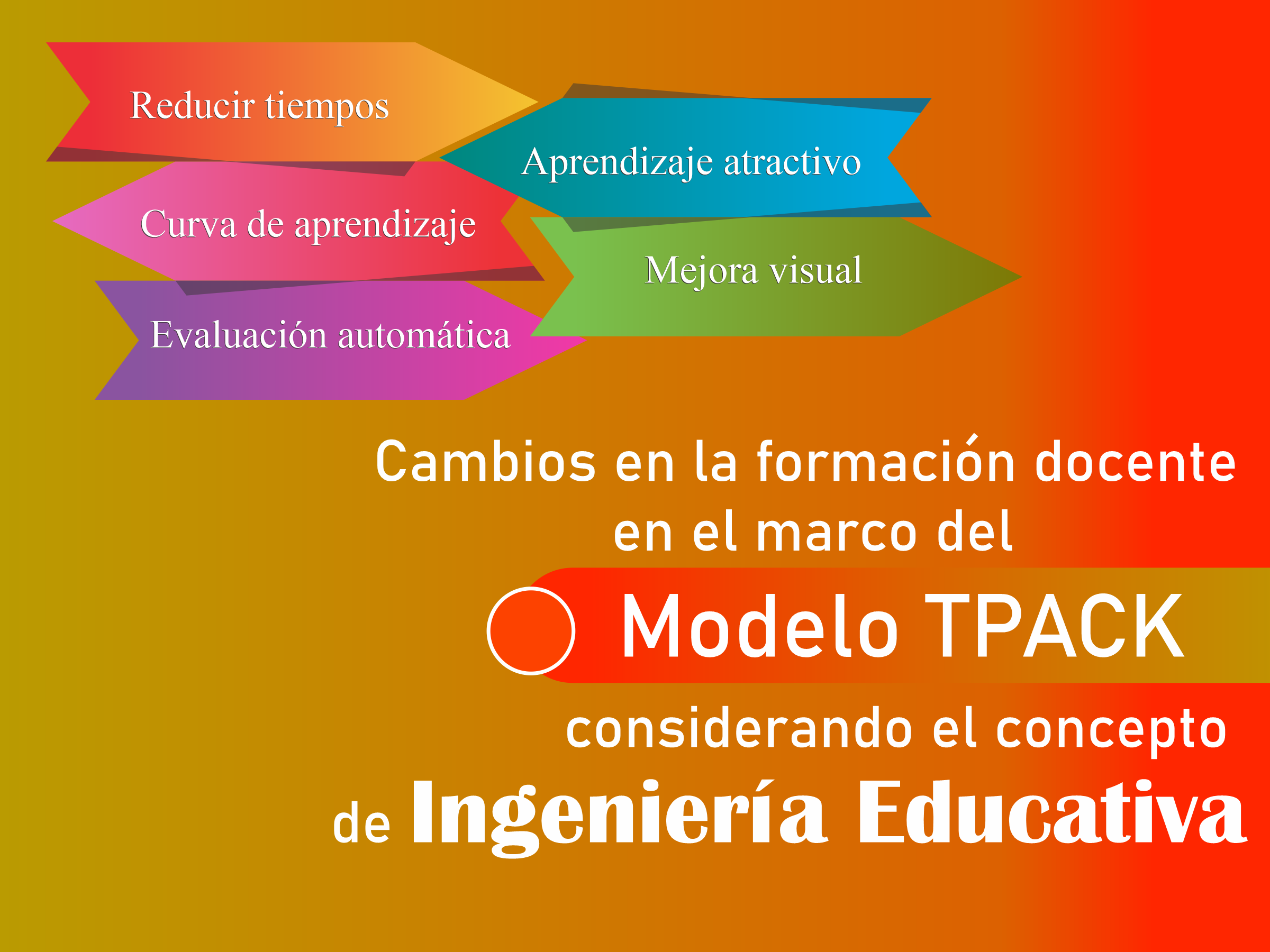
(Changes in teacher training within the framework of the tpack model considering the concept of educational engineering)
DOI:
https://doi.org/10.18779/ingenio.v8i1.847Keywords:
Teaching-learning process, teacher training, TPACK model, educational innovationAbstract
Technological evolution and the adoption of innovative methodologies are transforming education, impacting both students and teachers. This article aims to contribute to the existing literature on the integration of technology in teacher education. It presents a training model for educators based on the TPACK (Technological Pedagogical Content Knowledge) framework, which uses technological tools to optimize the teaching-learning process and improve efficiency in educational preparation, execution and evaluation. The research employs an empirical-analytical approach with a quantitative design. It is structured in two phases: the first consists of an exhaustive literature review to identify key concepts related to the study. In the second phase, the methods found are evaluated in the context of the TPACK model and a modular training flow is defined. Of the 90 articles analyzed, 19 that address the use of technologies for innovation in teaching are highlighted. A conceptual map is presented that identifies technological tools that can support teachers in the planning, execution and evaluation of classes. The results show that 74 % of teachers positively accept the use of digital tools within the TPACK framework, which supports their integration into educational practice. The research concludes that areas for improvement in teacher training have been identified and specific changes are proposed, including the incorporation of new tools, to strengthen the integration of the TPACK model and the principles of educational engineering.
Downloads
References
E. T. Khor, and M. K, “A Systematic Review of the Role of Learning Analytics in Supporting Personalized Learning”, Educ. Sci, vol. 14, no. 1, dec. 2023. [Online]. Available: https://doi.org/10.3390/educsci14010051
R. Ayala-Carabajo, and J. Llerena-Izquierdo, “Bibliometric Review on a Hybrid Learning Model with VLEs from a Higher Education Context”, in Systems, Smart Technologies and Innovation for Society, J. P. Salgado-Guerrero, H. R. Vega-Carrillo, G. García-Fernández, and V. Robles-Bykbaev, Eds., Cham: Springer Nature Switzerland, 2024, pp. 148–157. [Online]. Available: https://doi.org/10.1007/978-3-031-52090-7_15
H. A. Younis et al., “A Systematic Review and Meta-Analysis of Artificial Intelligence Tools in Medicine and Healthcare: Applications, Considerations, Limitations, Motivation and Challenges”, Diagnostics, vol. 14, no. 1, jan. 2024. [Online]. Available: https://doi.org/10.3390/diagnostics14010109
D. Shin, “Teaching Mathematics Integrating Intelligent Tutoring Systems: Investigating Prospective Teachers’ Concerns and TPACK”, Int. J. Sci. Math. Educ, vol. 20, no.8, pp. 1–17, sep. 2021. [Online]. Available: https://doi.org/10.1007/s10763-021-10221-x
E. Goode, T. Roche, E. Wilson, J. Zhang, and J. McKenzie, “The success, satisfaction and experiences of international students in an immersive block model”, J. Univ. Teach. Learn. Pract., vol. 21, no. 2, jul. 2024. [Online]. Available: https://doi.org/10.53761/1.21.2.08
C.-J. Shieh, and J. Nasongkhla, “Effects of motivation to use social networking sites on students’ media literacy and critical thinking”, Online J. Commun. Media Technol., vol. 14, no. 1, p. e202404, dec. 2023. [Online]. Available: https://doi.org/10.30935/ojcmt/14060
R. López-Chila, J. Llerena-Izquierdo, N. Sumba-Nacipucha, and J. Cueva-Estrada, “Artificial Intelligence in Higher Education: An Analysis of Existing Bibliometrics”, Educ. Sci, vol. 14, no. 1, dec. 2023. [Online]. Available: https://doi.org/10.3390/educsci14010047
A. Grund, S. Fries, M. Nuckles, A. Renkl, and J. Roelle, “When is Learning ‘Effortful’? Scrutinizing the Concept of Mental Effort in Cognitively Oriented Research from a Motivational Perspective”, Educ. Psychol. Rev., vol. 36, no. 1, 2024. [Online]. Available: https://doi.org/10.1007/s10648-024-09852-7
T. Dhurumraj, S. Ramaila, F. Raban, and A. Ashruf, “Broadening educational pathways to stem education through online teaching and learning during covid-19: Teachers’ perspectives”, J. Balt. Sci. Educ., vol. 19, no. 6, pp. 1055–1067, dec. 2020. [Online]. Available: https://doi.org/10.33225/jbse/20.19.1055
F. B. Potes-Duque, and J. J. Jiménez-Contreras, “Innovación pedagógica en el proceso de enseñanza-aprendizaje de matemáticas para estudiantes de Educación General Básica considerando las Tecnologías de la Información y la Comunicación”, INNOVA Res. J., vol. 8, no. 3.1, pp. 25–44, nov. 2023. [En línea]. Disponible en: https://doi.org/10.33890/innova.v8.n3.1.2023.2319
P. Garzon, and E. Inga, “Advancing Primary Education through Active Teaching Methods and ICT for Increasing Knowledge”, Sustainability, vol. 15, no. 12, jun. 2023. [Online]. Available: https://doi.org/10.3390/su15129551
S. Adipat, “Developing Technological Pedagogical Content Knowledge (TPACK) through Technology-Enhanced Content and Language-Integrated Learning (T-CLIL) Instruction”, Educ. Inf. Technol., vol. 26, no. 5, pp. 6461–6477, 2021. [Online]. Available: https://doi.org/10.1007/s10639-021-10648-3
N. Pilapaxi-Cunalata, and J. Llerena-Izquierdo, “Experience of the Disruption of Educational Technologies Based on the UTAUT Model”, in 2023 IEEE Seventh Ecuador Technical Chapters Meeting (ECTM), 2023, pp. 1–5. [Online]. Available: https://doi.org/10.1109/ETCM58927.2023.10308981
C. D. Vásconez Paredes, and E. M. Inga Ortega, “El modelo de aprendizaje TPACK y su impacto en la innovación educativa desde un análisis bibliométrico”, INNOVA Res. J, vol. 6, no. 3, pp. 79–97, sep. 2021. [Online]. Available: https://doi.org/10.33890/innova.v6.n3.2021.1773
N. Sumba-Nacipucha, J. Cueva-Estrada, E. Conde-Lorenzo, and M. C. Mármol-Castillo, “Reflections on the role of the professor from the TPACK model perspective during covid-19”, in 2021 IEEE World Conference on Engineering Education (EDUNINE), 2021, pp. 1–6. [Online]. Available: https://doi.org/10.1109/EDUNINE51952.2021.9429097
A. Kaplon-Schilis, and I. Lyublinskaya, “Analysis of Relationship Between Five Domains of TPACK Framework: TK, PK, CK Math, CK Science, and TPACK of Pre-service Special Education Teachers”, Technol. Knowl. Learn, vol. 25, no. 1, pp. 25–43, apr. 2019. [Online]. Available: https://doi.org/10.1007/s10758-019-09404-x
J. M. Santos, and R. D. R. Castro, “Technological Pedagogical content knowledge (TPACK) in action: Application of learning in the classroom by pre-service teachers (PST),” Soc. Sci. Humanit. Open, vol. 3, no. 1, p. 100110, 2021. [Online]. Available: https://doi.org/10.1016/j.ssaho.2021.100110
K. Acikgul, and R. Aslaner, “Effects of Geogebra supported micro teaching applications and technological pedagogical content knowledge (TPACK) game practices on the TPACK levels of prospective teachers”, Educ. Inf. Technol, vol. 25, no. 3, pp. 2023–2047, dec. 2020. [Online]. Available: https://doi.org/10.1007/s10639-019-10044-y
D. Baser, R. Akkus, S. Akayoglu, E. Top, and M. D. Gurer, “Training in-service teachers through individualized technology-related mentorship,” Educ. Technol. Res. Dev, vol. 69, no. 6, pp. 3131–3151, dec. 2021. [Online]. Available: https://doi.org/10.1007/s11423-021-10065-w
R. Lopez-Chila, N. Sumba-Nacipucha, J. Córdova-León, R. Valverde-Arrieta, J. Jimenez-Contreras, and J. Llerena-Izquierdo, “A Management Model for the Development of Meaningful Digital Learning Resources in Homogeneous Linear Algebra Courses”, in 2023 International Conference on Electrical, Computer and Energy Technologies (ICECET), IEEE, Nov. 2023, pp. 1–6. [Online]. Available: https://doi.org/10.1109/ICECET58911.2023.10389227
F. C. Bonafini, and Y. Lee, “Investigating Prospective Teachers’ TPACK and their Use of Mathematical Action Technologies as they Create Screencast Video Lessons on iPads”, TechTrends, vol. 65, no. 3, pp. 303–319, 2021. [Online]. Available: https://doi.org/10.1007/s11528-020-00578-1
J. Zapata-Martínez, and J. Llerena-Izquierdo, “Las TIC después del COVID-19: la perspectiva de los profesores universitarios”, Congr. Docencia en Educ. Super. CODES, vol. 5, nov. 2023. [En línea]. Disponible en: https://doi.org/10.15443/codes1988
M. Núñez-Canal, M. de las M. de Obesso, and C. A. Pérez-Rivero, “New challenges in higher education: A study of the digital competence of educators in Covid times”, Technol. Forecast. Soc. Change, vol. 174, jan. 2022. [Online]. Available: https://doi.org/10.1016/j.techfore.2021.121270
J. B. Silva, I. N. Silva, and S. Bilessimo, “Technological structure for technology integration in the classroom, inspired by the maker culture”, J. Inf. Technol. Educ. Res., vol. 19, pp. 167–204, jan. 2020. [Online]. Available: https://doi.org/10.28945/4532
P. Ingavélez-Guerra, S. Otón-Tortosa, J. Hilera-González, and M. Sánchez-Gordón, “Correction to: The use of accessibility metadata in e-learning environments: a systematic literature review”, Univers. Access Inf. Soc., vol. 22, no. 3, p. 1095, mar. 2022. [Online]. Available: https://doi.org/10.1007/s10209-022-00876-w
J. Moncayo Redin, J. Jiménez Contreras, and J. Llerena-Izquierdo, “Innovación pedagógica en el proceso de enseñanza-aprendizaje de matemáticas para estudiantes de bachillerato general unificado considerando tecnologías de información y comunicación ”, Rev. InGenio, vol. 7, no. 2 SE-Artículos, pp. 70–84, jul. 2024. [En línea]. Disponible en: https://doi.org/10.18779/ingenio.v7i2.807
F.J. Hinojo-Lucena, I. Aznar-Díaz, M.-P. Cáceres-Reche, and J.-M. Romero-Rodríguez, “Artificial Intelligence in Higher Education: A Bibliometric Study on its Impact in the Scientific Literature”, Educ. Sci., vol. 9, no. 1, pp. 51, 2019. [Online]. Available: https://doi.org/10.3390/educsci9010051
Z. Hashim, M. Khalip, and R. Dayang, “Innovation culture in education: A systematic review of the literature”, Manag. Educ, vol. 36, no. 3, pp. 135-149, oct. 2020. [Online]. Available: https://doi.org/10.1177/0892020620959760
K. Wollmann and K. Lange-Schubert, “The Development of Prospective Primary School Science Teachers’ TPaCK Fostered by Innovative Science-Teacher Education”, Educ. Sci, vol. 12, no. 6, may. 2022. [Online]. Available: https://doi.org/10.3390/educsci12060381
C. A. Hernández-Suárez, R. Prada-Núñez, and A. A. Gamboa-Suárez, “Pre-service teacher education: Active scenarios from a flipped classroom a perspective”, Formación Universitaria, vol. 13, no. 5, pp. 213–222, oct. 2020. [Online]. Available: 10.4067/S0718-50062020000500213
Y. Wu, Y. Yang, W. Xu, and Q. Chen, “The Influence of Innovation Resources in Higher Education Institutions on the Development of Sci-Tech Parks ’ Enterprises in the Urban Innovative Districts at the Stage of Urbanization Transformation”, land, vol. 9, no. 396, pp. 1–10, oct. 2020. [Online]. Available: https://doi.org/10.3390/land9100396
C. Fuller, "Education Innovation Clusters: Supporting transformative teaching and learning", Child. Educ. vol. 96, no. 1, pp. 34-37, jan. 2020. [Online]. Available: https://doi.org/10.1080/00094056.2020.1707534
Y. F. Yeh, K. K. H. Chan, and Y. S. Hsu, "Toward a framework that connects individual TPACK and collective TPACK: A systematic review of TPACK studies investigating teacher collaborative discourse in the learning by design process", Comput. Educ., vol. 171, oct. 2021. [Online]. Available: doi: https://doi.org/10.1016/j.compedu.2021.104238
CEPAL, "Las tecnologías digitales frente a los desafíos de una educación inclusiva en América Latina: algunos casos de buenas prácticas". CEPAL. Acceso: 24 de agosto de 2024. [En línea]. Disponible en: https://www.cepal.org/es/publicaciones/21658-tecnologias-digitales-frente-desafios-educacion-inclusiva-america-latina-algunos
OECD, "The impact of ICT on learning: design for a quasi-experimental study", 2000.
A. Widowati, S. Atun, I. G. P. Suryadarma, A. Wiyarsi, Setuju, and N. A. Raduan, "Innovative education program for science preservice teachers: Technological, pedagogical, and science knowledge-Contextual (TPACK-C) approach", Int. J. Innov. Creat. Chang., vol. 12, no. 11, pp. 83–93, 2020. [Online]. Available: https://rb.gy/s3rhps
S. Haryati, I. Yuliasri, J. Nurkamto, and W. Fitriati, "TPACK Praxis in EFL Reading Classroom: A Case of Technology-Infused Teaching from Indonesia", PEGEGOG, vol. 14, no. 1, pp. 205–217, aug. 2023. [Online]. Available: https://doi.org/10.47750/pegegog.14.01.23
J. C. Bush, "Using screencasting to give feedback for academic writing", Innov. Lang. Learn. Teach, vol. 15, no. 5, pp. 473–486, 2021. [Online]. Available: https://doi.org/10.1080/17501229.2020.1840571
K. L. Neumann, F. Alvarado-Albertorio, and A. Ramírez-Salgado, "Aligning with Practice: Examining the Effects of a Practice-Based Educational Technology Course on Preservice Teachers’ Potential to Teach with Technology", TechTrends, vol. 65, no. 6, pp. 1027–1041, 2021. [Online]. Available: https://doi.org/10.1007/s11528-021-00672-y
T. Kartal, I. Dilek, and I. Preservice, "Preservice Science Teachers’ TPA CK Development in a Technology-Enhanced Science Teaching Method Course", Journal of Education in Science Environment and Health, vol. 7, no. 4, pp. 339-353, oct. 2021. [Online]. Available: https://doi.org/10.21891/jeseh.994458
P. Chaipidech, T. Kajonmanee, K. Chaipah, P. Panjaburee, and N. Srisawasdi, “Implementation of an Andragogical Teacher Professional Development Training Program for Boosting TPACK in STEM Education”, Educ. Technol. Soc, vol. 24, no. 4, pp. 220–239, oct. 2021. [Online]. Available: https://www.jstor.org/stable/48629257
A. Lachner et al., “Fostering pre-service teachers’ technological pedagogical content knowledge (TPACK): A quasi-experimental field study,” Comput. Educ., vol. 174, aug. 2021. [Online]. Available: https://doi.org/10.1016/j.compedu.2021.104304
I. María Gómez-Trigueros, “Teaching Professional Ethical Knowledge and Teaching Digital Skills in Higher Education”, Education and Human Development. IntechOpen, no. 2, jan. 2023. [Online]. Available: https://doi.org/10.5772/intechopen.109221
K. A. Papanikolaou, K. Makri, I. Sofos, M. G. Tzelepi, and E. Zalavra, “Putting TPACK into action in learning design: The case of PeerLAND”, Australas. J. Educ. Technol, vol. 38, no. 6, pp. 53–74, nov. 2022. [Online]. Available: https://doi.org/10.14742/ajet.7556
F. Zimmermann, I. Melle, and J. Huwer, “Developing Prospective Chemistry Teachers’ TPACK-A Comparison between Students of Two Different Universities and Expertise Levels Regarding Their TPACK Self-Efficacy, Attitude, and Lesson Planning Competence”, Journal of Chemical Education, vol. 98, no. 6. pp. 1863–1874, 2021. [Online]. Available: https://doi.org/10.1021/acs.jchemed.0c01296.
R. A. Filho, and V. Gitirana, “Pre-service Teachers’ Knowledge: Analysis of teachers’ education situation based on TPACK”, Math. Enthus, vol. 19, no. 2, pp. 594–631, 2022. [Online]. Available: https://doi.org/10.54870/1551-3440.1565
E. Ifinedo, J. Rikala, and T. Hämäläinen, “Factors affecting Nigerian teacher educators’ technology integration: Considering characteristics, knowledge constructs, ICT practices and beliefs”, Comput. Educ, vol. 146, mar. 2020. [Online]. Available: https://doi.org/10.1016/j.compedu.2019.103760
J. Moon, S. Lee, and X. Xu, “Exploring pre-service teachers’ technology-integration belief and scientific inquiry in a teacher-development course,” Int. J. Technol. Des. Educ, vol. 32, no. 3, pp. 1777–1798, 2022. [Online]. Available: https://doi.org/10.1007/s10798-021-09672-8
M. H. Salleh, S. A. Kadir, R. Jamaluddin, and M. H. M. Puad, “Factors Influencing TVET Teacher’s TPACK Competencies in Peninsular Malaysia,” J. Tech. Educ. Train., vol. 14, no. 3, pp. 105–111, 2022. [Online]. Available: https://doi.org/10.30880/jtet.2022.14.03.010
L. Meroño, A. Calderón, and J. L. Arias-Estero, “Digital pedagogy and cooperative learning: Effect on the technological pedagogical content knowledge and academic achievement of pre-service teachers”, Rev. Psicodidáctica (English ed.), vol. 26, no. 1, pp. 53–61, 2021. [Online]. Available: https://doi.org/10.1016/j.psicoe.2020.10.002
J. Marbán, and E. Sintema, “Pre-Service Teachers’ TPACK and Attitudes Toward Integration of ICT in Mathematics Teaching”, Int. J. Technol. Math. Educ, vol. 28, no. 1, pp. 37–46, may. 2021. [Online]. Available: https://doi.org/10.1564/tme_v28.4.03
U. Izgi-Onbasili, A. Avsar-Tuncay, B. Sezginsoy-Seker, and S. A. Kiray, “an Examination of Pre-Service Teachers’ Experiences in Creating a Scientific Digital Story in the Context of Their Self Confidence in Technological Pedagogical Content Knowledge”, J. Balt. Sci. Educ., vol. 21, no. 2, pp. 207–223, apr. 2022. [Online]. Available: https://doi.org/10.33225/jbse/22.21.207
I. M. Gómez-Trigueros and C. Y. De Aldecoa, “The digital gender gap in teacher education: The TPACK framework for the 21st century”, Eur. J. Investig. Heal. Psychol. Educ., vol. 11, no. 4, pp. 1333–1349, oct. 2021. [Online]. Available: https://doi.org/10.3390/ejihpe11040097
Twinkl. (2024). Twinkl. [Online]. Available: https://www.twinkl.es/
Classroomscreen. (2024). Classroomscreen. [Online]. Available: https://classroomscreen.com
kahoot. (2024). kahoot. [Online]. Available: https://kahoot.com/
Educaplay. (2024). Educaplay. [Online]. Available: https://es.educaplay.com/
Edpuzzle. (2024). Edpuzzle. [Online]. Available: https://edpuzzle.com/
Zipgrade. (2024). Zipgrade. [Online]. https://www.zipgrade.com/
Liveworksheets. (2024). Liveworksheets. [Online]. https://www.liveworksheets.com/es
Published
How to Cite
Issue
Section
License
Copyright (c) 2025 César Jácome Mármol, Esteban Mauricio Inga Ortega , Joe Llerena Izquierdo

This work is licensed under a Creative Commons Attribution-NonCommercial-ShareAlike 4.0 International License.
Licensing Agreement
This journal provides free access to its content through its website following the principle that making research available free of charge to the public supports a larger exchange of global knowledge.
Web content of the journal is distributed under a Attribution-NonCommercial-ShareAlike 4.0 International.
Authors may adopt other non-exclusive license agreements for the distribution of the version of the published work, provided that the initial publication in this journal is indicated. Authors are allowed and recommended to disseminate their work through the internet before and during the submission process, which can produce interesting exchanges and increase citations of the published work.