Factores de contenido asociados al éxito crítico de videojuegos en la plataforma Steam: un análisis interpretativo mediante Canonical Biplot
DOI:
https://doi.org/10.18779/ingenio.v9i2.1293Palabras clave:
éxito crítico, CRISP-DM, MetacriticResumen
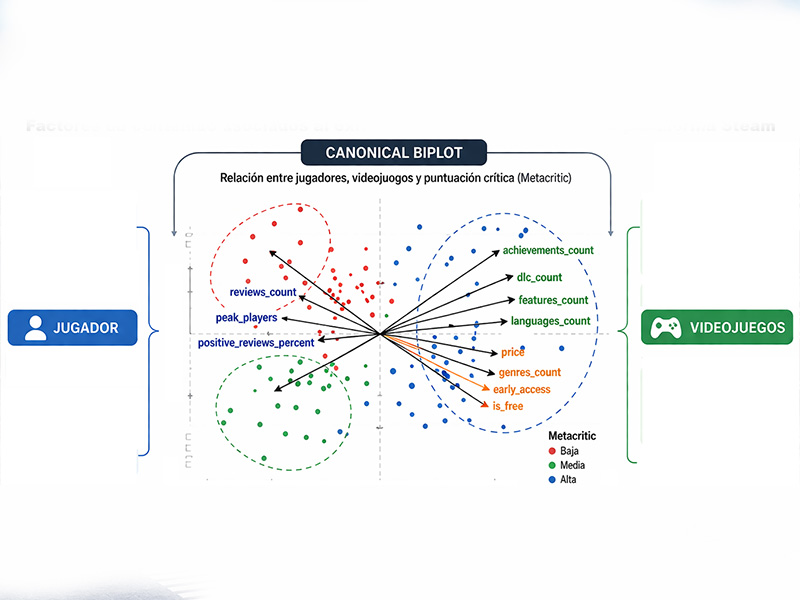
La plataforma Steam concentra gran parte de la actividad del mercado de videojuegos para PC, siendo un entorno clave para estudiar factores asociados al desempeño de un juego. Investigaciones recientes relacionan reseñas, actividad de jugadores, precio e idiomas con la popularidad, aunque predominan enfoques predictivos con limitada capacidad interpretativa. El objetivo propuesto es determinar qué factores de contenido se asocian al éxito crítico en la plataforma Steam medido por Metacritic. Se realizó un estudio observacional, correlacional, cuantitativo y transversal, con una muestra no probabilística por cuotas anuales y filtrado por disponibilidad de valoración Metacritic los cuales fueron recolectados por web scraping y analizados bajo CRISP-DM mediante Canonical Biplot. Los resultados muestran que la interacción del jugador (reseñas, jugadores concurrentes, reseñas positivas) es el principal eje diferenciador. Además, en juegos actuales predominan variables de participación, mientras en juegos antiguos adquieren peso los logros, características adicionales y contenido descargable (DLC). El principal aporte es brindar una explicación visual e interpretativa de los factores asociados al éxito crítico de los videojuegos en la plataforma Steam, mostrando que las métricas de interacción del jugador tienen mayor peso que varias características estructurales del producto, y que esta relación cambia entre videojuegos antiguos y actuales.
Descargas
Citas
A. De Luisa, J. Hartman, D. Nabergoj, S. Pahor, M. Rus, B. Stevanoski, J. Demsar, y E. Strumbelj, "Predicting the popularity of games on Steam," arXiv, 2021. [En línea]. Disponible en: https://doi.org/10.48550/arXiv.2110.02896
E. Salkanovic, N. Zukorlic, L. Okovic, y D. Keco, "A data analysis of Steam’s game catalog and diverse recommendation strategies," International Journal of Computer Applications, vol. 186, no. 54, pp. 39-49, dic. 2024. [En línea]. Disponible en: https://doi.org/10.5120/ijca2024924261
H. Zhou, "More games, more playtime," Interdisciplinary Humanities and Communication Studies, vol. 1, no. 1, jun. 2023. [En línea]. Disponible en: https://doi.org/10.61173/2y9xnj78
X. Li, Z. Zhang, y K. Stefanidis, "A data-driven approach for video game playability analysis based on players’ reviews," Information, vol. 12, no. 3, mar. 2021. [En línea]. Disponible en: https://doi.org/10.3390/info12030129
H. Ding, "Modeling user behavior online: A comparison of Pareto/NBD and BG/NBD models," Highlights in Engineering and Technology, vol. 61, pp. 128-132, jul. 2023. [En línea]. Disponible en: https://doi.org/10.54097/hset.v61i.10283
S. Heidenreich, F. Handrich, y T. Kraemer, "Flawless victory! Investigating search and experience qualities as antecedent predictors of video game success," Electronic Markets, vol. 33, no. 1, 2023. [En línea]. Disponible en: https://doi.org/10.1007/s12525-023-00647-2
T. Kraemer, W. H. Weiger, y S. Heidenreich, "Do all stars shine the same? Investigating the nonlinear effects of user and critic reviews on video game sales," Journal of Business Research, vol. 188, 2025. [En línea]. Disponible en: https://doi.org/10.1016/j.jbusres.2024.115034
J. Pfau, M. Debus, J. Juul, E. Lundedal Hammar, A. Canossa, y M. Seif El-Nasr, "Predicting success factors of video game titles and companies," in Entertainment Computing - ICEC 2022, B. Göbl, E. Van Der Spek, J. Baalsrud Hauge, y R. McCall, Eds. Cham, Switzerland: Springer, 2022, vol. 13477, pp. 269-282. [En línea]. Disponible en: https://doi.org/10.1007/978-3-031-20212-4_22
H. Yu, "A comprehensive analysis of game success: Synergy between quality, brand, and market," Applied and Computational Engineering, vol. 110, no. 1, pp. 22-28, nov. 2024. [En línea]. Disponible en: https://doi.org/10.54254/2755-2721/110/2024MELB0101
V. Brodschneider, y J. Pirker, "On the influence of reviews on play activity on Steam: A statistical approach," en 2023 IEEE Conference on Games (CoG), pp. 1-5, 2023. [En línea]. Disponible en: https://doi.org/10.1109/CoG57401.2023.10333235
D. Chen, "Signals of video game success on Steam: Evidence from Kickstarter campaigns," Finance Research Letters, vol. 86, 2025. [En línea]. Disponible en: https://doi.org/10.1016/j.frl.2025.108995
G. C. Ullmann, C. Politowski, Y.-G. Guéhéneuc, y F. Petrillo, "What makes a game high-rated?: Towards factors of video game success," in Proc. 6th International CSE Workshop on Games and Software Engineering: Engineering Fun, Inspiration, and Motivation, Pittsburgh, PA, USA, May 2022, pp. 16-23. [En línea]. Disponible en: https://doi.org/10.1145/3524494.3527628
N. le Roux y S. Gardner-Lubbe, "A two-group canonical variate analysis biplot for an optimal display of both means and cases," Advances in Data Analysis and Classification, vol. 19, no. 3, pp. 721-748, 2025. [En línea]. Disponible en: https://doi.org/10.1007/s11634-024-00593-7
M. N. Rizani, M. N. A. Khalid, y H. Iida, "Application of meta-gaming concept to the publishing platform: Analysis of the Steam games platform," Information, vol. 14, no. 2, pp. 110, 2023. [En línea]. Disponible en: https://doi.org/10.3390/info14020110
A. M. Shimaoka, R. C. Ferreira, y A. Goldman, "The evolution of CRISP-DM for data science: Methods, processes and frameworks," SBC Reviews on Computer Science, vol. 4, no. 1, pp. 28-43, 2024. [En línea]. Disponible en: https://doi.org/10.5753/reviews.2024.3757
V. Plotnikova, M. Dumas, y F. P. Milani, "Applying the CRISP-DM data mining process in the financial services industry: Elicitation of adaptation requirements," Data & Knowledge Engineering, vol. 139, 2022. [En línea]. Disponible en: https://doi.org/10.1016/j.datak.2022.102013
S. Tripathi, D. Muhr, M. Brunner, H. Jodlbauer, M. Dehmer, y F. Emmert-Streib, "Ensuring the robustness and reliability of data-driven knowledge discovery models in production and manufacturing," Frontiers in Artificial Intelligence, vol. 4, 2021. [En línea]. Disponible en: https://doi.org/10.3389/frai.2021.576892
M. Elkabalawy, A. Al-Sakkaf, E. M. Abdelkader, y G. Alfalah, "CRISP-DM-based data-driven approach for building energy prediction utilizing indoor and environmental factors," Sustainability, vol. 16, no. 17, 2024. [En línea]. Disponible en: https://doi.org/10.3390/su16177249
C. J. F. Ter Braak, P. Smilauer, y S. Dray, "Algorithms and biplots for double constrained correspondence analysis," Environmental and Ecological Statistics, vol. 25, no. 2, pp. 171-197, jun. 2018. [En línea]. Disponible en: https://doi.org/10.1007/s10651-017-0395-x
L. Wells, K. Thurimella, y S. Bacallado, "Regularised canonical correlation analysis: Graphical lasso, biplots and beyond," arXiv, nov. 16, 2025. [En línea]. Disponible en: https://doi.org/10.48550/arXiv.2403.02979
J. L. Vicente-Villardón, MultBiplotR: Multivariate Analysis Using Biplots in R, ver. 23.11.0. CRAN, 2023. [En línea]. Disponible en: https://CRAN.R-project.org/package=MultBiplotR
Publicado
Cómo citar
Número
Sección
Licencia
Derechos de autor 2026 Ariosto Vicuña Pino, Edwin Pacha-Herrera

Esta obra está bajo una licencia internacional Creative Commons Atribución-NoComercial-CompartirIgual 4.0.
Acuerdo de licencia
Esta revista ofrece acceso gratuito a su contenido a través de su sitio web, siguiendo el principio de que hacer que la investigación esté disponible gratuitamente para el público apoya un mayor intercambio de conocimiento global.
El contenido web de la revista se distribuye bajo la licencia Atribución-NoComercial-CompartirIgual 4.0 Internacional.
Los autores podrán celebrar otros acuerdos de licencia no exclusivos para la distribución de la versión publicada de la obra, siempre que se reconozca la publicación inicial en esta revista. Se permite y recomienda que los autores publiquen sus trabajos en línea antes y durante el proceso de envío, lo que puede generar intercambios interesantes y aumentar las citas del trabajo publicado.