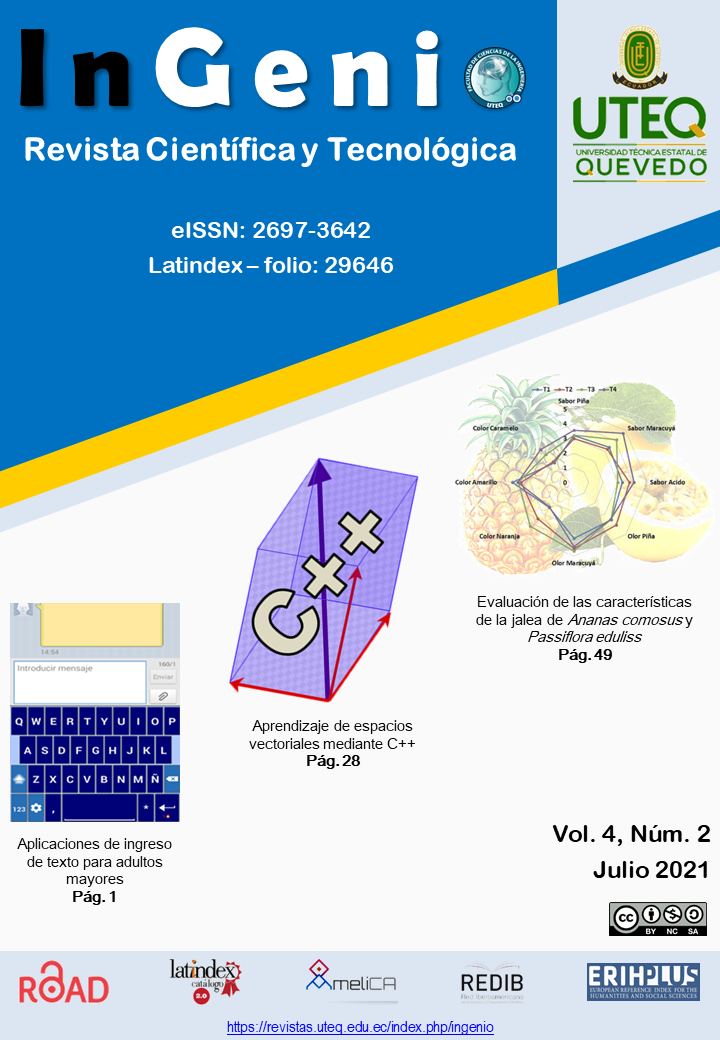
Guidelines for the Design of Text Entry Applications for Older Adults
DOI:
https://doi.org/10.18779/ingenio.v4i2.411Keywords:
Older adults, Internet of Things, guidelines, textual applications, mobile application designAbstract
The care and monitoring of the health of the elderly in order to increase life expectancy, their safety, make them self-sufficient, and improve their quality of life, have been the focus of many investigations that involve the use of the Internet of the Things or Internet of Things (IoT). Likewise, many of these systems, social networks and communication tools, are making it necessary for older people to be interested in the use of smartphones or Smartphones, which has inspired to carry out this work, whose objective is to determine the guidelines for the design of text entry applications for older adults.
Some works carried out by other authors were considered to obtain the guidelines used for the development of a prototype (called KeySenior) focused on the entry of text, applying the guidelines considered positive for our purpose. The prototype was tested through a user study with a very heterogeneous group of elderly people, from their socio-economic level, the frequency of use and type of mobile phone, to the pathologies they suffer from. They finally answered a questionnaire with the help of one of the researchers, who also took notes of the most important observations, to help to determine the degree of fulfillment of the objective of this work. Some of the guidelines implemented in KeySenior did not have the expected acceptance, however most of them had great acceptance.
Downloads
Published
How to Cite
Issue
Section
License
Copyright (c) 2021 Gleiston Guerrero-Ulloa, Karla Cabrera

This work is licensed under a Creative Commons Attribution-NonCommercial-ShareAlike 4.0 International License.
Licensing Agreement
This journal provides free access to its content through its website following the principle that making research available free of charge to the public supports a larger exchange of global knowledge.
Web content of the journal is distributed under a Attribution-NonCommercial-ShareAlike 4.0 International.
Authors may adopt other non-exclusive license agreements for the distribution of the version of the published work, provided that the initial publication in this journal is indicated. Authors are allowed and recommended to disseminate their work through the internet before and during the submission process, which can produce interesting exchanges and increase citations of the published work.