Use of Urban Public Spaces in Quito in the Post-Pandemic Context: Spatial Quality, User Perception, and Urban Design
DOI:
https://doi.org/10.18779/ingenio.v9i2.1298Keywords:
urban livability, place appropriation, social cohesion, citizen satisfaction, urban resilience, spatial planningAbstract
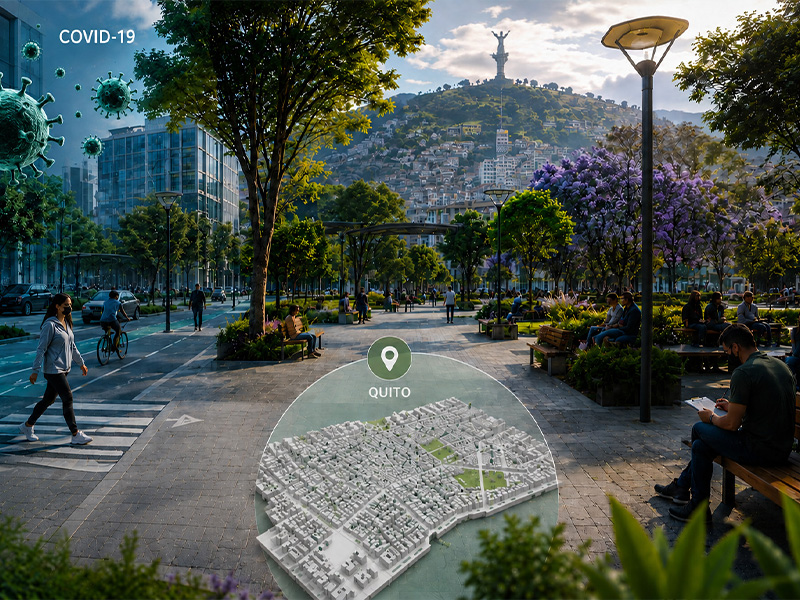
The COVID-19 pandemic caused a significant shift in the relationship between society and public space, highlighting its importance as key infrastructure for quality of life in cities. In Quito, a city distinguished by its diverse territorial structure, these transformations manifested differently depending on socio-spatial conditions. This research examines the use of public spaces in the post-pandemic scenario through three aspects: citizen perception, urban design, and spatial quality. A mixed-method, non-experimental, and descriptive study was conducted. The research took place in six representative public spaces across different urban sectors of Quito. Surveys were administered to users over 18 years of age, selected through non-probability convenience sampling, along with semi-structured interviews and systematic direct observation. Changes in frequency of use were detected, increasing from 28% to 46%, with a predominance of recreational activities (32%) and physical exercise (27%), as well as positive assessments of cleanliness, lighting, and safety. Furthermore, users gave high marks to urban amenities (mean = 4.6), variables that determine how space is appropriate. The findings show that usage has intensified, that there is increased sensitivity to quality and safety standards, and that there is a direct connection between urban design and social behavior. It can be inferred that public space has gained renewed centrality in current urban planning, demanding more inclusive, resilient, and user-centered perspectives.
Downloads
References
J. Gehl, Cities for People. Washington, DC, USA: Island Press, 2010. [En línea]. Disponible: https://islandpress.org/books/cities-people
S. Low y N. Smith, The Politics of Public Space. New York, NY, USA: Routledge, 2006. [En línea]. Disponible: https://www.routledge.com/The-Politics-of-Public-Space/Low-Smith/p/book/9780415951395
N. Cuvi y L. C. Gómez Vélez, “Los parques urbanos de Quito: distribución, accesibilidad y segregación espacial”, Fronteiras: Journal of Social, Technological and Environmental Science, vol. 10, no. 2, pp. 200–231, 2021. [En línea]. Disponible en: https://doi.org/10.21664/2238-8869.2021v10i2.p200-231
J. Honey-Rosés, I. Anguelovski, V. K. Chireh, C. Daher, C. Konijnendijk van den Bosch, J. S. Litt, V. Mawani, M. T. McCall, A. Orellana, E. Oscilowicz, U. Sánchez, M. Senbel, X. Tan, E. Villagomez, O. Zapata, W. J. Nieuwenhuijsen, “The impact of COVID-19 on public space: An early review of the emerging questions – design, perceptions and inequities”, Cities & Health, vol. 5, no. 1, pp. S263–S279, 2021. [En línea]. Disponible en: https://doi.org/10.1080/23748834.2020.1780074.
D. Rojas-Rueda, E. Vaught y D. Buss, “Why a New Research Agenda on Green Spaces and Health Is Needed in Latin America: Results of a Systematic Review”, International Journal of Environmental Research and Public Health, vol. 18, no. 11, 2021. [En línea]. Disponible en: https://doi.org/10.3390/ijerph18115839.
P. C. Muñoz-Vanegas, M. A. Quizhpe-Marín y X. Salazar-Guamán, “Uso y percepción del espacio público, una mirada desde la población: el caso de Cuenca, Ecuador”, Revista de Urbanismo, no. 41, pp. 1–18, 2019. doi: 10.5354/0717-5051.2019.53536. [En línea]. Disponible en: https://revistaurbanismo.uchile.cl/index.php/RU/article/view/53536
UN-Habitat, “Global Public Space Toolkit: From Global Principles to Local Policies and Practice”. Nairobi, Kenya: United Nations Human Settlements Programme (UN-Habitat), 2015. [En línea]. Disponible en: https://unhabitat.org/sites/default/files/2019/10/global-public-space-toolkit-from-global-principles-to-local-policies-and-practice.pdf
E. Molina Velásquez, P. Mamarandi Mossot, P. Villagrán Olivo, J. Torres Sarabia y T. Azúa Cañarte, “El consumo del ocio post Covid-19. Caso de estudio: Quito Urbano - Distrito Metropolitano de Quito”, Revista Universitaria de Geografía, vol. 33, no. 1, pp. 143–180, 2024, doi: 10.52292/j.rug.2024.33.1.0071. [En línea]. Disponible en: https://revistas.uns.edu.ar/rug/article/view/4517
G. M. Navarro Narváez, Las zonas verdes urbanas en la Ciudad de Quito: Un análisis de las percepciones sociales de los servicios ecosistémicos de sus usuarios. Caso parque “Las Cuadras”. Tesis de maestría, Facultad Latinoamericana de Ciencias Sociales (FLACSO Ecuador), Quito, Ecuador, 2024. [En línea]. Disponible en: https://repositorio.flacsoandes.edu.ec/items/3d49291e-6f21-4def-b3b5-311c1e1b624a
M. van den Berg, W. Wendel-Vos, M. van Poppel, H. Kemper, W. van Mechelen y J. Maas, “Health benefits of green spaces in the living environment: A systematic review of epidemiological studies”, Urban Forestry & Urban Greening, vol. 14, no. 4, pp. 806–816, 2015. [En línea]. Disponible en: https://doi.org/10.1016/j.ufug.2015.07.008.
A. Sharifi y A. R.Khavarian-Garmsir, “The COVID-19 pandemic: Impacts on cities and major lessons for urban planning, design and management”, Science of the Total Environment, vol. 749, Art. no. 142391, 2020. [En línea]. Disponible en: https://doi.org/10.1016/j.scitotenv.2020.142391
R. Hernández Sampieri, C. Fernández Collado y M. del P. Baptista Lucio, Metodología de la investigación, 6.ª ed. Ciudad de México, México: McGraw-Hill Education, 2014. [En línea]. Disponible en: https://www.esup.edu.pe/wp-content/uploads/2020/12/2.%20Hernandez,%20Fernandez%20y%20Baptista-Metodolog%C3%ADa%20Investigacion%20Cientifica%206ta%20ed.pdf
Instituto Nacional de Estadística y Censos (INEC), VIII Censo de Población y VII de Vivienda 2022: Resultados. Quito, Ecuador: INEC, 2023. [En línea]. Disponible en: https://www.ecuadorencifras.gob.ec/censo-de-poblacion-y-vivienda/.
Municipio del Distrito Metropolitano de Quito, Plan Metropolitano de Desarrollo y Ordenamiento Territorial (PMDOT 2024–2033). Quito, Ecuador, 2024. [En línea]. Disponible: https://zonales.quito.gob.ec/wp-content/uploads/PMDOT-2024-2033.pdf
Municipio del Distrito Metropolitano de Quito, Plan de Uso y Gestión de Suelo del Distrito Metropolitano de Quito (PUGS). Quito, Ecuador, 2021. [En línea]. Disponible en: https://www7.quito.gob.ec/mdmq_ordenanzas/Administraci%C3%B3n%202019-2023/Ordenanzas/2021/ORD-001-2021-PMDOT-PUGS/Ordenanza%20PMDOT-PUGS-001-2021.pdf
Empresa Pública Metropolitana de Movilidad y Obras Públicas, Informe de gestión y estado del espacio público en el Distrito Metropolitano de Quito. Quito, Ecuador, 2020. [En línea]. Disponible: https://goo.su/zOeNly
UN-Habitat, Cities and Pandemics: Towards a More Just, Green and Healthy Future. Nairobi, Kenya: United Nations, 2021. [En línea]. Disponible: https://unhabitat.org/cities-and-pandemics-towards-a-more-just-green-and-healthy-future-0
R. A. Marino, E. Vargas y M. Flores, “Impacts of COVID-19 Lockdown Restrictions on Housing and Public Space Use and Adaptation: Urban Proximity, Public Health, and Vulnerability in Three Latin American Cities”, en COVID-19 Pandemic, Geospatial Information, and Community Resilience: Global Applications and Lessons, Routledge, 2021. [En línea]. Disponible en: https://doi.org/10.1201/9781003181590-31.
V. Mehta, “Evaluating Public Space”, Journal of Urban Design, vol. 19, no. 1, pp. 53–88, 2014. [En línea]. Disponible en: https://doi.org/10.1080/13574809.2013.854698.
M. Carmona, T. Heath, T. Oc y S. Tiesdell, Public Places, Urban Spaces: The Dimensions of Urban Design, 2nd ed. Oxford, UK: Architectural Press, 2010. [En línea]. Disponible en: https://goo.su/kUnV1
ONU-Hábitat, El espacio público: componente clave de una ciudad sostenible. Nairobi, Kenya: United Nations Human Settlements Programme (UN-Habitat), 2018. [En línea]. Disponible en: https://onu-habitat.org/index.php/el-espacio-publico-componente-clave-de-una-ciudad-sostenible
UN-Habitat, Global Public Space Programme Annual Report. Nairobi, Kenya: United Nations Human Settlements Programme, 2023. [En línea]. Disponible: https://unhabitat.org/global-public-space-programme-annual-report-2023
Published
How to Cite
Issue
Section
License
Copyright (c) 2026 Mauricio Leonel Mendoza Riofrio

This work is licensed under a Creative Commons Attribution-NonCommercial-ShareAlike 4.0 International License.
Licensing Agreement
This journal provides free access to its content through its website following the principle that making research available free of charge to the public supports a larger exchange of global knowledge.
Web content of the journal is distributed under a Attribution-NonCommercial-ShareAlike 4.0 International.
Authors may adopt other non-exclusive license agreements for the distribution of the version of the published work, provided that the initial publication in this journal is indicated. Authors are allowed and recommended to disseminate their work through the internet before and during the submission process, which can produce interesting exchanges and increase citations of the published work.