Experimental Study of Defect Detection in Photovoltaic Panels Using Electroluminescence
DOI:
https://doi.org/10.18779/ingenio.v9i2.1232Keywords:
electroluminescence, photovoltaic panels, preventive maintenance, semantic segmentation, U-NetAbstract
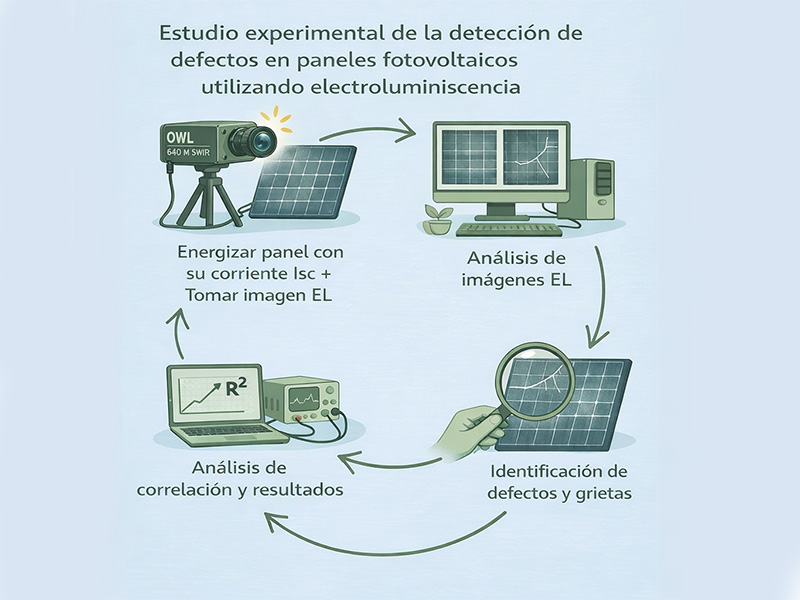
This study presents an experimental investigation of defect detection in monocrystalline and polycrystalline photovoltaic panels using electroluminescence imaging. Twelve modules with varying levels of degradation, deployed in rural Andean installations, were evaluated through visual inspection and automatic analysis based on convolutional neural networks. The methodology included manual defect segmentation and the application of a U-Net model for automatic classification of structural and electrical anomalies. Results showed that fractures and inactive areas were more frequent in monocrystalline panels, whereas potential-induced degradation (PID) and discoloration were mainly observed in polycrystalline ones. The comparison between manual inspection and the automated model demonstrated high performance in detecting discrete defects such as cracks and busbars, although lower accuracy was obtained for diffuse anomalies like PID. Spatial analysis of defect maps revealed the clustering of certain fault types within cell regions, highlighting the importance of considering spatial correlations in future detection algorithms. These findings support the development of targeted preventive maintenance strategies and reinforce the potential of semantic segmentation as a diagnostic tool for photovoltaic modules.
Downloads
References
R. Zhang et al., “Optimizing PV Panel Segmentation in Complex Environments Using Pre-Training and Simulated Annealing Algorithm: The JSWPVI”, Land, vol. 14, no. 6, jun. 2025. [Online]. Available: https://doi.org/10.3390/land14061245
H. Munawer Al-Otum,“Deep learning-based automated defect classification in Electroluminescence images of solar panels”, Adv. Eng. Inform, vol. 58, oct. 2023. [Online]. Available: https://doi.org/10.1016/j.aei.2023.102147
A. El-Tayeb, F. Li, A. Kumar, y G. Tamizhmani,“Electrical Impedance Spectroscopy: A Complementary Approach Differentiating PID Mechanisms in Photovoltaics”, Electronics, vol. 14, no. 5, pp. 1021, mar. 2025. [Online]. Available: https://doi.org/10.3390/electronics14051021
D. Matusz-Kalász, I. Bodnár, y M. Jobbágy, “An Overview of CNN-Based Image Analysis in Solar Cells, Photovoltaic Modules, and Power Plants”, Appl. Sci., vol. 15, no. 10, pp. 5511, jan. 2025. [Online]. Available: https://doi.org/10.3390/app15105511
A. Tihane, M. Boulaid, A. Elfanaoui, M. Nya, y A. Ihlal, “Performance analysis of mono and poly-crystalline silicon photovoltaic modules under Agadir climatic conditions in Morocco”, Mater. Today Proc., vol. 24, pp. 85-90, jan. 2020. [Online]. Available: https://doi.org/10.1016/j.matpr.2019.07.620
M. Köntges, S. Kurtz, C. Packard, U. Jahn, K. A. Berger, y K. Kato, Performance and reliability of photovoltaic systems: subtask 3.2: Review of failures of photovoltaic modules: IEA PVPS task 13: external final report IEA-PVPS. Sankt Ursen: International Energy Agency, Photovoltaic Power Systems Programme, 2014. [Online]. Available: https://doi.org/10.2314/GBV:856979287
T. Fuyuki, H. Kondo, T. Yamazaki, Y. Takahashi, y Y. Uraoka, “Photographic surveying of minority carrier diffusion length in polycrystalline silicon solar cells by electroluminescence”, Appl. Phys. Lett., vol. 86, no. 26, pp. 262108, jun. 2005. [Online]. Available: https://doi.org/10.1063/1.1978979
Y. Zhang, R. Wang, F. Wang, D. Zhu, X. Gong, y X. Cheng, “Electroluminescence as a Tool to Study the Polarization Characteristics and Generation Mechanism in Silicon PV Panels”, Appl. Sci., vol. 13, no. 3, pp. 1591, 2023. [Online]. Available: https://doi.org/10.3390/app13031591
R. A. M. Rudro et al., “SPF-Net: Solar panel fault detection using U-Net based deep learning image classification”, Energy Rep., vol. 12, pp. 1580-1594, dic. 2024. [Online]. Available: https://doi.org/10.1016/j.egyr.2024.07.044
F. Gómez-López, D. Ochoa-Correa, y I. Cabrera-Carrera, “U-Net–based semantic segmentation of defects in photovoltaic panels”, Ingenius, no. 35, pp. 110-121, jan. 2026. [Online]. Available: https://doi.org/10.17163/ings.n35.2026.08
A. B. Alao, O. M. Adeyanju, M. Chamana, S. Bayne, y A. Bilbao, “Photovoltaic Farm Power Generation Forecast Using Photovoltaic Battery Model with Machine Learning Capabilities”, Solar, vol. 5, no. 2, p. 26, 2025. [Online]. Available: https://doi.org/10.3390/solar5020026
T. Hussain, M. Hussain, H. Al-Aqrabi, T. Alsboui, y R. Hill, “A Review on Defect Detection of Electroluminescence-Based Photovoltaic Cell Surface Images Using Computer Vision”, Energies, vol. 16, no. 10, pp. 4012, ene. 2023. [Online]. Available: https://doi.org/10.3390/en16104012
H. F. M. Romero et al., “Synthetic Dataset of Electroluminescence Images of Photovoltaic Cells by Deep Convolutional Generative Adversarial Networks”, Sustainability, vol. 15, no. 9, jan. 2023. [Online]. Available: https://doi.org/10.3390/su15097175
S. Ding, W. Jing, H. Chen, y C. Chen, “Yolo Based Defects Detection Algorithm for EL in PV Modules with Focal and Efficient IoU Loss”, Appl. Sci., vol. 14, no. 17, pp. 7493, jan. 2024. [Online]. Available: https://doi.org/10.3390/app14177493
J. L. Espinoza, L. G. González, y R. Sempértegui, “Micro Grid Laboratory as a Tool for Research on Non-Conventional Energy Sources in Ecuador”, en 2017 IEEE International Autumn Meeting on Power, Electronics and Computing (ROPEC), 2017, pp. 1-7. [Online]. Available: https://doi.org/10.1109/ROPEC.2017.8261615
International Electrotechnical Commission, “IEC 61215-1:2016 - Terrestrial Photovoltaic (PV) Modules – Design Qualification and Type Approval – Part 1: Test Requirements”. 2016. [Online]. Available: https://www.iecee.org/certification/iec-standards/iec-61215-12021
Published
How to Cite
Issue
Section
License
Copyright (c) 2026 Franklin Mauricio Gómez López, Danny Vinicio Ochoa Correa, Isabel Dolores Cabrera Carrera

This work is licensed under a Creative Commons Attribution-NonCommercial-ShareAlike 4.0 International License.
Licensing Agreement
This journal provides free access to its content through its website following the principle that making research available free of charge to the public supports a larger exchange of global knowledge.
Web content of the journal is distributed under a Attribution-NonCommercial-ShareAlike 4.0 International.
Authors may adopt other non-exclusive license agreements for the distribution of the version of the published work, provided that the initial publication in this journal is indicated. Authors are allowed and recommended to disseminate their work through the internet before and during the submission process, which can produce interesting exchanges and increase citations of the published work.