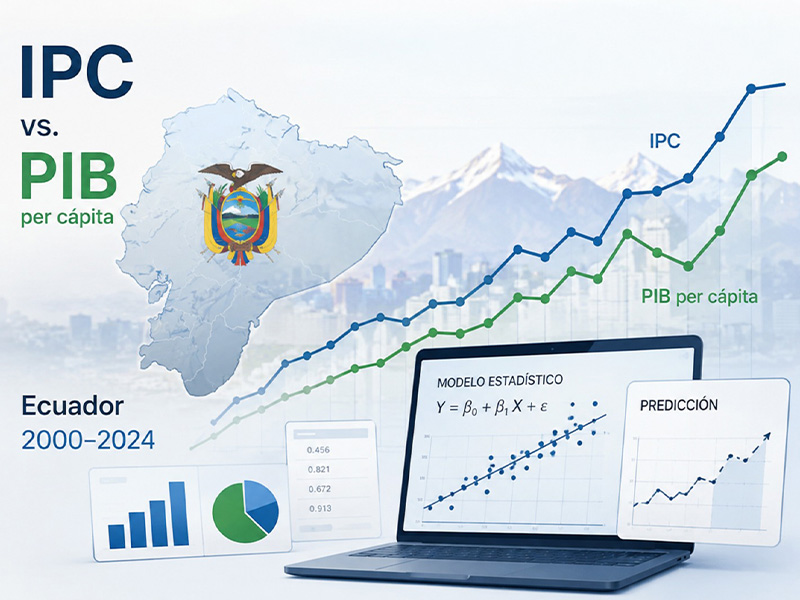
Analysis of the relationship between CPI and GDP per capita in Ecuador (2000–2024): A statistical modeling and prediction approach
DOI:
https://doi.org/10.18779/ingenio.v9i2.1205Keywords:
econometrics, inflation, time series, forecasting, economic growthAbstract
This study analyzes the relationship between the Consumer Price Index (CPI) and GDP per capita in Ecuador during the 2000–2024 period, with the aim of developing a predictive statistical model for inflation based on the level of economic activity. A quantitative approach and data analysis tools in R were employed, using linear regression and logarithmic transformations to explore the association between the two variables. Preliminary results indicate a positive correlation between economic growth and inflation, consistent with macroeconomic theories such as the Phillips curve. Although this empirical correlation does not imply direct causality, the developed model demonstrates high predictive potential useful for economic monitoring in dollarized economies. This work contributes to strengthening national quantitative analysis through structured, reproducible, and accessible methods for economic decision-making.
Downloads
References
C. Herrera-Oliva, J. Campos-Gaytán y F. M. Carrillo-González, “Estimación de datos faltantes de precipitación por el método de regresión lineal: Caso de estudio Cuenca Guadalupe, Baja California, México”, Investigación y Ciencia de la Universidad Autónoma de Aguascalientes, vol. 25, no. 71, pp. 34-44, 2017. [En línea]. Disponible: https://www.redalyc.org/journal/674/67452917005/html/.
E. Moreno Sarmiento, “Predicción con series de tiempo y regresión”, Panorama, vol. 2, no. 4, pp. 36-58, 2008. [En línea]. Disponible: https://www.redalyc.org/pdf/3439/343929216005.pdf.
I. Rivera, Principios de macroeconomía: un enfoque de sentido común, Pontificia Universidad Católica del Perú - Fondo Editorial, 2017, pp. 135. [En línea]. Disponible: https://repositorio.pucp.edu.pe/items/19c322c4-61f1-4bdf-bd80-c0f6f99ab63b.
F. A. Manzano,“Síntesis de la demografía y la economía: el producto bruto interno (PBI) per cápita”, Boletim Goiano de Geografia, vol. 36, no. 1, pp. 102-124, 2016. [En línea]. Disponible: https://www.redalyc.org/pdf/3371/337144713007.pdf.
M. A. Arcentales Mero, “El crecimiento económico ha influido significativamente en el comportamiento del PIB per cápita de Ecuador en los últimos cinco años”, Tesis de grado, Universidad Laica “Eloy Alfaro” de Manabí., Manta, 2024.Disponible: https://bit.ly/4oXVqT1.
J. Martínez, “El pib (per cápita) como indicador de sostenibilidad”, boletin de estudios economicos, vol. 65, no. 200, pp. 283-308, 2010. [En línea]. Disponible: https://www.ehu.eus/documents/6902252/12061410/J.+Mart%C3%ADnez-El+PIB+como+indicador+de+sostenibiidad.pdf/e3a21594-7298-f9ae-28a0-02ca40c535d7.
I. González, “El Índice de Precios de Consumo. Evolución metodológica y propuestas futuras”, Estadística Española, vol. 60, no.195, pp.11-31, 2018. [En línea]. Disponible: https://bit.ly/4xNIKSN.
A. E. Pilco Córdova, “Índice de precios al consumidor y la canasta básica familiar en el Ecuador pospandemia”, Perspectivas Sociales y Administrativas, vol. 2, no. 2, pp. 13-24, 2024. [En línea]. Disponible: https://perspectivas.esprint.tech/index.php/perspectivas/article/view/68.
V. M. Zúñiga Jaramillo, “Análisis de los componentes del IPC en el Ecuador a nivel nacional y regional periodo 2005 – 2014”, Tesis de grado, Universidad Particular Técnica de Loja, Loja, 2017. [En línea]. Disponible: https://dspace.utpl.edu.ec/handle/20.500.11962/21174.
Instituto Nacional de Estadística y Censos, “Metodología Índice de Precios al Consumidor (Base: 2014=100)”, INEC, Ecuador, 2023. [En línea]. Disponible en: https://www.ecuadorencifras.gob.ec/indice-de-precios-al-consumidor. https://www.ecuadorencifras.gob.ec/documentos/web-inec/Inflacion/2023/enero/Metodologia_IPC(Base%202014=100).pdf
M. Zúñiga-González, P. Vargas-Ramirez y G. Rivas-Tejena, “Impacto de la inflación y PIB per cápita en el gasto de consumo de los hogares de Ecuador, periodo 1990-2019”, Dominio de la ciencias, vol. 6, no. 4, pp. 31-45, 2020. [En línea]. Disponible: https://dialnet.unirioja.es/descarga/articulo/8638151.pdf.
S. Segovia, “20 años de dolarización de la economía ecuatoriana: análisis del sector real e indicadores sociales”, Banco Central del Ecuador, 2020. [En línea]. Disponible: https://repositorio.bce.ec/handle/32000/3222.
M. B. Castro y K. Beltrán, “Análisis correlación del crecimiento económico y la tasa de desempleo en el Ecuador (período 2012-2021)”, Ciencia Latina Revista Científica Multidisciplinar, vol. 7, no. 4, pp. 4020-4035, 2023. [En línea]. Disponible: https://ciencialatina.org/index.php/cienciala/article/view/7248.
L. G. Pinos Luzurriaga y J. E. Malo Ottati, “Análisis econométrico de la variación del tipo de cambio real, y como este ha afectado a la inflación del Ecuador en el periodo 2007-2017”, Tesis de grados, Universidad del Azuay, 2019. [En línea]. Disponible: https://dspace.uazuay.edu.ec/handle/datos/8865.
A. Smith, Investigación sobre la naturaleza y causas de la riqueza de las naciones, Ciudad de México: Fondo de Cultura Económica, 1958. [En línea]. Disponible: https://omegalfa.es/downloadfile.php?file=libros/la-riqueza-de-las-naciones.pdf.
R. M. Solow, “A Contribution to the Theory of Economic Growth”, The Quarterly Journal of Economics, vol. 70, no. 1, pp. 65-94, 1956. [En línea]. Disponible: http://piketty.pse.ens.fr/les/Solow1956.pdf.
M. Friedman, Inflation: Causes and Consequences, Bombay: Asia Publishing House, 1963. [En línea]. Disponible: https://miltonfriedman.hoover.org/internal/media/dispatcher/271018/full.
D. F. Cardona Madariaga, J. L. González Rodríguez, M. Rivera Lozamo y E. H. Cárdenas Vallejo, “Aplicación de la regresión lineal en un problema de pobreza”, Universidad del Rosario, vol. 12, pp. 73-80, 2013. [En línea]. Disponible: https://revistas.unilibre.edu.co/index.php/interaccion/article/view/2315/1767.
V. Quinde Rosales, R. Bucaram Leverone, M. Saldaña Vargas y A. Ordeñana Proaño, “Relación entre el crecimiento y el desarrollo económico: caso Ecuador”, Universidad y Sociedad, vol. 12, no. 3, pp. 60-66, 2020. [En línea]. Disponible: https://rus.ucf.edu.cu/index.php/rus/article/view/1600.
Instituto Nacional de Estadística y Censos (INEC), “Índice de Precios al Consumidor”, 2024. [En línea]. Disponible: https://www.ecuadorencifras.gob.ec/indice-de-precios-al-consumidor.
Banco Central del Ecuador, “Producto Interno Bruto per cápita,” 2024. [En línea]. Disponible: https://bit.ly/4g1u63V.
Downloads
Published
How to Cite
Issue
Section
License
Copyright (c) 2026 Walter Joffred Jácome Vélez, Jeyson Patricio Egas García, Andrea Lissbeth Abad Echeverría, David Josué Cárdenas Vera

This work is licensed under a Creative Commons Attribution-NonCommercial-ShareAlike 4.0 International License.
Licensing Agreement
This journal provides free access to its content through its website following the principle that making research available free of charge to the public supports a larger exchange of global knowledge.
Web content of the journal is distributed under a Attribution-NonCommercial-ShareAlike 4.0 International.
Authors may adopt other non-exclusive license agreements for the distribution of the version of the published work, provided that the initial publication in this journal is indicated. Authors are allowed and recommended to disseminate their work through the internet before and during the submission process, which can produce interesting exchanges and increase citations of the published work.