Evaluación rápida del grado de madurez de badea (Passiflora quadrangularis L.) mediante análisis de imágenes digitales y técnicas estadísticas multivariantes
DOI:
https://doi.org/10.18779/ingenio.v9i1.1104Palabras clave:
Índice de madurez, análisis multivariante, fruta tropical, RGB, PLS-DAResumen
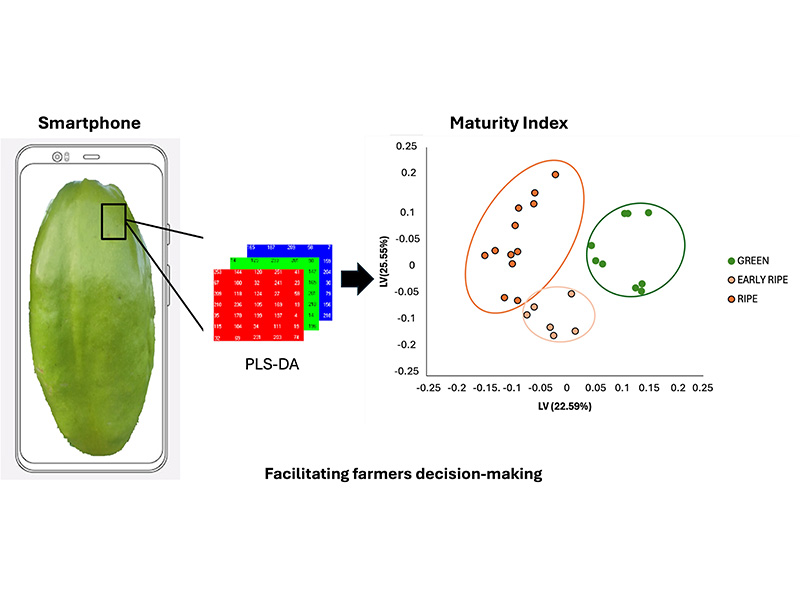
Las frutas y verduras esenciales para una dieta saludable a nivel mundial son de naturaleza perecible. Según la Organización de las Naciones Unidas para la Alimentación y la Agricultura (FAO), aproximadamente el 45 % de los alimentos se pierden antes de su consumo. La identificación del punto óptimo de maduración, tanto para la cosecha como para la venta, y su manipulación adecuada permiten reducir este desperdicio. La Passiflora quadrangularis (badea) es un cultivo tradicional sudamericano rico en antioxidantes y de gran importancia económica para las comunidades. Determinar el grado de madurez de la badea es fundamental para garantizar la calidad y reducir las pérdidas postcosecha. En este estudio, se realizó una caracterización fisicoquímica por días de maduración y se utilizaron imágenes de la badea en tres etapas de maduración: verde-madura, madura para la cosecha y completamente madura. La caracterización fisicoquímica sugiere un pH promedio de 5,73 y un índice de madurez de 11,62 %, lo que indica un estado de maduración temprana, adecuado para la cosecha. Las imágenes fueron analizadas mediante algoritmos multivariantes, incluidos el Análisis de Componentes Principales (ACP) y el Análisis Discriminante de Mínimos Cuadrados Parciales (PLS-DA), con el fin de identificar patrones visuales y clasificar los niveles de madurez. El modelo alcanzó una precisión de entrenamiento del 100 % y de crosvalidación del 83 %. Estas metodologías ofrecen una manera rápida y no invasiva de evaluar la madurez de la fruta, facilitando la toma de decisiones sobre el momento adecuado para la cosecha y contribuyendo a reducir el desperdicio postcosecha.
Descargas
Citas
D. Aune et al., “Fruit and vegetable intake and the risk of cardiovascular disease, total cancer and all-cause mortality-a systematic review and dose-response meta-analysis of prospective studies”, International Journal of Epidemiology, vol. 46, no.3, pp. 1029–1056, Jun. 2017. [Online]. Available: http://doi.org/10.1093/ije/dyw319
Organización de las Naciones Unidas para la Alimentación y la Agricultura (FAO), FAO, El estado mundial de la agricultura y la alimentación 2019: Pérdidas y desperdicio de alimentos en el contexto de sistemas alimentarios sostenibles. 2019. Accessed: Dec. 31, 2024. [Online]. Available: https://openknowledge.fao.org
M. V. Pardo Solórzano, G. M. Costa, and L. Castellanos, “Passiflora By-Products: Chemical Profile and Potential Use as Cosmetic Ingredients,” Sci Pharm, vol. 92, no. 4, pp. 57, Oct. 2024. [Online]. Available: https://doi.org/10.3390/scipharm92040057
A. C. Gazola et al., “The sedative activity of flavonoids from Passiflora quadrangularis is mediated through the GABAergic pathway,” Biomedicine & Pharmacotherapy, vol. 100, pp. 388–393, Apr. 2018. [Online]. Available: https://doi.org/10.1016/j.biopha.2018.02.002
N. Aghilinategh, M. J. Dalvand, and A. Anvar, “Detection of ripeness grades of berries using an electronic nose,” Food Sci Nutr, vol. 8, no. 9, pp. 4919–4928, Sep. 2020. [Online]. Available: https://doi.org/10.1002/fsn3.1788
M. Manzoor, S. B. Hussain, M. A. Anjum, M. Naseer, R. Ahmad, and V. Ziogas, “Effects of Harvest Time on the Fruit Quality of Kinnow and Feutrell’s Early Mandarins (Citrus reticulata Blanco),” Agronomy, vol. 13, no. 3, pp. 802, Mar. 2023. [Online]. Available: https://doi.org/10.3390/agronomy13030802
V. Prasanna, T. N. Prabha, and R. N. Tharanathan, “Fruit Ripening Phenomena–An Overview,” Crit Rev Food Sci Nutr, vol. 47, no. 1, pp. 1–19, Jan. 2007. [Online]. Available: https://doi.org/10.1080/10408390600976841
L. Ortenzi et al., “A Machine Vision Rapid Method to Determine the Ripeness Degree of Olive Lots,” Sensors, vol. 21, no. 9, pp. 2940, Apr. 2021. [Online]. Available: https://doi.org/10.3390/s21092940
V. Paul, R. Pandey, and G. C. Srivastava, “The fading distinctions between classical patterns of ripening in climacteric and non-climacteric fruit and the ubiquity of ethylene—An overview,” J Food Sc. Technol, vol. 49, no. 1, pp. 1–21, Feb. 2012. [Online]. Available: https://doi.org/10.1007/s13197-011-0293-4
A. Payasi, and G. G. Sanwal, “Ripening of climacteric fruits and their control,” J Food Biochem, vol. 34, no. 4, pp. 679–710, Aug. 2010. [Online]. Available: https://doi.org/10.1111/j.1745-4514.2009.00307.x
K. Simkova et al., “Non-destructive and destructive destructive physical measurements as indicators of sugar and organic acid contents in strawberry fruit during ripening,” Sci Hortic, vol. 327, pp. 112843, Mar. 2024. [Online]. Available: https://doi.org/10.1016/j.scienta.2024.112843
M. A. Quelal-Vásconez, M. J. Lerma-García, É. Pérez-Esteve, P. Talens, and J. M. Barat,“Roadmap of cocoa quality and authenticity control in the industry: A review of conventional and alternative methods,” Compr Rev Food Sci Food Saf, vol. 19, no. 2, pp. 448–478, Mar. 2020. [Online]. Available: https://doi.org/10.1111/1541-4337.12522
M. A. Quelal-Vásconez, M. J. Lerma-García, É. Pérez-Esteve, A. Arnau-Bonachera, J. M. Barat, and P. Talens, “Changes in methylxanthines and flavanols during cocoa powder processing and their quantification by near-infrared spectroscopy,” Lwt, vol. 117, pp. 108598, Jan. 2020. [Online]. Available: https://doi.org/10.1016/j.lwt.2019.108598
S. Cubero, N. Aleixos, E. Moltó, J. Gómez-Sanchis, and J. Blasco, “Advances in Machine Vision Applications for Automatic Inspection and Quality Evaluation of Fruits and Vegetables,” Food Bioproc Tech, vol. 4, no. 4, pp. 487–504, May. 2011. [Online]. Available: https://doi.org/10.1007/s11947-010-0411-8
E. Saldaña, R. Siche, M. Luján, and R. Quevedo, “Review: computer vision applied to the inspection and quality control of fruits and vegetables,” Brazilian Journal of Food Technology, vol. 16, no. 4, pp. 254–272, Dec. 2013. [Online]. Available: https://doi.org/10.1590/S1981-67232013005000031
K. Ncama, L. S. Magwaza, A. Mditshwa, and S. Z. Tesfay, “Application of Visible to Near-Infrared Spectroscopy for Non-Destructive Assessment of Quality Parameters of Fruit,” in Infrared Spectroscopy - Principles, Advances, and Applications, IntechOpen, 2019. [Online]. Available: https://doi.org/10.5772/intechopen.80069
S. N. Jha, and S. Gunasekaran, “Authentication of sweetness of mango juice using Fourier transform infrared-attenuated total reflection spectroscopy,” J Food Eng, vol. 101, no. 3, pp. 337–342, Dec. 2010. [Online]. Available: https://doi.org/10.1016/j.jfoodeng.2010.07.019
S. Teerachaichayut, and H. T. Ho, “Non-destructive prediction of total soluble solids, titratable acidity and maturity index of limes by near infrared hyperspectral imaging,” Postharvest Biol Technol, vol. 133, pp. 20–25, Nov. 2017. [Online]. Available: https://doi.org/10.1016/j.postharvbio.2017.07.005
A. A. Bhosale, and K. K. Sundaram, “Nondestructive Method for Ripening Prediction of Papaya,” Procedia Technology, vol. 19, pp. 623–630, 2015. [Online]. Available: https://doi.org/10.1016/j.protcy.2015.02.088
P. P. Subedi, and K. B. Walsh, “Non-invasive techniques for measurement of fresh fruit firmness,” Postharvest Biol Technol, vol. 51, no. 3, pp. 297–304, Mar. 2009. [Online]. Available: https://doi.org/10.1016/j.postharvbio.2008.03.004
Anjali et al., “State-of-the-art non-destructive approaches for maturity index determination in fruits and vegetables: principles, applications, and future directions,” Food Production, Processing and Nutrition, vol. 6, no. 1, pp. 56, Feb. 2024. [Online]. Available: https://doi.org/10.1186/s43014-023-00205-5
G. Vuksani, A. Vuksani, O. Kyçyk, F. Pazari, and T. Thomaj, “Determination of Olive Maturity Stage and Optimal Harvest Interval of ‘Kalinjot’ Cultivar Using Destructive and Non-Destructive Methods,” AgriEngineering, vol. 7, no. 8, pp. 253, Aug. 2025. [Online]. Available: https://doi.org/10.3390/Agriengineering7080253
C. Neupane, M. Pereira, A. Koirala, and K. B. Walsh, “Fruit Sizing in Orchard: A Review from Caliper to Machine Vision with Deep Learning,” Sensors, vol. 23, no. 8, pp. 3868, Apr. 2023. [Online]. Available: https://doi.org/10.3390/s23083868
AOAC, “AOAC Official Method 942.15Acidity (Titratable) of Fruit Products,” in Official Methods of Analysis of AOAC INTERNATIONAL, New York: Oxford University Press, 2023. [Online]. Available: https://doi.org/10.1093/9780197610145.003.3390
D. Kimball, “The Brix/Acid Ratio,” in Citrus Processing, Dordrecht: Springer Netherlands, 1991, pp. 55–65. [Online]. Available: https://doi.org/10.1007/978-94-011-3700-3_4
M. E. Arena, I. S. Povilonis, V. Borroni, D. Constenla, and S. Radice, “Changes in physicochemical properties at different development stages of Hexachlamys edulis fruit, an underutilized South American species,” Heliyon, vol. 7, no. 11, pp. e08323. Nov. 2021. [Online]. Available: https://doi.org/10.1016/j.heliyon.2021.e08323
S. D. Ramaiya, H. A. Ismail, N. Khairuddin, and M. A. Awang, “Ripening Characterization, Fruit Quality and Sensory Attributes of Passiflora quarangularis L.,” International Journal of Chemical and Biochemical Sciences, vol.24, no.6, pp. 925-936, 2023. [Online]. Available: https://www.iscientific.org/wp-content/uploads/2024/01/106-ijcbs-23-24-6-106.pdf
J. M. Sánchez Soto, L. H. Ramos, and E. J. Torres Mendoza, “Efectos fisiológicos de badea (Passiflora quadrangularis) y yuca (Manihot esculenta) utilizando recubrimientos a base de cera y parafina bajo conservación en frío.,” Revista colombiana de investigaciones agroindustriales, vol. 1, no. 1, pp. 33-43, Dec. 2014. [Online]. Available: https://doi.org/10.23850/24220582.113
S. D. Ramaiya, H. H. Lee, Y. J. Xiao, N. S. Shahbani, M. H. Zakaria, and J. S. Bujang, “Organic cultivation practices enhanced antioxidant activities and secondary metabolites in giant granadilla (Passiflora quadrangularis L.),” PLoS One, vol. 16, no. 7, Jul. 2021. [Online]. Available: https://doi.org/10.1371/journal.pone.0255059
Simkova, K., Veberic, R., Hudina, M., Grohar, M. C., Pelacci, M., Smrke, T., Ivancic, T., Cvelbar Weber, N., and Jakopic, J. (2024b). Non-destructive and destructive physical measurements as indicators of sugar and organic acid contents in strawberry fruit during ripening. Scientia Horticulturae, vol. 327, Mar. 2024. [Online]. Available: https://doi.org/10.1016/j.scienta.2024.112843
D. Escobar Figueroa, and E. Roa Guerrero, “Sistema de visión artificial para la identificación del estado de madurez de frutas (granadilla),” Redes de Ingeniería, vol. 7, no. 1, pp. 78, Jun. 2016. [Online]. Available: https://doi.org/10.14483/udistrital.jour.redes.2016.1.a08
S. Tu, Y. Xue, C. Zheng, Y. Qi, H. Wan, and L. Mao, “Detection of passion fruits and maturity classification using Red-Green-Blue Depth images,” Biosyst Eng, vol. 175, pp. 156–167, Nov. 2018. [Online]. Available: https://doi.org/10.1016/J.Biosystemseng.2018.09.004
Descargas
Publicado
Cómo citar
Número
Sección
Licencia
Derechos de autor 2026 Luis Egas, Gina Guapi, Maribel Quelal-Vásconez

Esta obra está bajo una licencia internacional Creative Commons Atribución-NoComercial-CompartirIgual 4.0.
Acuerdo de licencia
Esta revista ofrece acceso gratuito a su contenido a través de su sitio web, siguiendo el principio de que hacer que la investigación esté disponible gratuitamente para el público apoya un mayor intercambio de conocimiento global.
El contenido web de la revista se distribuye bajo la licencia Atribución-NoComercial-CompartirIgual 4.0 Internacional.
Los autores podrán celebrar otros acuerdos de licencia no exclusivos para la distribución de la versión publicada de la obra, siempre que se reconozca la publicación inicial en esta revista. Se permite y recomienda que los autores publiquen sus trabajos en línea antes y durante el proceso de envío, lo que puede generar intercambios interesantes y aumentar las citas del trabajo publicado.