Growth and Territorial Concentration of Fixed Broadband Internet in Ecuador: A Provincial Comparison, 2024-2025
DOI:
https://doi.org/10.18779/ingenio.v9i2.1292Keywords:
digital divide, connectivity, fixed broadband, digital penetrationAbstract
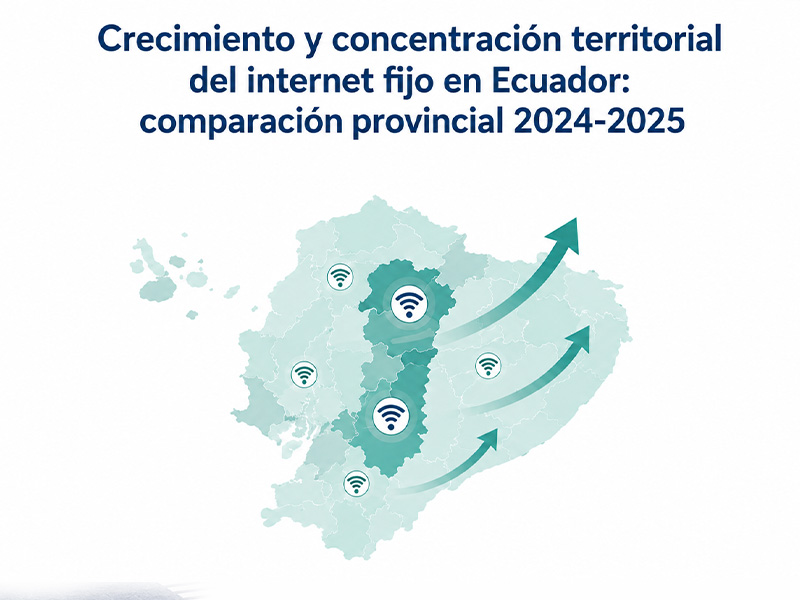
This study analyzed the territorial evolution of fixed internet in Ecuador at the provincial level, comparing the June 2024 and June 2025 reporting periods based on official ARCOTEL/SIETEL records. A quantitative, non-experimental, descriptive-analytical design was applied. The analysis considered absolute growth, relative growth, approximate penetration per inhabitant—accounts per 100 inhabitants based on the 2022 Population and Housing Census—and territorial concentration. For this purpose, the study used accounts assignable to a specific province, excluding non-provincial records identified as “study areas.” Provincial share, CR2, CR4, HHI, Gini coefficient, normalized Entropy, and normalized Theil indicators were calculated; in addition, non-parametric Wilcoxon and Spearman tests were applied. The results showed that all 24 provinces increased their number of fixed internet accounts. However, Guayas and Pichincha continued to account for more than half of the provincial total. Spearman’s correlation indicated that the initial size of the provincial market was positively associated with absolute growth (rho = 0.743; p < 0.001) and negatively associated with relative growth (rho = -0.521; p = 0.009). Likewise, provinces with higher initial penetration tended to capture greater absolute increases (rho = 0.498; p = 0.013). It is concluded that the expansion was widespread, but it reflected heterogeneous territorial diffusion rather than solid provincial convergence.
Downloads
References
I. Álvarez, C. Quirós,R. Marín, L. Medina y A. Biurrun, “Desigualdad digital en Iberoamérica. Retos en una sociedad conectada”, Fundación Carolina, jun. 2021. https://doi.org/10.33960/issn-e.1885-9119.DT50
A. Caragliu y C. F. Del Bo,“Smart cities and the urban digital divide”, npj Urban Sustainability, vol. 3, no. 1, pp. 43, jul. 2023. https://doi.org/10.1038/s42949-023-00117-w
M. Agudelo, E. Chomali y L. Torres, “Hacia el cierre de la brecha digital”, CAF, 2024. Consultado: 27 de febrero de 2026. [En línea]. Disponible en: https://scioteca.caf.com/handle/123456789/2272.
UNESCO, “Sociedad digital: brechas y retos para la inclusión digital en América Latina y el Caribe”, 2017. Consultado: 5 de junio de 2026. [En línea]. Disponible en: https://unesdoc.unesco.org/ark:/48223/pf0000262860.
I. Ruiz-Martínez y J. Esparcia, “Internet access in rural areas: brake or stimulus as Post-Covid-19 opportunity?”, Sustainability, vol. 12, no. 22, p. 9619, nov. 2020. https://doi.org/10.3390/su12229619
C. Rivera Zapata, E. Iglesias Rodríguez y A. García Zaballos, “Estado actual de las telecomunicaciones y la banda ancha en Ecuador”, Inter-American Development Bank, feb. 2020. https://doi.org/10.18235/0002200
Fundación Carolina y Telefónica S. A., “La transición digital: retos y oportunidades para Iberoamérica”, 2021. Consultado: 21 de febrero de 2026. [En línea]. Disponible en: https://www.fundacioncarolina.es/wp-content/uploads/2021/12/La_transicion_digital.pdf.
The World Bank, “Digital economy for Latin America and the Caribbean country diagnostic: Ecuador”, 2024. Consultado: 27 de febrero de 2026. [En línea]. Disponible en: https://goo.su/lUa2aae
M. V. Alderete, “Adopción de banda ancha en los países latinoamericanos: ¿importa la proximidad geográfica?”, Problemas del Desarrollo. Revista Latinoamericana de Economía, vol. 50, no. 198, may. 2019. https://doi.org/10.22201/iiec.20078951e.2019.198.67411
Z. Bánhidi, “The impact of broadband networks on growth and development in South America”, Periodica Polytechnica Social and Management Sciences, vol. 29, no. 1, pp. 33-39, sep. 2020. https://doi.org/10.3311/PPso.14905
INEC, “Tecnologías de la información y comunicación-TIC”, 2024. Consultado: 22 de febrero de 2026. [En línea]. Disponible en: https://www.ecuadorencifras.gob.ec/tecnologias-de-la-informacion-y-comunicacion-tic/.
H. Galperin, R. Katz y R. Valencia, “The impact of broadband on poverty reduction in rural Ecuador”, Telematics and Informatics, vol. 75, p. 101905, dic. 2022. https://doi.org/10.1016/j.tele.2022.101905
C. Uzcátegui-Sánchez, D. Zaldumbide-Peralvo y M. J. Pérez-Espinoza, “The impact of digital literacy on income growth among Ecuadorian workers”, Portal de la Ciencia, vol. 6, no. 1, pp. 81-94, ene. 2025. https://doi.org/10.51247/pdlc.v6i1.457
Secretaría Nacional de Administración Pública y Planificación, “Plan de Desarrollo para el Nuevo Ecuador 2024-2025”, 2024. Consultado: 22 de febrero de 2026. [En línea]. Disponible en: https://planificacion.presidencia.gob.ec/plan-de-desarrollo-para-el-nuevo-ecuador-2024-2025/.
ARCOTEL, “Abonados y usuarios: cuentas del servicio de acceso a internet fijo y móvil, junio de 2024 y junio de 2025”. [En línea]. Consultado: 5 de febrero de 2026. Disponible en: https://www.arcotel.gob.ec/abonados-y-usuarios/.
INEC, “Censo de Población y Vivienda 2022: población y densidad poblacional por provincia”, 2022. Consultado: 2 de abril de 2026. [En línea]. Disponible en: https://www.ecuadorencifras.gob.ec/censo-de-poblacion-y-vivienda/.
Ministerio de Telecomunicaciones y de la Sociedad de la Información, “Informe de Rendición de Cuentas periodo 2024”, 2025. [En línea]. Consultado: 22 de febrero de 2026. Disponible en: https://www.telecomunicaciones.gob.ec/wp-content/uploads/downloads/2025/08/INFORME-FINAL-RENDICION-DE-CUENTAS_2024-FIRMADO.pdf.
Ministry of Manpower, Singapore, “Absolute vs relative change concepts and definitions”. [En línea]. Consultado: 5 de junio de 2026. Disponible en: https://stats.mom.gov.sg/SL/Pages/Absolute-vs-Relative-Change-Concepts-and-Definitions.aspx
OECD, “Methodologies to measure market competition”, OECD Competition Law and Policy Working Papers, no. 253, jun. 2021. https://doi.org/10.1787/29bf31c1-en
The World Bank, “Gini index: metadata glossary”. Consultado: 2 de marzo de 2026. [En línea]. Disponible en: https://databank.worldbank.org/metadataglossary/gender-statistics/series/SI.POV.GINI.
D. Panzera, A. Cartone y P. Postiglione, “New evidence on measuring the geographical concentration of economic activities”, Papers in Regional Science, vol. 101, no. 1, pp. 59-79, 2022. [En línea]. Disponible en: https://doi.org/10.1111/pirs.12644
B. Purvis, Y. Mao y D. Robinson, “Entropy and its application to urban systems”, Entropy, vol. 21, no. 1, p. 56, ene. 2019. [En línea]. Disponible en: https://doi.org/10.3390/e21010056
D. A. Griffith, Y. Chun y J. Hauke, “A Moran eigenvector spatial filtering specification of entropy measures”, Papers in Regional Science, vol. 101, no. 1, pp. 259-280, feb. 2022. [En línea]. Disponible en: https://doi.org/10.1111/pirs.12646
C. E. Shannon, “A mathematical theory of communication”, Bell System Technical Journal, vol. 27, no. 4, pp. 623-656, oct. 1948. [En línea]. Disponible en: https://doi.org/10.1002/j.1538-7305.1948.tb00917.x
F. J. Goerlich, “Desigualdad, diversidad y convergencia: (algunos) instrumentos de medida”, 1a ed. Instituto Valenciano de Investigaciones Económicas, 1998. Consultado: 2 de abril de 2026. [En línea]. Disponible en: https://www.ivie.es/downloads/docs/mono/mono1998-01.pdf.
R. M. Sánchez-Torres, “Desigualdad del ingreso en Colombia: un estudio por departamentos”, Cuadernos de Economía, vol. 36, no. 72, pp. 139-178, oct. 2017. [En línea]. Disponible en: https://doi.org/10.15446/cuad.econ.v36n72.65880
J. Haughton y S. R. Khandker, Handbook on Poverty and Inequality. Washington, DC: World Bank, 2009. [En línea]. Disponible en: https://doi.org/10.1596/978-0-8213-7613-3
S. Siegel y N. J. Castellan Jr., Nonparametric Statistics for the Behavioral Sciences, 2nd ed. New York: McGraw-Hill, 1988. [En línea]. Disponible en: https://paulyecologia.wordpress.com/wp-content/uploads/2016/11/estadisticas_no_parametricas-siegel5b15d-1.pdf
Published
How to Cite
Issue
Section
License
Copyright (c) 2026 Karen Lissette Estacio Corozo

This work is licensed under a Creative Commons Attribution-NonCommercial-ShareAlike 4.0 International License.
Licensing Agreement
This journal provides free access to its content through its website following the principle that making research available free of charge to the public supports a larger exchange of global knowledge.
Web content of the journal is distributed under a Attribution-NonCommercial-ShareAlike 4.0 International.
Authors may adopt other non-exclusive license agreements for the distribution of the version of the published work, provided that the initial publication in this journal is indicated. Authors are allowed and recommended to disseminate their work through the internet before and during the submission process, which can produce interesting exchanges and increase citations of the published work.