PV Integration and Emission Offsets in a Campus Data Center: Evidence from Seven Years of Operation
DOI:
https://doi.org/10.18779/ingenio.v9i2.1268Keywords:
green-data centers, photovoltaic energy, self-consumption, CO2 emissions, renewable integrationAbstract
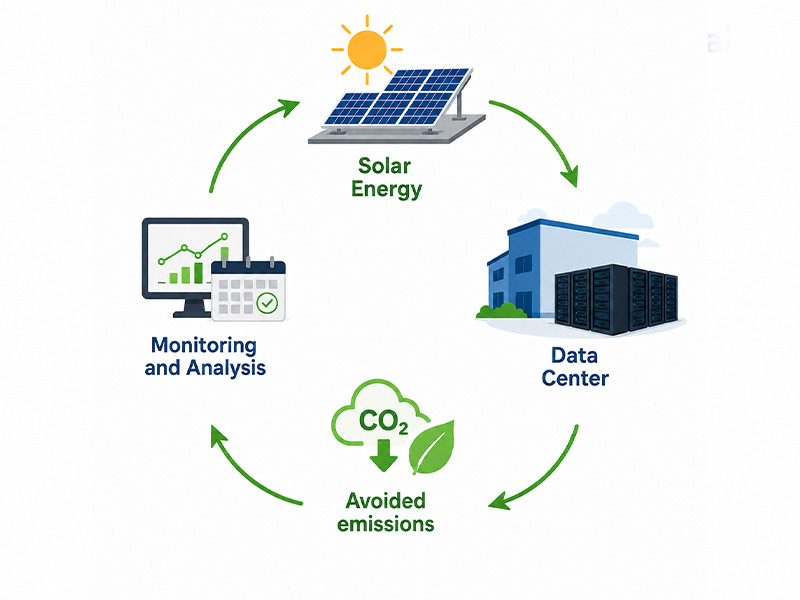
Data centers raise energy and environmental challenges for public and educational institutions. This paper evaluates an institutional data center at the University of Cuenca (Ecuador) supplied in part by a 35 kWp rooftop photovoltaic (PV) system operating without electrical storage since 2018. Seven years of data (2018–2024) were analyzed, including monthly records of electricity consumption, PV generation, and meteorological variables. Renewable-integration indicators are computed (demand coverage and on-site use of PV energy), and avoided CO2 emissions are estimated using official annual grid factors for Ecuador’s national power system, including a sensitivity case for higher carbon intensity. Annual PV generation ranged from 24.3 to 47.3 MWh (34.4 MWh average), while annual data center consumption increased from 63.0 MWh (2018) to 149.3 MWh (2024), with a step change starting in 2020. PV coverage at the shared distribution panel (laboratory + data center) declined from 52.8% (2018) to 23.4% (2023) and 15.6% (2024), driven mainly by demand growth; in 2024, PV output was further reduced by grid outages because anti-islanding protection disconnects a grid-tied, battery-less system. Over 2018–2024, avoided emissions are estimated at 64.9–72.1 tCO2 using national emission factors (0.27–0.30 kg CO2/kWh), and 96.2 tCO2 under a 0.40 kg CO2/kWh scenario. The results support the green data center agenda by informing planning decisions for integrating on-site renewable generation in data centers, with emphasis on finer submetering, energy storage, and PV capacity expansion as digital workloads grow.
Downloads
References
T. Murino, R. Monaco, P. S. Nielsen, X. Liu, G. Esposito, and C. Scognamiglio, “Sustainable Energy Data Centres: A Holistic Conceptual Framework for Design and Operations”, Energies, vol. 16, no. 15, pp. 5764, ago. 2023. [Online]. Available: https://doi.org/10.3390/en16155764
N. Hinov, “From Energy Efficiency to Energy Intelligence: Power Electronics as the Cognitive Layer of the Energy Transition”, Electronics, vol. 14, no 23, pp. 4673, nov. 2025. [Online]. Available: https://doi.org/10.3390/electronics14234673
M. Sarac, S. Adamovic, and D. Stamenkovic, “Experimental Analysis of Energy Efficiency of Server Infrastructure in University Datacenters”, Teh. vjesn., vol. 27, no 5, oct. 2020. [Online]. Available: https://doi.org/10.17559/TV-20160517155453
K. L. Veigas, A. Chinnici, D. De Chiara, and M. Chinnici, “Towards Energy Efficiency of HPC Data Centers: A Data-Driven Analytical Visualization Dashboard Prototype Approach”, Electronics, vol. 14, no 16, pp. 3170, ago. 2025. [Online]. Available: https://doi.org/10.3390/electronics14163170
M. D. Dikaiakos et al., “A cyber-physical management system for medium-scale solar-powered data centers”, Concurrency and Computation: Practice and Experienc, vol. 35, no 10, pp. e7658, may 2023. [Online]. Available: https://doi.org/10.1002/cpe.7658
A. Tryfonos et al .,“ENEDI: Energy Saving in Datacenters”, in 2018 IEEE Global Conference on Internet of Things (GCIoT), Alexandria, Egypt: IEEE, dic. 2018, pp. 1-5. [Online]. Available: https://doi.org/10.1109/GCIoT.2018.8620159
K. Zhang, P. Wang, N. Gu, and T. D. Nguyen, “GreenDRL: managing green datacenters using deep reinforcement learning”, in Proceedings of the 13th Symposium on Cloud Computing, San Francisco California: ACM, nov. 2022, pp. 445-460. [Online]. Available: https://doi.org/10.1145/3542929.3563501
Y. Zhou, F. Wei, S. Li, Z. Wang, J. Liu, and D. Yu, “Data center load modeling through optimal energy consumption characteristics: A path to simultaneously enhance energy efficiency and demand response quality”, Applied Energy, vol. 393, p. 126095, sep. 2025. [Online]. Available: https://doi.org/10.1016/j.apenergy.2025.126095
J. Xing, and B. C. Lee, “Datacenter Demand Response for Carbon Mitigation: From Concept to Practicality: Invited Paper”, in 2024 IEEE 15th International Green and Sustainable Computing Conference (IGSC), Austin, TX, USA: IEEE, nov. 2024, pp. 142-144. [Online]. Available: https://doi.org/10.1109/IGSC64514.2024.00034
J. L. Espinoza, L. G. González, y R. Sempértegui, "Micro grid laboratory as a tool for research on non-conventional energy sources in Ecuador", in 2017 IEEE International Autumn Meeting on Power, Electronics and Computing (ROPEC), Ixtapa, Mexico: IEEE, nov. 2017, pp. 1-7. [Online]. Available: https://doi.org/10.1109/ROPEC.2017.8261615
Operador Nacional de Electricidad (CENACE), "Factor de Emisión del CO2 del Sistema Nacional Interconectado del Ecuador - Año 2024". [Online]. Available: https://arconel.gob.ec/wp-content/uploads/downloads/2025/09/Factor-de-emision-de-CO2-del-Sistema-Nacional-Interconectado-de-Ecuador-Informe-2024_compressed.pdf
Operador Nacional de Electricidad (CENACE), “Factor de Emisión de CO2 del Sistema Nacional Interconectado del Ecuador - Informe 2023”. [Online]. Available: https://www.ambienteyenergia.gob.ec/wp-content/uploads/2024/09/Factor-de-emision-de-CO2-del-Sistema-Nacional-Interconectado-de-Ecuador-Informe-2023-comprimido.pdf
Operador Nacional de Electricidad (CENACE), “Factor de Emisión del CO2 del Sistema Nacional Interconectado de Ecuador - Informe 2021”. [Online]. Available: https://www.cenace.gob.ec/wp-content/uploads/downloads/2022/12/Informe-Factor-de-CO2-2021.pdf
Greenhouse Gas Protocol Initiative, “GHG Protocol Scope 2 Guidance: An Amendment to the GHG Protocol Corporate Standard”. [Online]. Available: https://ghgprotocol.org/sites/default/files/2023-03/Scope%202%20Guidance.pdf
Operador Nacional de Electricidad (CENACE), “Factor de Emisión del CO2 del Sistema Nacional Interconectado de Ecuador - Informe 2022”. [Online]. Available: https://www.ambienteyenergia.gob.ec/wp-content/uploads/2023/08/wp-1692720103183.pdf
Published
How to Cite
Issue
Section
License
Copyright (c) 2026 Danny Ochoa-Correa, Emilia Sempértegui-Moscoso

This work is licensed under a Creative Commons Attribution-NonCommercial-ShareAlike 4.0 International License.
Licensing Agreement
This journal provides free access to its content through its website following the principle that making research available free of charge to the public supports a larger exchange of global knowledge.
Web content of the journal is distributed under a Attribution-NonCommercial-ShareAlike 4.0 International.
Authors may adopt other non-exclusive license agreements for the distribution of the version of the published work, provided that the initial publication in this journal is indicated. Authors are allowed and recommended to disseminate their work through the internet before and during the submission process, which can produce interesting exchanges and increase citations of the published work.