Agricultural Waste for Electricity Production in Latin America: A Literature Review of Successful Cases in Mexico, Colombia, and Brazil)
DOI:
https://doi.org/10.18779/ingenio.v8i1.901Keywords:
Biomass, agricultural residues, electricityAbstract
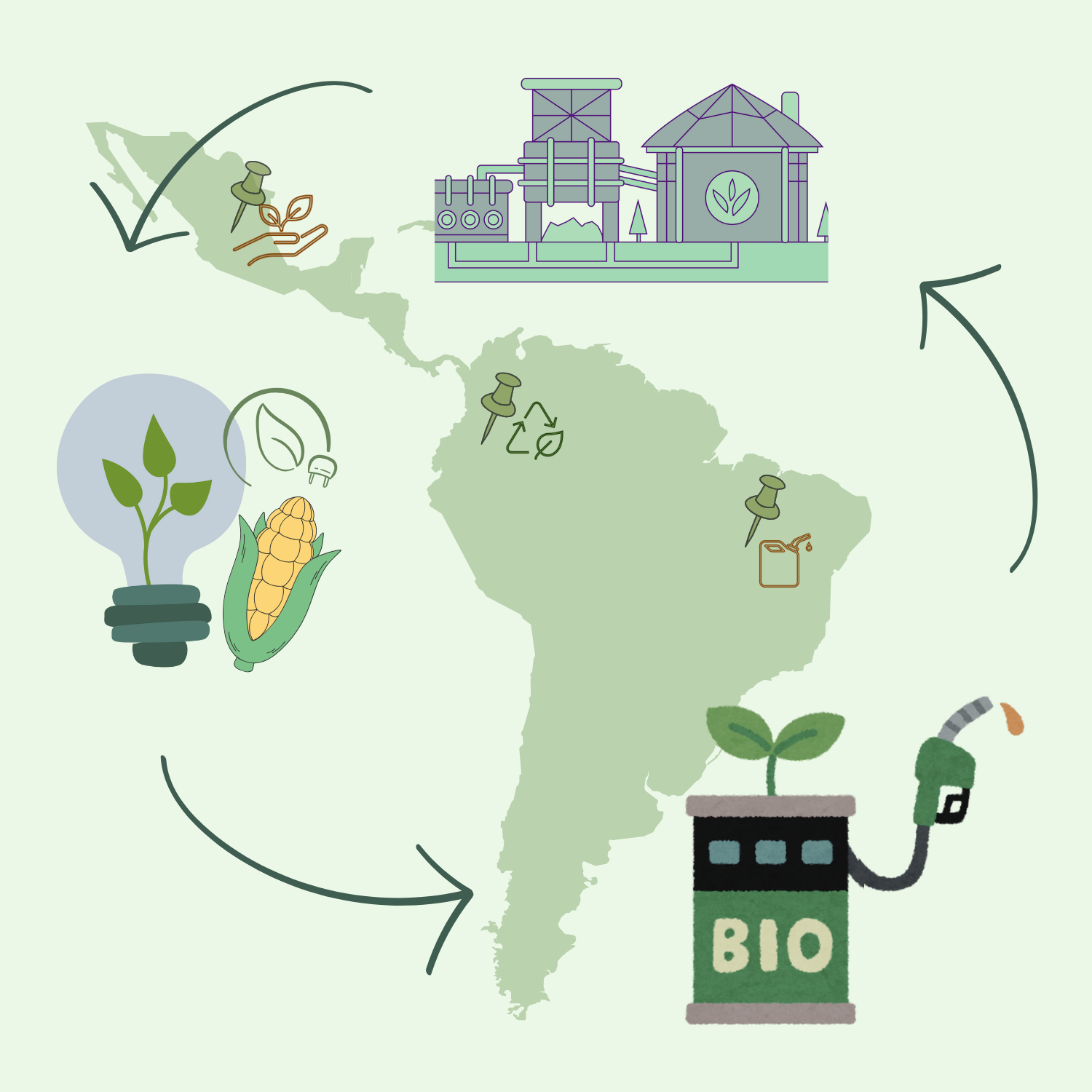
In Latin America, various wastes offer opportunities for the generation of electric energy, promoting a more sustainable energy matrix. Given this reality, several countries in the region are undergoing an energy transition and are conducting research aimed at this objective. The research reported in this article seeks to provide an overview of the availability of agricultural waste for electricity generation. The research focuses on three Latin American countries: Mexico, Colombia and Brazil; leaders in this advancement. The main objective is to evaluate the viability and degree of use of energy resources derived from agricultural waste in each country, through a comparative analysis of data on bioenergy. The methodology includes a bibliographic review, focused on the quantity and type of agricultural waste in each country, as well as a review of existing bioenergy projects. It was found that Mexico produced between 17.5-58.1 million tons of agricultural waste annually; Colombia, around 21.54 million tons; and Brazil, with 798.34 million tons, the latter having the largest amount due to its territorial extension. This study has revealed that, although Brazil and Mexico efficiently use resources such as sugarcane bagasse, and Colombia uses palm oil to generate electricity, there are still areas for improvement in waste management.
Downloads
References
T. Morato, M. Vaezi, and A. Kumar, “Assessment of energy production potential from agricultural residues in Bolivia”, Renewable and Sustainable Energy Reviews, vol. 102, pp. 14–23, mar. 2019. [Online]. Available: https://doi.org/10.1016/j.rser.2018.11.032
International Renewable Energy Agency [IRENA], “Agricultural residue-based bioenergy: Regional potential and scale-up strategies”, Abu Dhabi, 2023 [Online]. Available: https://bit.ly/4fKkEim
X. Liu, S. Zhang, and J. Bae, “The nexus of renewable energy-agriculture-environment in BRICS”, Applied Energy, vol. 204, pp. 489–496, oct. 2017. [Online]. Available: https://doi.org/10.1016/j.apenergy.2017.07.077
A. Sagastume Gutiérrez, J. J. Cabello Eras, L. Hens, and C. Vandecasteele, “The energy potential of agriculture, agroindustrial, livestock, and slaughterhouse biomass wastes through direct combustion and anaerobic digestion. The case of Colombia”, Journal of Cleaner Production, vol. 269, oct. 2020. [Online]. Available: https://doi.org/10.1016/j.jclepro.2020.122317
J. M. Rincón y E. Silva, Bioenergía: Fuentes, conversión y sustentabilidad, Primera. Bogotá, Colombia: La Red Iberoamericana de Aprovechamiento de Residuos Orgánicos en Producción de Energía, 2014.
J. A. Honorato Salazar, and J. Sadhukhan, “Annual biomass variation of agriculture crops and forestry residues, and seasonality of crop residues for energy production in Mexico”, Food and Bioproducts Processing, vol. 119, pp. 1–19, jan. 2020. [Online]. Available: https://doi.org/10.1016/j.fbp.2019.10.005
Ministerio de Energía y Minas, “Plan Maestro de Electricidad”, 2024. [En línea]. Disponible en: https://bit.ly/3Z7SXZR
D. F. Lozano-García, J. E. Santibañez-Aguilar, F. J. Lozano, and A. Flores-Tlacuahuac, “GIS-based modeling of residual biomass availability for energy and production in Mexico”, Renewable and Sustainable Energy Reviews, vol. 120, mar. 2020. [Online]. Available: https://doi.org/10.1016/j.rser.2019.109610
N. Moreno Clavijo y A. A. Romero Jiménez, “Evaluación de diferentes métodos para la transformación de la pulpa de café en abono orgánico en fincas cafeteras”, Tesis de maestria, Universidad de Manizales, Manizales, Colombia, 2016. [En línea]. Disponible en: https://ridum.umanizales.edu.co/handle/20.500.12746/2620
A.A Ramón eat al “Evaluation of Potential Substrates for Biogas Production in Colombia using Anaerobic Digestion Systems”, Ingenieria e Investigacion, vol. 43, no. 2, mar. 2023. [Online]. Available: https://doi.org/10.15446/ING.INVESTIG.100834
S. Saelor, P. Kongjan, and S. O-Thong, “Biogas Production from Anaerobic Codigestion of Palm Oil Mill Effluent and Empty Fruit Bunches”, Energy Procedia, vol. 138, pp. 717–722, oct. 2017. [Online]. Available: https://doi.org/10.1016/j.egypro.2017.10.206
L. P. Vega, K. T. Bautista, H. Campos, S. Daza, and G. Vargas, “Biofuel production in Latin America: A review for Argentina, Brazil, Mexico, Chile, Costa Rica and Colombia”, Energy Reports, vol. 11, pp. 28–38, jun. 2024. [Online]. Available: https://doi.org/10.1016/j.egyr.2023.10.060
S. Manrique, A. Salvo, C. Binda, C. Subelza, L. Mosconi, y B. Balderrama, Conversión energética de la Biomasa: bases para su aprovechamiento, Madrid, España: La Red Iberoamericana de Biomasa y Bioenergía Rural (ReBiBiR-T), 2023.
Instituto Brasileiro de Geografia e Estatística [IBGE], “Censo Agro 2017”, 2017. [En línea]. Disponible en: https://bit.ly/3CHH5pU
T. Forster Carneiro, M. D. Berni, I. L. Dorileo, and M. A. Rostagno, “Biorefinery study of availability of agriculture residues and wastes for integrated biorefineries in Brazil”, Resources, Conservation and Recycling, vol. 77, pp. 78–88, aug. 2013. [Online]. Available: https://doi.org/10.1016/j.resconrec.2013.05.007
“Brazil: electricity generated share by source 2022” [En línea]. Disponible en: https://bit.ly/3OpMF2u
M. de F. Vidal, “Producao e uso de biocombustiveis no Brasil”, Escritório Técnico de Estudos Econômicos do Nordeste - ETENE, 2019. [Online]. Available: https://www.bnb.gov.br/s482-dspace/bitstream/123456789/914/1/2021_CDS_184.pdf
International Renewable Energy Agency [IRENA], “Renewable energy statistics 2023”. 2023. [Online]. Available: https://bit.ly/3COSdBh
“Plataforma Nacional de Energía, Ambiente y Sociedad” [En línea]. Disponible en: https://energia.conacyt.mx/planeas
"Alumbrar las contradicciones del Sistema Eléctrico Nacional y de la transición energética” [En línea]. Disponible en: http://geocomunes.org/Visualizadores/SistemaElectricoMexico
“Atlas del potencial energético de la Biomasa residual en Colombia” [En línea]. Disponible en: https://bit.ly/4g6TrGs
“Sistemas de Informaciones Energéticas de Brasil” [En línea]. Disponible en: https://bit.ly/4iaSLSj
J. Arauzo, F. Bimbela, J. Ábrego, J. L. Sánchez y A. Gonzalo, “Introducción a las tecnologías de aprovechamiento de biomasa”, Grupo Español del Carbón, 2014. [En línea]. Disponible en: https://digital.csic.es/handle/10261/108763
M. J. B. Kabeyi, and O. A. Olanrewaju, “Technologies for biogas to electricity conversion”, Energy Reports, vol. 8, pp. 774–786, dec. 2022. [Online]. Available: https://doi.org/10.1016/j.egyr.2022.11.007
I. Valdez Vazquez, J. A. Acevedo Benítez, and C. Hernández Santiago, “Distribution and potential of bioenergy resources from agricultural activities in Mexico”, Renewable and Sustainable Energy Reviews, vol. 14, núm. 7, pp. 2147–2153, sep. 2010. [Online]. Available: https://doi.org/10.1016/j.rser.2010.03.034
A. Torroba y R. Orozco, Atlas de los biocombustibles líquidos 2021-2022. 3ª ed. San José, Costa Rica: Instituto Interamericano de Cooperación para la Agricultura (IICA), 2022. [En línea]. Disponible en: https://repositorio.iica.int/handle/11324/21328
L. V. M. De Sousa, E. E. Silva Lora, F. C. De Lisboa, F. B. D. Filho, and O. A. Del Olmo, “Holistic assessment of Brazil’s bioenergetic potential”, Biofuels, Bioproducts and Biorefining, pp. 675-685, oct. 2023. [Online]. Available: https://doi.org/10.1002/bbb.2547
E. S. Lora, and R. V. Andrade, “Biomass as energy source in Brazil”, Renewable and Sustainable Energy Reviews, vol. 13, núm. 4, pp. 777–788, may. 2009. [Online]. Available: https://doi.org/10.1016/j.rser.2007.12.004
"Global Electricity Review 2021” [Online]. Available: https://bit.ly/4eMyNuc
“¿Cómo va México en su transición energética?” [En línea]. Disponible en: https://bit.ly/3Zzy77b
A. C. F. Castro y J. L. Mojica, “Informe Perspectiva Sectorial - Energía Actualidad del sector energético colombiano”, Dirección de Sectores y Sostenibilidad, Colombia, Informe, 2023.
“Informe de Avance Proyectos de Generación - Julio 2023 SUBDIRECCIÓN DE ENERGÍA ELÉCTRICA – GRUPO DE GENERACIÓN”, Unidad de Planeación Minero Energética, Colombia. [En línea]. Disponible en: https://bit.ly/4iigTT4
“Brasil es el país con la matriz energética menos contaminante del mundo, señala AIE” [En línea]. Disponible en: https://www.sela.org/es/prensa/servicio-informativo/20181121/si/26490/brasil
"Ministerio de minas y energía Brasil", Ben 2024, SummaryReport 2024, 2024. [En línea]. Disponible en: https://www.epe.gov.br/sites-pt/publicacoes-dados-abertos/publicacoes/PublicacoesArquivos/publicacao-819/topico-715/BEB_Summary_Report_2024.pdf
Published
How to Cite
Issue
Section
License
Copyright (c) 2025 Yulissa del Cisne Marín-Apolo, María Eliza Vega Iñiguez, Danny Ochoa Correa

This work is licensed under a Creative Commons Attribution-NonCommercial-ShareAlike 4.0 International License.
Licensing Agreement
This journal provides free access to its content through its website following the principle that making research available free of charge to the public supports a larger exchange of global knowledge.
Web content of the journal is distributed under a Attribution-NonCommercial-ShareAlike 4.0 International.
Authors may adopt other non-exclusive license agreements for the distribution of the version of the published work, provided that the initial publication in this journal is indicated. Authors are allowed and recommended to disseminate their work through the internet before and during the submission process, which can produce interesting exchanges and increase citations of the published work.