Content Factors Associated With the Critical Success of Video Games on Steam: An Interpretative Analysis Using Canonical Biplot
DOI:
https://doi.org/10.18779/ingenio.v9i2.1293Keywords:
critical success, CRISP-DM, MetacriticAbstract
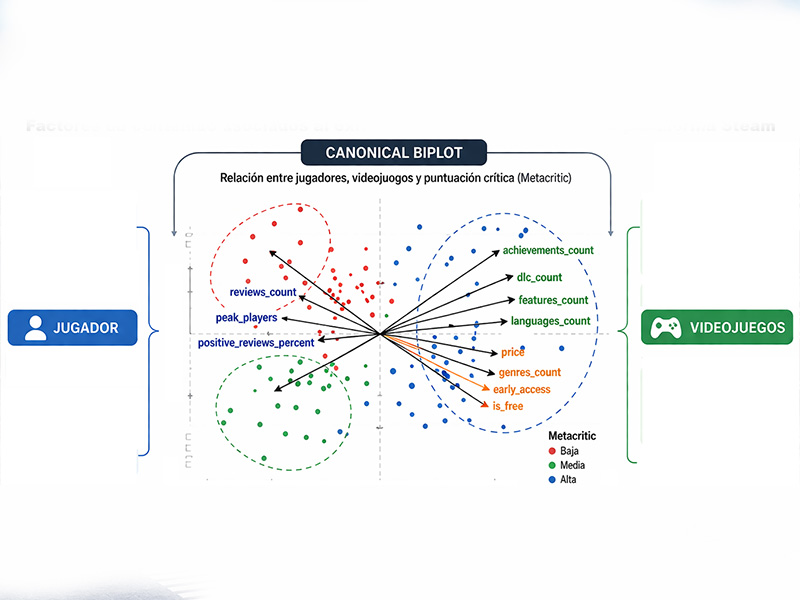
Steam platform accounts for a large share of activity in the PC video game market, making it a key environment for studying the factors associated with game performance. Recent research has linked reviews, player activity, price, and language availability to popularity, although predictive approaches with limited interpretive capacity still predominate. The objective of this study is to determine which content-related factors are associated with critical success on the Steam platform, as measured by Metacritic. This study employed an observational, correlational, quantitative, and cross-sectional design. A non-probability sample was constructed using annual quota sampling and then filtered based on the availability of Metacritic ratings. Data were obtained through web scraping and analyzed under the CRISP-DM methodology using the Canonical Biplot technique. The results show that player interaction variables reviews, concurrent players, and positive reviews constitute the main differentiating axis. In addition, participation-related variables predominate in recent games, whereas achievements, additional features, and Downloadable Content (DLC) carry greater weight in older games. The main contribution of this study is to provide a visual and interpretive explanation of the factors associated with the critical success of video games on the Steam platform, showing that player interaction metrics carry greater weight than several structural product characteristics, and that this relationship changes between older and more recent games.
Downloads
References
A. De Luisa, J. Hartman, D. Nabergoj, S. Pahor, M. Rus, B. Stevanoski, J. Demsar, y E. Strumbelj, "Predicting the popularity of games on Steam," arXiv, 2021. [En línea]. Disponible en: https://doi.org/10.48550/arXiv.2110.02896
E. Salkanovic, N. Zukorlic, L. Okovic, y D. Keco, "A data analysis of Steam’s game catalog and diverse recommendation strategies," International Journal of Computer Applications, vol. 186, no. 54, pp. 39-49, dic. 2024. [En línea]. Disponible en: https://doi.org/10.5120/ijca2024924261
H. Zhou, "More games, more playtime," Interdisciplinary Humanities and Communication Studies, vol. 1, no. 1, jun. 2023. [En línea]. Disponible en: https://doi.org/10.61173/2y9xnj78
X. Li, Z. Zhang, y K. Stefanidis, "A data-driven approach for video game playability analysis based on players’ reviews," Information, vol. 12, no. 3, mar. 2021. [En línea]. Disponible en: https://doi.org/10.3390/info12030129
H. Ding, "Modeling user behavior online: A comparison of Pareto/NBD and BG/NBD models," Highlights in Engineering and Technology, vol. 61, pp. 128-132, jul. 2023. [En línea]. Disponible en: https://doi.org/10.54097/hset.v61i.10283
S. Heidenreich, F. Handrich, y T. Kraemer, "Flawless victory! Investigating search and experience qualities as antecedent predictors of video game success," Electronic Markets, vol. 33, no. 1, 2023. [En línea]. Disponible en: https://doi.org/10.1007/s12525-023-00647-2
T. Kraemer, W. H. Weiger, y S. Heidenreich, "Do all stars shine the same? Investigating the nonlinear effects of user and critic reviews on video game sales," Journal of Business Research, vol. 188, 2025. [En línea]. Disponible en: https://doi.org/10.1016/j.jbusres.2024.115034
J. Pfau, M. Debus, J. Juul, E. Lundedal Hammar, A. Canossa, y M. Seif El-Nasr, "Predicting success factors of video game titles and companies," in Entertainment Computing - ICEC 2022, B. Göbl, E. Van Der Spek, J. Baalsrud Hauge, y R. McCall, Eds. Cham, Switzerland: Springer, 2022, vol. 13477, pp. 269-282. [En línea]. Disponible en: https://doi.org/10.1007/978-3-031-20212-4_22
H. Yu, "A comprehensive analysis of game success: Synergy between quality, brand, and market," Applied and Computational Engineering, vol. 110, no. 1, pp. 22-28, nov. 2024. [En línea]. Disponible en: https://doi.org/10.54254/2755-2721/110/2024MELB0101
V. Brodschneider, y J. Pirker, "On the influence of reviews on play activity on Steam: A statistical approach," en 2023 IEEE Conference on Games (CoG), pp. 1-5, 2023. [En línea]. Disponible en: https://doi.org/10.1109/CoG57401.2023.10333235
D. Chen, "Signals of video game success on Steam: Evidence from Kickstarter campaigns," Finance Research Letters, vol. 86, 2025. [En línea]. Disponible en: https://doi.org/10.1016/j.frl.2025.108995
G. C. Ullmann, C. Politowski, Y.-G. Guéhéneuc, y F. Petrillo, "What makes a game high-rated?: Towards factors of video game success," in Proc. 6th International CSE Workshop on Games and Software Engineering: Engineering Fun, Inspiration, and Motivation, Pittsburgh, PA, USA, May 2022, pp. 16-23. [En línea]. Disponible en: https://doi.org/10.1145/3524494.3527628
N. le Roux y S. Gardner-Lubbe, "A two-group canonical variate analysis biplot for an optimal display of both means and cases," Advances in Data Analysis and Classification, vol. 19, no. 3, pp. 721-748, 2025. [En línea]. Disponible en: https://doi.org/10.1007/s11634-024-00593-7
M. N. Rizani, M. N. A. Khalid, y H. Iida, "Application of meta-gaming concept to the publishing platform: Analysis of the Steam games platform," Information, vol. 14, no. 2, pp. 110, 2023. [En línea]. Disponible en: https://doi.org/10.3390/info14020110
A. M. Shimaoka, R. C. Ferreira, y A. Goldman, "The evolution of CRISP-DM for data science: Methods, processes and frameworks," SBC Reviews on Computer Science, vol. 4, no. 1, pp. 28-43, 2024. [En línea]. Disponible en: https://doi.org/10.5753/reviews.2024.3757
V. Plotnikova, M. Dumas, y F. P. Milani, "Applying the CRISP-DM data mining process in the financial services industry: Elicitation of adaptation requirements," Data & Knowledge Engineering, vol. 139, 2022. [En línea]. Disponible en: https://doi.org/10.1016/j.datak.2022.102013
S. Tripathi, D. Muhr, M. Brunner, H. Jodlbauer, M. Dehmer, y F. Emmert-Streib, "Ensuring the robustness and reliability of data-driven knowledge discovery models in production and manufacturing," Frontiers in Artificial Intelligence, vol. 4, 2021. [En línea]. Disponible en: https://doi.org/10.3389/frai.2021.576892
M. Elkabalawy, A. Al-Sakkaf, E. M. Abdelkader, y G. Alfalah, "CRISP-DM-based data-driven approach for building energy prediction utilizing indoor and environmental factors," Sustainability, vol. 16, no. 17, 2024. [En línea]. Disponible en: https://doi.org/10.3390/su16177249
C. J. F. Ter Braak, P. Smilauer, y S. Dray, "Algorithms and biplots for double constrained correspondence analysis," Environmental and Ecological Statistics, vol. 25, no. 2, pp. 171-197, jun. 2018. [En línea]. Disponible en: https://doi.org/10.1007/s10651-017-0395-x
L. Wells, K. Thurimella, y S. Bacallado, "Regularised canonical correlation analysis: Graphical lasso, biplots and beyond," arXiv, nov. 16, 2025. [En línea]. Disponible en: https://doi.org/10.48550/arXiv.2403.02979
J. L. Vicente-Villardón, MultBiplotR: Multivariate Analysis Using Biplots in R, ver. 23.11.0. CRAN, 2023. [En línea]. Disponible en: https://CRAN.R-project.org/package=MultBiplotR
Published
How to Cite
Issue
Section
License
Copyright (c) 2026 Ariosto Vicuña Pino, Edwin Pacha-Herrera

This work is licensed under a Creative Commons Attribution-NonCommercial-ShareAlike 4.0 International License.
Licensing Agreement
This journal provides free access to its content through its website following the principle that making research available free of charge to the public supports a larger exchange of global knowledge.
Web content of the journal is distributed under a Attribution-NonCommercial-ShareAlike 4.0 International.
Authors may adopt other non-exclusive license agreements for the distribution of the version of the published work, provided that the initial publication in this journal is indicated. Authors are allowed and recommended to disseminate their work through the internet before and during the submission process, which can produce interesting exchanges and increase citations of the published work.