Forecast of pollution by pm10 particulate material with time series
DOI:
https://doi.org/10.18779/cyt.v18i2.944Keywords:
Air pollution, air quality, GuamaníAbstract
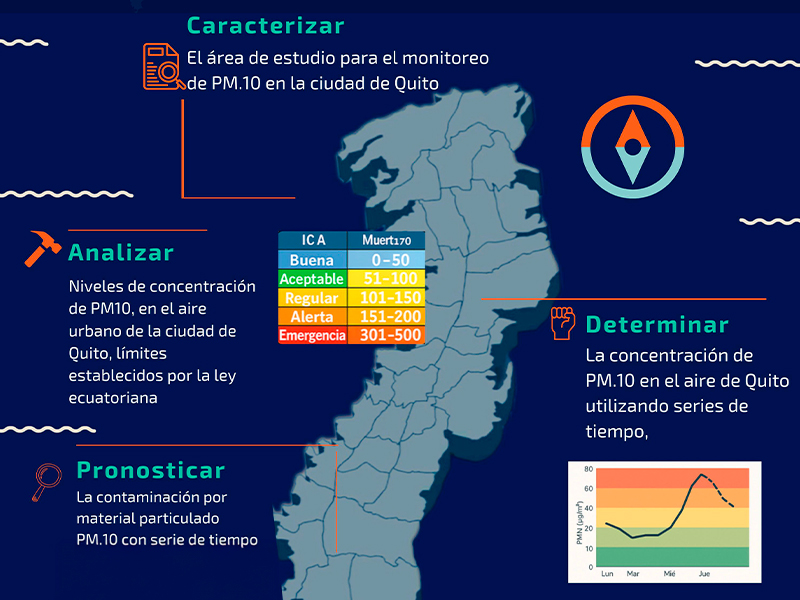
This study aims to explain the temporal variation of PM10 particles in Quito's air quality, estimate future pollution risks, and minimize adverse health effects through the implementation of preventive measures. The research adopts a quantitative approach, focusing on data from the Quito Metropolitan Atmospheric Monitoring Network (REMMAQ) to predict PM10 pollution. The results indicate that the average particulate matter concentrations at each station for a year are acceptable based on homoscedasticity, stationarity, and normality models. The most suitable station is Guamaní, where particulate matter concentrations reach up to 38.8%. According to forecasts, air quality is considered good when it falls within the 0-50 range, where the health effects are acceptable. Guamaní consistently presents acceptable values in the range,
The selected ARIMA (2, 1, 5) model, with an acceptable and appropriate fit, provides a robust alternative for managing air quality through PM10 particles using time series analysis. This study provides valuable information on air quality in Quito and the potential to address air pollution.
Downloads
References
Alcaldía de Cuenca. (2020). Informe de Calidad de Aire Cuenca. [Archivo PDF]. https://acortar.link/E304lH
Álvarez Mendoza, C.I. y Padilla Almeida, O.P. (2016). Estimación de la contaminación del aire por PM10 en Quito a través de índices ambientales con imágenes LANDSAT ETM+. Revista Cartográfica, 92, 135-147. https://doi.org/10.35424/rcarto.i92.441
Banco Interamericano de Desarrollo. (2024). Visita a CORPAIRE. https://www.iadb.org/es/proyecto/EC-T1017
Canales-Rodríguez, M.A., Quintero-Núñez, M., Castro-Romero, T.G. y García-Cuento, R.O. (2014). Las Partículas Respirables PM10 y su Composición Química en la Zona Urbana y Rural de Mexicali, Baja California en México. Información tecnológica, 25(6), 13-22. https://doi.org/10.4067/S0718-07642014000600003
Cruz Yépez, R., Domínguez Gómez A.J., Estrada Gámez, L.G., Martínez Estrada, D.P., Witrago Cruz, M.V. y Violante Gavira, A.E. (2025). Lo que debemos de saber sobre las partículas atmosféricas PM10. XXVII Verano De la Ciencia, 16, 1-8. https://tinyurl.com/4wu6rtxe
Dávila Morán, R.C., Agüero Corzo, E.C., Asencio Tarazona, V., Piñán García, J.H., Ramírez Reyes, G., Pastrana Díaz, N.C. y Montesinos Chávez, F.R. (2022). Calidad del aire interior mediante indicadores ecológicos y sociales asociados a la inmisión de material particulado (PM10) en la zona este 2. Boletín de Malariología y Salud Ambiental, 62(3), 607-613. https://tinyurl.com/3kukwr29
Índice Mundial de Calidad del Aire. (2024). Pronósticos de la calidad del aire en Quito. https://aqicn.org/forecast/quito/es/
Jiménez Perez, L.L. (2018). Estimación de la concentración del contaminante gaseoso NOX en el Distrito Metropolitano de Quito, a partir de imágenes de Satélite Landsat 7 ETM / Landsat 8 OLI de los años 2010, 2013 y 2015, considerando modelos estadísticos a partir de correlación entre estaciones de monitoreo atmosférico y los índices ambientales [Tesis de maestría, Universidad de las Fuerzas Armadas]. https://tinyurl.com/3ksjazwv
Mariño, J., Segovia, A., Yépez, E. y Sánchez, J. (2022). Plan Nacional de La Calidad. Ministerio de Producción, Comercio Exterior, Inversiones y Pesca [Archivo PDF] https://www.produccion.gob.ec/wp-content/uploads/downloads/2021/12/PLAN-NACIONAL-DE-CALIDAD-2022.pdf
Mejía Martínez, N. (2020). Pronostico y Prevención de la contaminación por PM10 en la red de monitoreo de calidad de aire de Bogotá (RMCAB). Universidad de los Andes, 1-31. https://acortar.link/g3kaau
Organización Mundial de la Salud. (2024). Contaminación del aire ambiente (exterior) y salud. Organización Mundial de la Salud. https://www.who.int/es/news-room/fact-sheets/detail/ambient-(outdoor)-air-quality-and-health
Querol, X. (2018). La calidad del aire en las ciudades Un reto mundial [Archivo PDF]. https://acortar.link/b3MiPo
Quito informa. (2018). Secretaría de Ambiente trabaja por la calidad del aire en Quito. https://acortar.link/OKcDgB
Rodríguez Castro, J.C. (2018). Evaluación de la concentración de material particulado de PM2.5 y PM10 en la Parroquia La Matriz en el Cantón Latacunga, Provincia de Cotopaxi en el Periodo 2018 – 2019 [Tesis de pregrado, Universidad Técnica de Cotopaxi] https://tinyurl.com/32fphr64
Rojas Quincho, J.P. y Medina Dionicio, E.A. (2022). Pronóstico de las concentraciones de material particulado en el aire (PM10) utilizando redes neuronales artificiales: Caso estudio en el distrito de Ate, Lima. Revista de la Sociedad Química del Perú, 88(3), 265-276. https://doi.org/10.37761/rsqp.v88i3.402
Rubio, J. (2019). Monitoreo y evaluación del impacto ambiental del material particulado PM10 y PM2,5 en la Universidad Politécnica Salesiana “Campo Sur” [Tesis de grado, Universidad Politécnica Salesiana] https://dspace.ups.edu.ec/handle/123456789/17086?utm_source=chatgpt.com .
Sepúlveda Suescún, J.P., Alzate Zuluaga, N.Y., Murillo Escobar, J.P., Orrego Metaute, D.A. y Correa Ochoa, M.A. (2020). Análisis de características tiempo-frecuencia para la predicción de series temporales de Material Particulado usando Regresión por Vectores de Soporte y Optimización por Enjambre de Partículas. Revista EIA, 17(34), 1-15. https://doi.org/10.24050/reia.v17i34.1347
Vélez Mendoza, N.L., Cano, Y. y Sánchez, L. (2023). Evaluación de las concentraciones de material particulado PM10 en la ciudad de Portoviejo, Ecuador. Revista Bases de la Ciencia, 7(ESPECIAL), 23-36. https://doi.org/10.33936/revbasdelaciencia.v7i3.4240
Verdezoto Mendoza, F.P., Muyulema Allaica, J.C., Cuba Torre, H.R y Serrano Castro, A.K. (2022). Evaluación temporal del material particulado PM2.5 y PM10 en el Distrito Metropolitano de Quito – Ecuador. Conciencia Digital, 5(4.1), 21-44. https://doi.org/10.33262/concienciadigital.v5i4.1.2393
Zafra Mejía, C., Alarcón Hincapié, J. y Echeverry Prieto, L. (2019). Análisis de series de tiempo para concentraciones de PM10: Influencia de la cobertura superficial urbana. Scientia et technica, 24(1), 146-153. https://doi.org/10.22517/23447214.18321
Published
How to Cite
Issue
Section
License
Copyright (c) 2025 Gabriela Johyma Guerrero Muñoz, Livino Manuel Armijos Toro

This work is licensed under a Creative Commons Attribution-NonCommercial-ShareAlike 4.0 International License.
Licensing Agreement
This journal provides free access to its content through its website following the principle that making research available free of charge to the public supports a larger exchange of global knowledge.
Web content of the journal is distributed under a Attribution-NonCommercial-ShareAlike 4.0 International.
Authors may adopt other non-exclusive license agreements for the distribution of the version of the published work, provided that the initial publication in this journal is indicated. Authors are allowed and recommended to disseminate their work through the internet before and during the submission process, which can produce interesting exchanges and increase citations of the published work.