Comprehensive review of the epidemiological, production, and health impacts of Ascaris suum in swine production systems
Keywords:
ascariasis, swine helminthiasis, animal health, biosecurity, zoonosisAbstract
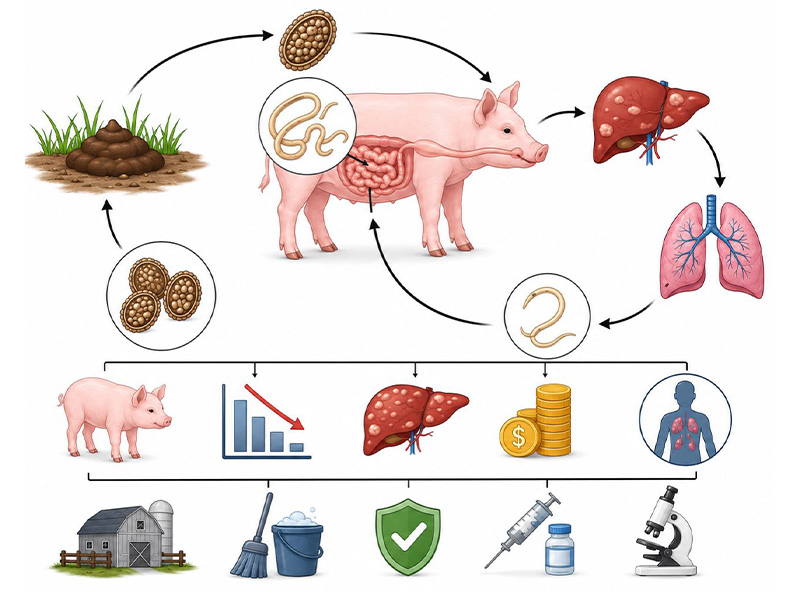
Ascaris suum is a common helminth in pig production and continues to cause problems related to animal health, productivity, welfare, and food safety. The objective of this review was to analyze its epidemiological, productive, and health impact in swine production systems based on scientific literature published between 2010 and 2025. A comprehensive narrative literature review was conducted, supported by searches in Scopus, Web of Science, PubMed, ScienceDirect, and Scopus AI. A total of 126 records potentially related to the topic were identified, and relevant scientific literature on prevalence, diagnosis, economic losses, biosecurity, control, and zoonotic risk was integrated. The evidence shows variable prevalence according to production system: 7.6% in intensive farms in northern Italy, 34.8% in backyard pigs in Myanmar, and regional variability from 52% to 85% in farrowing or family-based areas. In organic or near-organic systems, infection reached up to 74% in finishing pigs. In productive terms, reductions of 16.8 g/day in average daily gain and losses of USD 6.50 ± 3.20 per infected pig have been reported, together with liver lesions known as milk spots. Regarding diagnosis, ELISA (Ensayo por inmunoabsorción ligado a enzimas) detected higher exposure than fecal flotation (69% vs. 13%), showing that coprological methods may underestimate infection. It is concluded that control should integrate hygiene, biosecurity, environmental management, strategic deworming, and serological surveillance.
Downloads
References
Addy, F., Adu-Bonsu, G., Akurigo, C. A., Abukari, I., Suleman, H., y Quaye, L. (2023). Prevalence of gastrointestinal parasites in pigs: A preliminary study in Tolon and Kumbungu districts, Ghana. Journal of Parasitology Research, 2023. https://doi.org/10.1155/2023/1308329.
Ajibo, F. E., Njoga, E. O., Azor, N., Idika, I. K., y Nwanta, J. A. (2020). Epidemiology of infections with zoonotic pig parasites in Enugu State, Nigeria. Veterinary Parasitology: Regional Studies and Reports, 20. https://doi.org/10.1016/j.vprsr.2020.100397.
Allievi, C., Lana, E., Rizzi, R., Zanon, A., Mortarino, M., y Manfredi, M. T. (2025). Abattoir monitoring of liver lesions caused by Ascaris suum larvae: A longitudinal study conducted in northern Italy. Preventive Veterinary Medicine, 241. https://doi.org/10.1016/j.prevetmed.2025.106553.
Allievi, C., Valleri, M., Zanzani, S. A., Zanon, A., Mortarino, M., y Manfredi, M. T. (2024). Epidemiology and distribution of gastrointestinal parasites in fattening pig farms in northern Italy. Parasitology Research, 123. https://doi.org/10.1007/s00436-024-08320-z.
Bawm, S., Htun, L. L., Chel, H. M., Khaing, Y., Hmoon, M. M., Thein, S. S., Win, S. Y., Soe, N. C., Thaw, Y. N., Hayashi, N., Win, M. M., Nonaka, N., Katakura, K., y Nakao, R. (2024). A survey of gastrointestinal helminth infestation in smallholder backyard pigs and the first molecular identification of the two zoonotic helminths Ascaris suum and Trichuris suis in Myanmar. BMC Veterinary Research, 20. https://doi.org/10.1186/s12917-024-03998-w.
Boeira, V. L., Bezagio, R. C., Carvalho, M. S. de, Gandra, R. F., Abreu, A. P. de, Massara, C. L., Colli, C. M., y Ornelas Toledo, M. J. de O. (2025). Hybrid and/or mixed infection by pig and human Ascaris in a Guarani indigenous village in southern Brazil. PLOS Neglected Tropical Diseases, 19(2). https://doi.org/10.1371/journal.pntd.0012271.
Boes, J., Kanora, A., Havn, K. T., Christiansen, S., Vestergaard-Nielsen, K., Jacobs, J., y Alban, L. (2010). Effect of Ascaris suum infection on performance of fattening pigs. Veterinary Parasitology, 172(3-4), 269-276. https://doi.org/10.1016/j.vetpar.2010.05.007.
Elizalde-Velázquez, L. E., Schlosser-Brandenburg, J., Laubschat, A., Oser, L., Kundik, A., Adjah, J., Groenhagen, S., Kühl, A. A., Rausch, S., y Hartmann, S. (2024). Th2-biased immune responses to body migrating Ascaris larvae in primary infection are associated with pathology but not protection. Scientific Reports, 14. https://doi.org/10.1038/s41598-024-65281-0.
Fausto, M. C., Oliveira, I. de C., Fausto, G. C., Carvalho, L. M. de, Valente, F. L., Campos, A. K., y Araújo, J. V. de. (2015). Ascaris suum in pigs of the Zona da Mata, Minas Gerais State, Brazil. Revista Brasileira de Parasitologia Veterinária, 24(3), 375-378. https://doi.org/10.1590/S1984-29612015047.
Fischer, H. R. M., Krücken, J., Fiedler, S., Duckwitz, V., Nienhoff, H., Steuber, S., Daher, R., y von Samson-Himmelstjerna, G. (2024). Gastrointestinal nematodes in German outdoor-reared pigs based on faecal egg count and next-generation sequencing nemabiome data. Porcine Health Management, 10. https://doi.org/10.1186/s40813-024-00384-8.
Ilic, T., Becskei, Z., Tasic, A., y Dimitrijevic, S. (2013). Follow-up study of prevalence and control of ascariasis in swine populations in Serbia. Acta Parasitologica, 58(3), 278-283. https://doi.org/10.2478/s11686-013-0132-z
Joachim, A., Winkler, C., Ruczizka, U., Ladinig, A., Koch, M., Tichy, A., y Schwarz, L. (2021). Comparison of different detection methods for Ascaris suum infection on Austrian swine farms. Porcine Health Management, 7. https://doi.org/10.1186/s40813-021-00236-9.
Jones, B. P., Kozel, K., Alonte, A. J. I., Llanes, K. K. R., Juhász, A., Chaudhry, U., Roose, S., Geldhof, P., Belizario, V. Y., Nejsum, P., Stothard, J. R., LaCourse, E. J., van Vliet, A. H. M., Paller, V. G. V., y Betson, M. (2024). Worldwide absence of canonical benzimidazole resistance-associated mutations within B-tubulin genes from Ascaris. Parasites y Vectors, 17. https://doi.org/10.1186/s13071-024-06306-5.
Katakam, K. K., Thamsborg, S. M., Dalsgaard, A., Kyvsgaard, N. C., y Mejer, H. (2016). Environmental contamination and transmission of Ascaris suum in Danish organic pig farms. Parasites & Vectors, 9. https://doi.org/10.1186/s13071-016-1349-0.
Koehler, S., Springer, A., Issel, N., Klinger, S., Strube, C., y Breves, G. (2021). Changes in porcine nutrient transport physiology in response to Ascaris suum infection. Parasites & Vectors, 14. https://doi.org/10.1186/s13071-021-05029-1.
Li, Y. Z., Hernandez, A. D., Major, S., y Carr, R. (2022). Occurrence of intestinal parasites and its impact on growth performance and carcass traits of pigs raised under near-organic conditions. Frontiers in Veterinary Science, 9. https://doi.org/10.3389/fvets.2022.911561 .
Lindgren, K., Gunnarsson, S., Höglund, J., Lindahl, C., y Roepstorff, A. (2020). Nematode parasite eggs in pasture soils and pigs on organic farms in Sweden. Organic Agriculture, 10, 289-300. https://doi.org/10.1007/s13165-019-00273-3.
Martínez-Pérez, J. M., Vandekerckhove, E., Vlaminck, J., Geldhof, P., y Martínez-Valladares, M. (2017). Serological detection of Ascaris suum at fattening pig farms is linked with performance and management indices. Veterinary Parasitology, 248, 33-38. https://doi.org/10.1016/j.vetpar.2017.10.009.
Massaglia, S., Merlino, V. M., Borra, D., Verduna, T., Renna, M., y Rambozzi, L. (2018). Impact of swine ascariasis on feeding costs and revenues in farms associated with the Italian PDOs dry-cured hams industry. Quality - Access to Success, 19, 146-154.
Mendes, Â. J., Ribeiro, A. I., Severo, M., y Niza-Ribeiro, J. (2017). A multilevel study of the environmental determinants of swine ascariasis in England. Preventive Veterinary Medicine, 148, 10-20. https://doi.org/10.1016/j.prevetmed.2017.09.012.
Musimbi, Z. D., Laubschat, A., Oser, L., Mugo, R. M., Hempel, B.-F., Höfler, P., Schlosser-Brandenburg, J., Midha, A., Rausch, S., y Hartmann, S. (2025). Larval ascariasis induces prominent IgA and IgG1/2 antibody responses against adult Ascaris excretory-secretory antigens in pigs. Frontiers in Immunology, 16. https://doi.org/10.3389/fimmu.2025.1606128.
Oba, P., Dione, M., Mwiine, F. N., Wieland, B., Erume, J., y Ouma, E. (2023). Economic losses associated with respiratory and helminth infections in domestic pigs in Lira district, Northern Uganda. Frontiers in Veterinary Science, 10. https://doi.org/10.3389/fvets.2023.1198461.
Oser, L., Midha, A., Schlosser-Brandenburg, J., Rausch, S., Mugo, R. M., Kundik, A., Elizalde-Velázquez, L. E., Adjah, J., Musimbi, Z. D., Klopfleisch, R., Helm, C. S., von Samson-Himmelstjerna, G., Hartmann, S., y Ebner, F. (2024). Ascaris suum infection in juvenile pigs elicits a local Th2 response in a setting of ongoing Th1 expansion. Frontiers in Immunology, 15. https://doi.org/10.3389/fimmu.2024.1396446.
Palma, A., Matamoros, G., Escobar, D., Sánchez, A. L., y Fontecha, G. (2020). Absence of mutations associated with resistance to benzimidazole in the beta-tubulin gene of Ascaris suum. Revista da Sociedade Brasileira de Medicina Tropical, 53. https://doi.org/10.1590/0037-8682-0155-2019.
Roepstorff, A., Mejer, H., Nejsum, P., y Thamsborg, S. M. (2011). Helminth parasites in pigs: New challenges in pig production and current research highlights. Veterinary Parasitology, 180(1-2), 72-81. https://doi.org/10.1016/j.vetpar.2011.05.029.
Senanayake, N. S., Boyle, L., O’Driscoll, K., Menant, O., y Butler, F. (2025). Effects of season, age and parasite management practices on gastro-intestinal parasites in pigs kept outdoors in Ireland. Irish Veterinary Journal, 78. https://doi.org/10.1186/s13620-025-00297-0.
Tassis, P., Symeonidou, I., Gelasakis, A. I., Kargaridis, M., Aretis, G., Arsenopoulos, K. V., Tzika, E., y Papadopoulos, E. (2022). Serological assessment of Ascaris suum exposure in Greek pig farms and associated risk factors including Lawsonia intracellularis. Pathogens, 11(9). https://doi.org/10.3390/pathogens11090959.
Vandekerckhove, E., Vlaminck, J., del Pozo Sacristán, R., y Geldhof, P. (2019). Effect of strategic deworming on Ascaris suum exposure and technical performance parameters in fattening pigs. Veterinary Parasitology, 268, 67-72. https://doi.org/10.1016/j.vetpar.2019.03.006.
Vargas-Hidalgo, J. S., Pisuña-Lluglluna, E. N., y Brito-Torres, J. G. (2024). Revisión bibliográfica sobre la prevalencia de parásitos gastrointestinales en cerdos destinados al faenamiento en Ecuador. Revista Multidisciplinaria Perspectivas Investigativas, 4(especial), 166-174. https://doi.org/10.62574/rmpi.v4iespecial.121.
Vismarra, A., Lenti, A., Genchi, M., Kramer, L., y Geldhof, P. (2023). Seroprevalence of Ascaris suum compared to milk spot prevalence at slaughter in Italian fattening pigs. Veterinary Parasitology: Regional Studies and Reports, 37. https://doi.org/10.1016/j.vprsr.2022.100828.
Vlaminck, J., Masure, D., Wang, T., Nejsum, P., Hokke, C. H., y Geldhof, P. (2016). A phosphorylcholine-containing glycolipid-like antigen present on the surface of infective stage larvae of Ascaris spp. is a major antibody target in infected pigs and humans. PLOS Neglected Tropical Diseases, 10(12). https://doi.org/10.1371/journal.pntd.0005166.
Zheng, Y., Xie, Y., Geldhof, P., Vlaminck, J., Ma, G., Gasser, R. B., y Wang, T. (2020). High anti-Ascaris seroprevalence in fattening pigs in Sichuan, China, calls for improved management strategies. Parasites & Vectors, 13. https://doi.org/10.1186/s13071-020-3935-4.
Published
How to Cite
Issue
Section
License
Copyright (c) 2026 Marco Antonio Alcívar Martínez, Ashley Nicole Campozano Parrales

This work is licensed under a Creative Commons Attribution-NonCommercial-ShareAlike 4.0 International License.
Licensing Agreement
This journal provides free access to its content through its website following the principle that making research available free of charge to the public supports a larger exchange of global knowledge.
Web content of the journal is distributed under a Attribution-NonCommercial-ShareAlike 4.0 International.
Authors may adopt other non-exclusive license agreements for the distribution of the version of the published work, provided that the initial publication in this journal is indicated. Authors are allowed and recommended to disseminate their work through the internet before and during the submission process, which can produce interesting exchanges and increase citations of the published work.