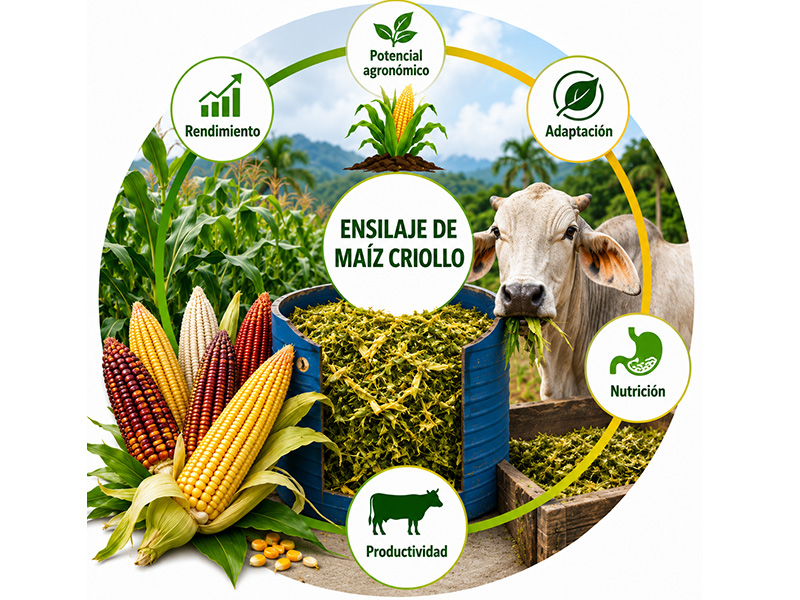
Agronomic and nutritional potential of creole maize in silage for ruminant feed in the humid tropics
DOI:
https://doi.org/10.18779/cyt.v19i2.1214Keywords:
cattle, bromatology, forage, food security, native seedsAbstract
Since the green revolution, the use of improved varieties and products that help increase crop yields has been promoted, thus obtaining many commercial hybrids of different crops, including corn, which is one of the main commodities worldwide. This trend has caused the decrease and in some cases the extinction of many endemic and/or native seeds whose productive potential and capacity to adapt to the conditions of the sector have been underestimated. Aware of this and of the current tendencies to recover this type of traditional seeds, it is proposed to investigate the production potential of fresh corn forage for silage, as well as the bromatological quality and production volumes in kg·ha-1. A DBCA was performed for fresh forage production and a DCA for the analysis of bromatological components, obtaining significantly and statistically higher results for Criollo corn in terms of green forage production (48999.31 kg·ha-1) and contribution of non-nitrogenous elements in kg-ha-1 reaching 23470.67 kg·ha-1 while, for the other variables, the results were statistically similar for both varieties. This allows us to conclude that the use of native seeds can be similar or even better than using hybrid seeds, with the additional advantage of being able to obtain and conserve seeds of our own production and not depend on commercial companies, which allows us to achieve food sovereignty in the future.
Downloads
References
Afonso, P. R., Jolomba Silva, M. R., Cirilo Silva, B. E., Moras Cordeiro, J. M., & Morais, J. (2024). Caracterizacoo produtiva e do valor nutritivo dos pastos implantados na fazenda 7 Quintas, Waco-Kungo, Angola. Revista de Ciências Agroveterinárias, 23(3), 367-380. https://doi.org/10.5965/223811712332024367.
Alba-Rojas, J. L., Alemán-Pérez, R. y Galeano-Montero, K. (2023). Respuesta a la fertilización química y orgánica de la variedad de maíz Tusilla en las condiciones de la Amazonía Ecuatoriana. Revista De Ciencias Agropecuarias ALLPA, 6(12), 2–11. https://publicacionescd.uleam.edu.ec/index.php/allpa/article/view/663.
Analuisa, I. A., Jimber del Río, J. A., Fernández Gallardo, J. A. y Vergara-Romero, A. (2023). La cadena de valor del maíz amarillo duro ecuatoriano. Retos y oportunidades. Lecturas de Economía, (98), 231-262. https://doi.org/10.17533/udea.le.n98a347315.
Atencio Solano, L., Suarez Paternina, E., Tapia Coronado, J.J., Paternina Paternina,Y., Barragan Hernández, W. y Mestra Vargas, L. (2025). Efecto de la suplementación con ensilaje de maíz y yuca en el desempeño productivo y económico de ovinos criollos. ACI Avances en Ciencias e Ingenierías, 17(2). https://doi.org/10.18272/aci.vi.3748.
Briceño Zabaleta, D. (2023). Boletín técnico de muestreo de suelos [Archivo PDF]. https://goo.su/jZxAAgx.
Cañas Correa, N. (2020). Producción de 5.000 m2 de maíz criollo amarillo duro (Zea mays) para comercialización en grano seco y canales de comercialización de banano bocadillo en el municipio de Landázuri Santander. [Tesis de grado, Universidad de La Salle] https://ciencia.lasalle.edu.co/server/api/core/bitstreams/801860e0-7200-4479-bb33-fb2867e602d1/content.
Cedeño Moreira, A. A. (2022). Ensilaje con subproductos de plátano con aplicación de microorganismos lácticos [Tesis de grado, Universidad Laica Eloy Alfaro De Manabí]. https://repositorio.uleam.edu.ec/handle/123456789/5144.
Fuentes Figueroa, T., Parrales Quimis, A. D., Morán Morán, J., García Cabrera, J. y Ortega, G. J. (2022). Caracterización morfológica y etnobotánica del maíz criollo (Zea mays L.) en la comuna Sancán, Ecuador: caracterización morfológica del maíz criollo (Zea mays L.). UNESUM - Ciencias. Revista Científica Multidisciplinaria, 6(2), 101–116. https://doi.org/10.47230/unesum-ciencias.v6.n2.2022.631
Galindo-Domínguez, H. (2020). Estadística para no estadísticos: una guía básica sobre la metodología cuantitativa de trabajos académicos. 3Ciencias Editorial. https://doi.org/10.17993/EcoOrgyCso.2020.59.
Instituto Nacional de Estadística y Censos. (2022). Estadísticas agropecuarias (Estadístico Núm. 2021). https://www.ecuadorencifras.gob.ec/estadisticas-agropecuarias-2/.
Jiang, M., Ma, Y., Khan, N., Khan, M. Z., Akbar, A., Khan, R. U., Kamran, M. y Khan, N. A. (2022). Effect of spring maize genotypes on fermentation and nutritional value of whole plant maize silage in northern Pakistan. Fermentation, 8(11), 587. https://doi.org/10.3390/fermentation8110587.
Karnatam, K. S., Mythri, B., Un Nisa, W., Sharma, H., Meena, T. K., Rana, P., Vikal, Y., Gowda, M., Dhillon, B. S. y Sandhu, S. (2023). Silage maize as a potent candidate for sustainable animal husbandry development - Perspectives and strategies for genetic enhancement. Frontiers in Genetics, 14. https://doi.org/10.3389/fgene.2023.1150132.
Laorodphan, N., Poonpaiboonpipat, T., Incharoen, T., Foiklang, S., Cherdthong, A., Panase, P., Chaporton, N., y Intawicha, P. (2026). Effects of Replacing Corn Stover Silage with Sweet Sorghum Silage on Dry Matter Intake, Fibre Digestibility, and Milk Composition in Thai Holstein Crossbred Dairy Cows. Ruminants, 6(2), 27. https://doi.org/10.3390/ruminants6020027.
Lima, L. S. de C. F., Fachini, C., Silva, V. R. da, Borges, J. R. P., y Forti, V. A. (2022). Maíz criollo del suroeste de Sao Paulo , Brasil: diversidad y calidad de semillas. Revista Mexicana De Ciencias Agrícolas ,13(1), 15-28.https://doi.org/10.29312/remexca.v13i1.2790.
Mancipe-Muñoz, E. A., Castillo-Sierra, J.,Vargas-Martínez, J. de J. y Avellaneda-Avellaneda, Y. (2022). Calidad composicional del ensilaje de tres cultivares de maíz (Zea mays) del trópico alto colombiano. Agronomía Mesoamericana, 33(2),16. https://doi.org/10.15517/am.v33i2.46412.
Martínez Reyna, P. (2023). Caracterización física, química, nutracéutica y propiedades tecnofuncionales de tres variedades de maíz (Zea mays) criollo pigmentado (blanco, amarillo y negro). [Tesis de maestría, Universidad Autónoma de Querétaro] https://ri-ng.uaq.mx/handle/123456789/4340.
Mestanza Uquillas, C. A., Cedeño Cárcamo, P. J., Veliz, D. V., Vásquez Matute, S. C. y Pinargote Alava, J. J. (2025). Distanciamiento de siembra en Zea mays L. durante la época seca y lluviosa en la costa central del Ecuador. LA GRANJA. Revista de Ciencias de la Vida, 41(1), 151-161. https://doi.org/10.17163/lgr.n41.2025.10.
Ministerio de Agricultura, Ganadería y Pesca - MAGP. (2025). Rendimientos de maíz amarillo duro 2025—Caracterización Producción. SIPA. https://sipa.agricultura.gob.ec/index.php/rendimientos-de-maiz-duro-2025-cp.
Muñoz Loor, J. H., y Olmedo Rosado, D. A. O. (2025). Evaluación de la calidad bromatológica de dos tipos de ensilaje en el cantón Chone. Chone, Ciencia y Tecnología, 3(2). https://doi.org/10.56124/cct.v3i2.005.
Palma, R., Zambrano Mendoza, M. E., Cedeño Espinoza, A. M., Pérez Zambonino, Y. A., y Balcázar Almeida, M. I. (2026). Calidad del Ensilaje de Megathyrsus maximus Enriquecido con Harina de Maíz e Inoculación Microbiana. Erevna Research Reports, 4(1), 1.
Solís Lucas, L. A. S., y Castaño, E. (2022). Efectos de los niveles de fertilización, distancias de siembra y momentos de corte sobre la calidad nutricional del ensilaje de maíz. Archivos de Zootecnia, 71(273), 18-22. https://doi.org/10.21071/az.v71i273.5606.
Souza, A. M. de, Neumann, M., Rampim, L., Almeida, E. R. de, Matchula, A. F., Cristo, F. B., y Faria, M. V. (2022). Effect of storage time on the chemical composition of whole and grainless corn plant silage harvested at different maturity stages. Revista Brasileira de Zootecnia, 51,e20200180. https://doi.org/10.37496/rbz5120200180.
Zambrano, C. E. y Andrade Arias, M. S. (2021). Productividad y precios de maíz duro pre y post Covid-19 en el Ecuador. Revista Universidad y Sociedad, 13(4), 143–150. https://goo.su/boHuTYr.
Zaragoza-Esparza, J., Tadeo-Robledo, M., Espinosa-Calderón, A., López-López, C., García-Espinosa, J. C., Zamudio-González, B., Turrent Fernández, A. y Rosado-Núñez, F. (2019). Rendimiento y calidad de forraje de híbridos de maíz en Valles Altos de México: Rendimiento y calidad de forraje de híbridos de maíz. Revista mexicana de ciencias agrícolas, 10(1), 101–111. https://doi.org/10.29312/remexca.v10i1.1403.
Zhang, P., Chang, J., Xiao, L., Shi, Y., Harrison, M. T., Zhao, M., Feng, Y., Zhao, H., Wang, C., Shen, H., Luo, Z., Shi, Z., y Fang, J. (2026). Shifts in sowing dates and water management promote high and stable potential yield of silage maize in China: Implications for quality feed intensification. Field Crops Research, 341, 110433. https://doi.org/10.1016/j.fcr.2026.110433.
Zhao, M., Feng, Y., Shi, Y., Shen, H., Hu, H., Luo, Y., Xu, L., Kang, J., Xing, A., Wang, S., y Fang, J. (2022). Yield and quality properties of silage maize and their influencing factors in China. Science China Life Sciences, 65(8), 1655-1666. https://doi.org/10.1007/s11427-020-2023-3.
Published
How to Cite
Issue
Section
License
Copyright (c) 2026 Miguel Angel Macay Anchundia, Rodrigo Alberto Saquicela Rojas; Roxanna Patricia Palma; Gabriela Liseth Zambrano Vera

This work is licensed under a Creative Commons Attribution-NonCommercial-ShareAlike 4.0 International License.
Licensing Agreement
This journal provides free access to its content through its website following the principle that making research available free of charge to the public supports a larger exchange of global knowledge.
Web content of the journal is distributed under a Attribution-NonCommercial-ShareAlike 4.0 International.
Authors may adopt other non-exclusive license agreements for the distribution of the version of the published work, provided that the initial publication in this journal is indicated. Authors are allowed and recommended to disseminate their work through the internet before and during the submission process, which can produce interesting exchanges and increase citations of the published work.