
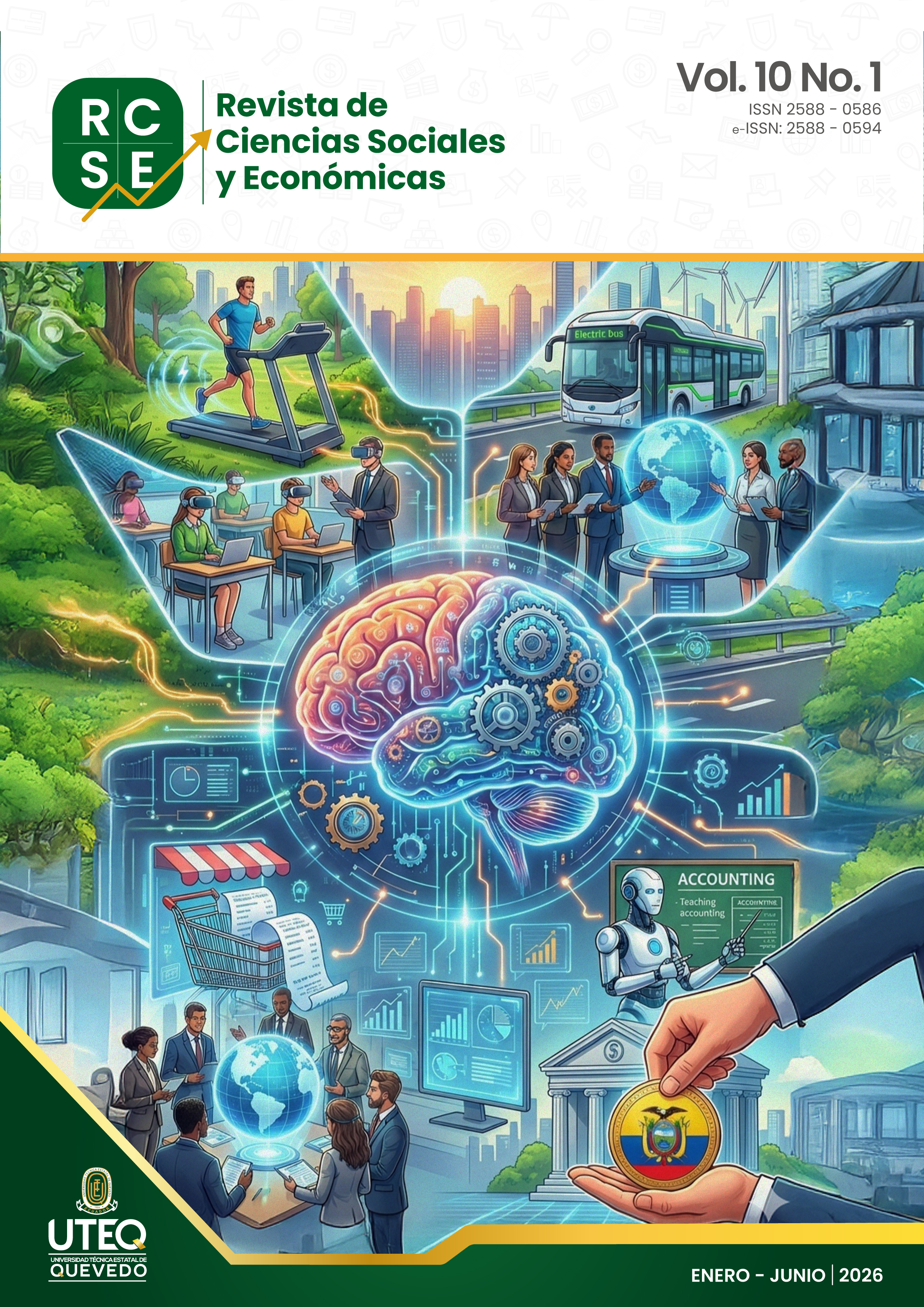
Artificial Intelligence In Accounting Education. A View from the Protagonists
DOI:
https://doi.org/10.18779/csye.v10i1.1120Keywords:
Accounting, Teachers, Teaching, Emerging Technology, CurriculumAbstract
This research analyzes the integration of Artificial Intelligence (AI) into the teaching process of accounting at the higher education level, justifying its importance in light of the growing demand in the educational and professional sectors. The objective was to identify mechanisms for integrating AI into university teaching and to evaluate its impact and perception among students and faculty. The methodology was descriptive with a mixed-methods approach, using surveys administered to 92 students from the last four years of study and to 12 faculty members (out of 14) at the National University of Loja. The surveys were conducted via Google Forms, and descriptive statistical analyses, including the Chi-square test and Cramer's V coefficient, were performed. The results show that 87% of the students are women, 59% have an intermediate level of AI knowledge, 60% occasionally use AI in their studies, 47% consider AI effective for solving accounting problems, and 63% believe it should be part of the curriculum. Ninety-two percent of the faculty have a high level of AI knowledge, and 42% consider it very important for teaching. However, statistical analyses revealed no statistically significant relationships between the variables of knowledge, use, and perception of AI between the two groups. The study concluded that, although a positive perception of AI use was observed, it is essential to promote training and its integration into the curriculum, as well as to expand the sample size to obtain more detailed and meaningful results, especially among teachers.
Downloads
References
Acurio-Paredes, S. M., Jiménez-Moreno, L. S. y Hidalgo-Achig, M. (2025). La inteligencia artificial en el Desarrollo Profesional de Contadores en Pichincha: Un enfoque adaptativo. MQRInvestigar, 9(1), 1-17. https://doi.org/10.56048/MQR20225.9.1.2025.e42
Alcívar-Nieto, A. P. y Escobar-García, M. C. (2025). Aportes de la inteligencia artificial en la auditoría: Revisión sistemática de la literatura. RevCient. Multidiciplinaria Arbitrada, Yachasum. 9(16), 102–115. https://editorialibkn.com/index.php/Yachasun/article/view/589
Armijos, J. C., La Paz, A. y López, R. (2025). Formación contable en América Latina: Entre la uniformidad y la diversidad. Revista Andina De Educación. 8(1), 5092. https://doi.org/10.32719/26312816.5092
Ballantine, J., Boyce, G. y Stoner, G. (2024). A critical review of AI in accounting education: Threat and opportunity. Critical Perspectives on Accounting. 99, 102711. Elsevier. https://doi.org/10.1016/j.cpa.2024.102711
Castillo-Pindo, B. M. C. P., Calderón-Aguirre, A. J., Humanante-Endara, M. G., Chang-Dávila, C. F. y Ojeda-Aguirre, J. C. (2024). La Inteligencia Artificial como Recurso Educativo en Educación Superior: Perspectivas Éticas sobre su Uso. Ciencia Latina Revista Científica Multidisciplinar, 8(4), 3950-3965. https://doi.org/10.37811/cl_rcm.v8i4.12622
Cualchi-Guasgua, R. A., Pasquel-Diaz, L. M. y Arteaga-Alcívar, Y. (2024). Impacto de la IA en la educación contable: nuevas herramientas y habilidades. Nexus Research Journal, 3(2), 164-181. https://doi.org/10.62943/nrj.v3n2.2024.139
Gaona-Portal, M., Bazán-Linares, M. V., Luna-Acuña, M. L. y Peralta-Roncal, L. (2024). Competencias digitales en educación superior: Una revisión sistemática. Revista Científica UISRAEL, 11(2), 13-30. https://doi.org/10.35290/rcui.v11n2.2024.959
González-Mejía, S. L., Chamorro-Quiñónez, J. G. y Rivera-Pizarro, C. F. (2024). Impacto de la inteligencia artificial en los procesos contables mediante revisión de tendencias y desafíos. Multidisciplinary Collaborative Journal, 2(2), 45-56. https://doi.org/10.70881/mcj/v2/n2/35
Guevara-Alban, G. P., Verdesoto-Arguello, A. E. y Castro-Molina, N. E. (2020). Metodologías de investigación educativa (descriptivas, experimentales, participativas, y de investigación-acción). Revista Recimundo. 4(3), 163-173. https://doi.org/10.26820/recimundo/4.(3).julio.2020.163-173
Kroff, F. J., Coria, D. F. y Ferrada, C. A. (2024). Inteligencia Artificial en la educación universitaria: Innovaciones, desafíos y oportunidades. Revista Espacios. 45(5), 120-135. https://doi.org/10.48082/espacios-a24v45n05p09
Luzette-Huertas, Y. (2024). La IA en la Educación Contable: Innovación para el Pensamiento Crítico y Creativo en una Fuerza Laboral emergente. Asociación Interamericana de Contabilidad. 1-8. https://contadores-aic.org/la-ia-en-la-educacion-contable-innovacion-para-el-pensamiento-critico-y-creativo-en-una-fuerza-laboral-emergente/
Manosalvas-Mafla, A. M., Chisag, M. B., Baque-Arteaga, M. B. y Maliza-Cruz, W. I. (2024). La inteligencia artificial como herramienta de enseñanza-aprendizaje en la Contabilidad. Polo del Conocimiento, 9(1), 85, 1749-1770. https://doi.org/10.23857/pc.v9i1
Morocho-Cevallos, R. A., Tipan-Llanos, A. M., Ríos-Quiñónez, M. B., Cartuche-Gualán, A., P. y Guevara-Guevara, A. M. (2023). Integración de la Inteligencia Artificial en la Educación. Ciencia Latina Revista Científica Multidisciplinar, 7(6), 2032-2053. https://doi.org/10.37811/cl_rcm.v7i6.8832
Ortega-Méndez, J. X., Pinto-Arboleda, R. A., Fajardo-Bravo, N. J., Zambrano-Toapanta, A. Y. y Zambrano-Recalde, P. E. (2025). Inteligencia artificial en la auditoría contable. Aplicaciones y desafíos del uso de IA en la auditoría. Sinergía Académica. 8(2 Especial), 624-636. https://goo.su/UrIykM9
Quimi Franco, D. I., Flores Villacrés, E. J., Quimi Franco, W. P. y Merizalde Andrade, C. E. (2025). Percepciones Estudiantiles en la Integración de un Aplicativo Web Contable en la Formación Profesional. Universidad y Sociedad. 17(3), e5238. https://rus.ucf.edu.cu/index.php/rus/article/view/5238
Salvador , M. y Martínez, C. (2025). La Influencia de la Inteligencia Artificial en la Contabilidad. Ciencia Latina Revista Científica Multidisciplinar. 8(6), 5669-5682. https://doi.org/10.37811/cl_rcm.v8i6.15277
Sánchez-Caguana, D. F., Philco-Reinozo, M. A., Salinas-Arroba, J. M. y Pico-Lescano, J. C. (2024). Impacto de la Inteligencia Artificial en la Precisión y Eficiencia de los Sistemas Contables Modernos. Journal of Economic and Social Science Research. 4(3), 1-12. https://doi.org/10.55813/gaea/jessr/v4/n3/117
Suarez Almeira, M. Á., Aspajo Torres, N. y Castro Burgos, P. G. (2026). Innovación en la enseñanza de la contabilidad: una revisión sistemática sobre tendencias y desafíos en la formación profesional. Revista InveCom. 6(2), e602001. https://doi.org/10.5281/zenodo.15708508
Valladares-Albarracín, J. J. y Ordóñez-Parra, Y. L. (2024). La aplicación de inteligencia artificial en la auditoría contable. Revista Multidisciplinaria Perspectivas Investigativas, 4 (especial), 73–85. https://doi.org/10.62574/rmpi.v4iespecial.172
Vizcaíno-Zúñiga, P. I., Cedeño-Cedeño, R. J. y Maldonado-Palacios, I. A. (2023). Metodología de la investigación científica: guía práctica. Ciencia Latina Revista Científica Multidisciplinar. 7(4), 9723-9762. https://ciencialatina.org/index.php/cienciala/article/download/7658/11619/
Zambrano-Saltos, C. F., Gamarra-Yanez, A. C., La O Mendoza, Y. y Reigosa-Lara. A. (2025). Uso de herramientas de inteligencia artificial en la auditoría de certificación de estados financieros. Sinergia Académica, 8(Especial 2), 264-282. https://doi.org/10.51736/sa494
Published
How to Cite
Issue
Section
License
Copyright (c) 2026 Elida del Cisne Alvarado Jaramillo , Paola Lizbeth Cabrera Rivera , Yadira Soledad PatiñoPatiño Calderón , Lilia De Fátima Rueda Sarango

This work is licensed under a Creative Commons Attribution-NonCommercial-ShareAlike 4.0 International License.
Licensing Agreement
This journal provides free access to its content through its website following the principle that making research available free of charge to the public supports a larger exchange of global knowledge.
Web content of the journal is distributed under a Attribution-NonCommercial-ShareAlike 4.0 International.
Authors may adopt other non-exclusive license agreements for the distribution of the version of the published work, provided that the initial publication in this journal is indicated. Authors are allowed and recommended to disseminate their work through the internet before and during the submission process, which can produce interesting exchanges and increase citations of the published work.


