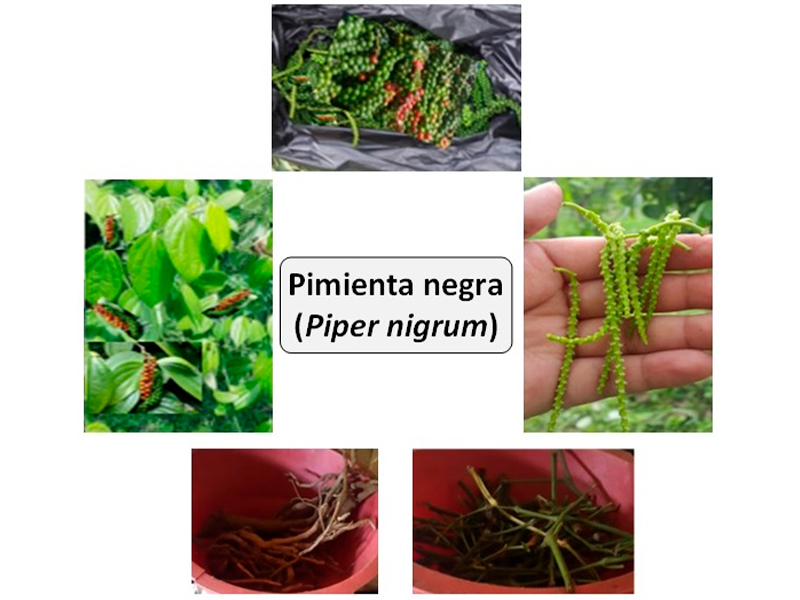
Absorción de nutrientes de la pimienta negra (Piper nigrum) al inicio de su producción
DOI:
https://doi.org/10.18779/cyt.v18i2.913Palavras-chave:
Nutrición vegetal, cultivo, cosecha, órganos vegetalesResumo
La absorción de nutrientes por el cultivo de pimienta negra (Piper nigrum) es fundamental para estimar su demanda nutricional y diseñar planes de fertilización eficientes. Este estudio evaluó la absorción de nutrientes en diferentes órganos de la planta al inicio de su producción (1,5 años) en un cultivo ubicado en la parroquia Valle Hermoso, Santo Domingo de los Tsáchilas, Ecuador. Se empleó el diseño completamente al azar simple, utilizando la prueba de Di Rienzo, Guzman y Casanoves para comparar medias (a = 0,05). Los tratamientos incluyeron los órganos de la planta, los macronutrientes y los micronutrientes, con tres repeticiones por tratamiento. Los principales resultados revelaron que hojas presentaron los mayores contenidos de nitrógeno, potasio y calcio (2,86 ± 0,18 a 3,14 ± 0,26 dag kg-1), mientras que las raíces tuvieron más de boro, zinc, cobre y hierro. De igual forma, las hojas acumularon la mayor cantidad de nitrógeno, calcio y azufre (1,00 ± 0,32 a 40,5 ± 3,1 kg ha-1), así como de boro, zinc y manganeso (32,6 ± 3,9 a 217,1 ± 21,5 g ha-1). La absorción de los macronutrientes por el cultivo siguió el orden nitrógeno = potasio = calcio > magnesio > fósforo = azufre, mientras que para los micronutrientes fue hierro > manganeso > zinc > boro > cobre. Estos resultados son relevantes para diseñar planes de fertilización que optimicen la disponibilidad y absorción de nutrientes en el cultivo de pimienta negra en su etapa inicial de producción.
Downloads
Referências
Abd-Hamid, I., Wan-Yahaya, W., y Idris, W. (2023). Effect of different black pepper crop ages on the availability of nitrogen, phosphorus, and potassium. AGRIVITA Journal of Agricultural Science, 45(1), 1-10. https://doi.org/10.17503/agrivita.v45i1.2618
Boniche, J., Alvarado, A., Molina, E. y Smyth, T. (2007). Variación estacional de nutrimentos en hojas de pejibaye para palmito en Costa Rica. Agronomía Costarricense, 32(1), 55-72. https://doi.org/10.15517/rac.v32i1.6770
Bortolon, L., Oliveira, E. S., De Camargo, F. P., Seraglio, N. A., Lima, A. O., Rocha, P. H., De Souza, J. P., Sousa, W. C., Tomazzi, M., Lago, B. C., Nicolodi, M. y Gianello, C. (2018). Yield and nutrient uptake of soybean cultivars under intensive cropping systems. Journal of Agricultural Science, 10(12), 344-357. https://doi.org/10.5539/jas.v10n12p344
Cordeiro, C. F., Galdi, L. V., y Echer, F. R. (2025). Nutrient uptake and removal by runner peanut cultivars of different maturity groups. Revista Brasileira de Ciência Do Solo, 49, 1-18. https://doi.org/10.36783/18069657rbcs20240088
Dalazen, J., Pereira, G., Duarte, H., Cochicho, J., Lacerda, V., Romão, W. y Luiz, F. (2022a). Nutrient accumulation in fruits and grains of black pepper at different ripening stages. Ciência Rural, 52(9), 1-9. http://doi.org/10.1590/0103-8478cr20210470
Dalazen, J., Pereira, G., Gontijo, I., Machado, J., y Partelli, F. (2022b). Micronutrient content and accumulation in leaves and bunches of black pepper during two crop cycles. Revista Ceres, 65(5), 594-602. https://doi.org/10.1590/0034-737X202269050013
De Mello, R. (2021). Mineral nutrition of tropical plants. Springer. https://doi.org/10.1007/978-3-030-71262-4
Di Rienzo, J. A., Guzman, A. W. y Casanoves, F. (2002). A multiple-comparisons method based on the distribution of the root node distance of a binary tree. Journal of Agricultural, Biological, and Environmental Stastistics, 7, 129-142. https://doi.org/10.1198/10857110260141193
Dombroskie, S. L., Tracey, A. J., y Aarssen, L. W. (2016). Leafing intensity and the fruit size/number trade-off in woody angiosperms. Journal of Ecology, 104(6), 1759-1767. https://doi.org/10.1111/1365-2745.12622
Flis, S. (2019). Calcium: Improved plant health and nutrition through 4R management. Crops & Soils, 52(4), 28-30. https://doi.org/10.2134/cs2019.52.0401
Hernández-Leal, O. F., y Sánchez, F. (2021). Black pepper’s essential oils affect the foraging behavior of Seba’s fruit-eating bat. International Journal of Pest Management, 69(4), 299-305. https://doi.org/10.1080/09670874.2021.1918355
Instituto Nacional de Meteorología e Hidrología. (2017). Anuario meteorológico No. 53-2013. https://lc.cx/a5_aoE
Issukindarsyah, I., Sulistyaningsih, E., Indradewa, D. y Putra, E.T.S. (2021). The effect of ammonium nitrate ratio and support types on the NPK uptake and growth of black pepper (Piper nigrum L.) in field conditions. Poljoprivreda, 27(2), 25-33. https://doi.org/10.18047/poljo.27.2.3
Li, Y.-M., Elson, M., Zhang, D., He, Z., Sicher, R. C. y Baligar, V. (2015). Macro and micro nutrient uptake parameters and use efficiency in cacao genotypes as influenced by levels of soil applied K. International Journal of Plant & Soil Science, 7(2), 80-90. https://doi.org/10.9734/IJPSS/2015/17368
Magalhães, D. D., Viégas, I. D., Barata, H. D., Costa, M. G., Silva, B. C. y Mera, W. Y. (2023). Deficiencies of nitrogen, calcium, and micronutrients are the most limiting factors for growth and yield of smell pepper plants. Revista Ceres, 70(3), 125-135. https://doi.org/10.1590/0034-737x202370030013
Mailappa, A. S. (2024). Experimental soil biology and fertility (1ra ed.). CRC Press. https://doi.org/10.1201/9781003430100
Muñoz, J., Huerta, M., Lara, A., Rangel, R. y De la Rosa, J. (2016). Producción de materia seca de forrajes en condiciones de Trópico Húmedo en México. Revista Mexicana de Ciencias Agrícolas, 16, 3329-3341. https://doi.org/10.29312/remexca.v0i16.400
Nair, K. P. (2022). Precise quantification of plant nutrient bioavailability: The relevance of the nutrient buffer power concept. Advances in Agronomy (174), 189-233. Academic Press. https://doi.org/10.1016/bs.agron.2022.03.003
Paduit, N., Pampolino, P., Aye, T. M. y Oberthür, T. (2018). Nutrient uptake and distribution in black pepper. Better Crops, 102(4), 24-27. https://lc.cx/u2iK1a
Pereira, M. L., Aquino, L., Ferreira, R., Clemente, J., De Aquino, P. y Oliveira, T. (2016). Diagnosis of the nutritional status of garlic crops. Revista Brasileira de Ciência do Solo, 40, 1-14. https://doi.org/10.1590/18069657rbcs20140771
Quezada-Crespo, C. J., Carrillo-Zenteno, M. D., Morales-Intriago, F. L., y Carrillo-Alvarado, R. A. (2017). Nutrient critical levels and availability in soils cultivated with peach palm (Bactris gasipaes Kunth.) in Santo Domingo de Los Tsáchilas, Ecuador. Acta Agronómica, 66(2), 235-240. https://lc.cx/-gQj6Q
Resmi, P., y Divya, K. K. (2024). Variability analysis in genotypes of black pepper (Piper nigrum L.) for yield and yield related traits. Plant Science Today, 11(sp3), 25-29. https://lc.cx/03uHUt
Swarnapriya, R. (2020). Effect of spacing and application of foliar nutrients on growth and yield of black pepper (Piper nigrum). Journal of Dry Zone Agriculture, 6(1), 52-62. https://lc.cx/vmhTUZ
Tran, D. M., Nguyen, T. H., Huynh, T. U., Do, T. O., Nguyen, Q.-V., y Nguyen, A. D. (2022). Analysis of endophytic microbiome dataset from roots of black pepper (Piper nigrum L.) cultivated in the Central Highlands region, Vietnam using 16S rRNA gene metagenomic next-generation sequencing. Data in Brief, 42, 1-7. https://doi.org/10.1016/j.dib.2022.108108
Tucuch-Haas, C., Pérez-Balam, J., Dzib-Ek, M., Alcántar-González, G. y Larqué-Saavedra, A. (2019). El ácido salicílico aumenta la acumulación de macro y micronutrientes en chile habanero. Revista Mexicana de Ciencias Agrícolas, 10(4), 839-847. https://doi.org/10.29312/remexca.v10i4.1694
Turiello, P., Larriestra, A., Bargo, F., Relling, A., y Weiss, W. (2018). Sources of variation in corn silage and total mixed rations of commercial dairy farms. The Professional Animal Scientist, 34(2), 148-155. https://doi.org/10.15232/pas.2017-01704
Wendling, A., Foletto, F. L., Cubilla, M. M., Carneiro, T. J. y Mielniczuk, J. (2008). Recomendação de adubação potássica para trigo, milho e soja sob sistema plantio direto no Paraguai. Revista Brasileira de Ciência do Solo, 32(5), 1929-1939. https://doi.org/10.1590/S0100-06832008000500014
Yap, C. A. (2012). Determination of nutrient uptake characteristic of black pepper (Piper nigrum L.). Journal of Agricultural Science and Technology B, 2, 1091-1099. https://lc.cx/jTrzCB
Zhang, J., Lv, J., Dawuda, M. M., Xie, J., Yu, J., Li, J., Zhang, X., Tang, C., Wang, C., y Gan, Y. (2019). Appropriate ammonium-nitrate ratio improves nutrient accumulation and fruit quality in pepper (Capsicum annuum L.). Agronomy, 9(11), 1-21. https://doi.org/10.3390/agronomy9110683
Zu, C., Li, Z., Yang, J., Yu, H., Sun, Y., Tang, H., Yost, R. y Wu, H. (2014). Acid soil is associated with reduced yield, root growth and nutrient uptake in black pepper (Piper nigrum L.). Agricultural Sciences, 5(5), 466-473. http://dx.doi.org/10.4236/as.2014.55047
Publicado
Como Citar
Edição
Seção
Licença
Copyright (c) 2025 Rodrigo Alberto Saquicela Rojas, Liliana Lisbeth Zúñiga Sánchez, Olga Benigna Pérez Chamorro

Este trabalho está licenciado sob uma licença Creative Commons Attribution-NonCommercial-ShareAlike 4.0 International License.
Contrato de Licenciamento
Este jornal oferece acesso gratuito ao seu conteúdo por meio de seu site, seguindo o princípio de que disponibilizar pesquisas gratuitamente ao público promove uma grande mudança no conhecimento global.
O conteúdo do site do jornal é distribuído sob a licença Atribuição-NãoComercial-CompartilhaIgual 4.0 Internacional.
Os autores podem adotar outros acordos de licenciamento não exclusivos para a distribuição da versão publicada de seu trabalho, desde que a publicação inicial seja indicada neste periódico. É permitido e recomendado que os autores divulguem seus trabalhos na Internet antes e durante o processo de submissão, ou que possam gerar mudanças interessantes e aumentar as citações dos trabalhos publicados.