Behavior of egg production in generations of Turquino hens from eggs classified as "not suitable" for incubation
DOI:
https://doi.org/10.18779/cyt.v19i1.906Keywords:
generation, incubation, persistence, laying peakAbstract
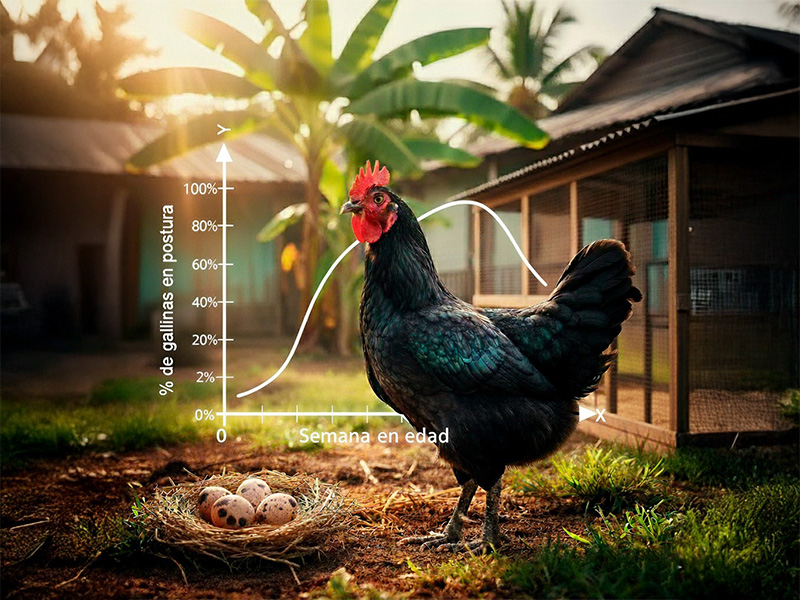
To demonstrate that second-generation Turquino pullets, derived from "non-standard" eggs, had similar performance to their progenitors (first generation) in egg production, a study was conducted with 2,000 pullets (1,000 for each treatment under study, from the incubation of "non-standard" eggs) from Unit #33 Antonio Maceo of the National Poultry Combine Companies (UECAN). A completely randomized design was used to evaluate the treatments, and correlations were established between different statistics to analyze relationships between variables: onset of laying (5 %), peak of laying, percentage of egg production at the peak of laying, and persistence of egg production. The animals were reared on the floor throughout the experiment (39 weeks). Regression equations for the studied curves were obtained using Curve Expert 1.3. The relationship of the egg production curves was established for each generation using a 6th-degree polynomial. The Chi-square test evaluated the independence or association between the variables used. The second-generation pullets showed similar productive performance to their first-generation progenitors, demonstrating the potential use of these eggs in the production of Turquino hens in Cuba. The similarity in egg production in the second generation was comparable to the first generation and the established typical curve. IBM SPSS Statistics version 24 – 2016 was used.
Downloads
References
Ajakaiye, J., Pérez, A., y Mollineda, Á. (2011). Efectos de la alta temperatura sobre la producción en gallinas ponedoras suplementadas con vitaminas C y E. Revista MVZ Córdoba, 16(1). https://doi.org/10.21897/rmvz.286
Báez Quiñones, N., y Oramas Santos, O. (2018). El enfoque de cadenas de valor: una necesidad en el sector avícola cubano. Economía y Desarrollo, 159(1). https://revistas.uh.cu/econdesarrollo/article/view/2009
Bain, M. M., Nys, Y., y Dunn, I. C. (2016). Increasing persistency in lay and stabilising egg quality in longer laying cycles. What are the challenges? British Poultry Science, 57(3), 330–338. https://doi.org/10.1080/00071668.2016.1161727
Barrios Castellanos, R., Soca Pérez, M., y Vale Cañizares, A. (2012). Comportamiento de la incubabilidad y fertilidad, de tres líneas de gallinas semirústicas. REDVET. Revista Electrónica de Veterinaria, 13(4),1-9. https://www.redalyc.org/pdf/636/63623403004.pdf
Galeano V., L., Estrada P, M., Restrepo B, L., y Sorza Z, J. (2012). Respuesta productiva de gallinas semipesadas inducidas al descanso ovárico en diferentes edades. Revista MVZ Córdoba, 17(3), 3200-3208. https://doi.org/10.21897/rmvz.221
Gispert Muñoz, A. C., Pedraza Olivera, R. M., Vázquez Montes de Oca, R., y Bidot Fernández, A. I. (2019). Características generales de sistemas familiares de producción caprina del municipio Camagüey, Cuba. Revista de Producción Animal, 31(3). http://scielo.sld.cu/scielo.php?script=sci_arttext&pid=S2224-79202019000300088
Gómez-Cuello, J. E., Fraga Benítez, L. M., Pedraza Olivera, R. M., Vázquez Montes de Oca, R., Guerra, L. D., y Valdivié Navarro, M. (2017). Modelación de curvas de puesta de los tres últimos años en gallinas White Leghorn en la provincia Ciego de Ávila. Rev. prod. anim., 29(2), 42–49. http://scielo.sld.cu/pdf/rpa/v29n2/rpa06217.pdf
Guerra, L., Pardo, C. G., Pedraza, C. R., Padilla, O., y Uña, F. (2009). Potencial incubatorio de diferentes tipos de huevos procedentes de reproductoras ligeras White Leghorn clasificados como defectuosos por su forma y peso. Revista Cubana de Ciencia Avícola, 33(1), 31–35. https://dialnet.unirioja.es/servlet/articulo?codigo=3330078
Madrigal-Portilla, J., Salas-Durán, C., y Macaya-Quirós, S. (2023). Effect of temperature and storage time on hen egg quality, Agronomía Mesoamericana, 34(2). https://doi.org/10.15517/am.v34i2.51223
Nguyen, T. K., Nguyen, L. T., Chau, T. T. H., Nguyen, T. T., Tran, B. N., Taniguchi, T., Hayashidani, H., y Ly, K. T. L. (2021). Prevalence and antibiotic resistance of Salmonella isolated from poultry and its environment in the Mekong Delta, Vietnam. Veterinary World, 14(12), 3216–3223. https://doi.org/10.14202/vetworld.2021.3216-3223
Romera, B. M., Canet, Z. E., Fernández, R., Dottavio, A. M., y Di Masso, R. J. (2022). Peso corporal y peso del huevo de Campero Casilda como gallina doble propósito. Revista de Producción Animal, 34(1). http://scielo.sld.cu/scielo.php?script=sci_arttext&pid=S2224-79202022000100025
Rosabal Nava, O., Martínez Aguilar, Y., Rodríguez Bertot, R., Pupo Torres, G., Olmo González, C., y Más Toro, D. (2017). Efecto de la suplementación dietética del polvo de hojas de Anacardium occidentale L. (marañón) en la producción y calidad del huevo de gallinas ponedoras. Revista Cubana de Plantas Medicinales, 22(1). http://scielo.sld.cu/scielo.php?script=sci_arttext&pid=S1028-47962017000100006
Vargas-Hidalgo, J. S., Masaquiza-Moposita, D. A., y Ortiz-Naveda, N. R. (2021). Parámetros productivos en la incubación de huevos considerados como no aptos procedentes de reproductoras pesadas. Revista Arbitrada Interdisciplinaria Koinonía, 6(12), 488–503. https://doi.org/10.35381/r.k.v6i12.1371
Vidal, A. (2001). Guía de manejo del ave semirrústica. Instituto de Investigaciones Avícolas. La Habana, Cuba.
Vila Licea, M., Ravelo Adán, E., Pardo Cardoso, G., y Guevara Viera, R. (2008). Modelo de crianza de la gallina reproductora Turquino con seis meses de puesta. Revista Producción Animal, 20(1), 14–20. https://core.ac.uk/download/pdf/268092694.pdf
WingChing-Jones, R., Zamora Sanabria, R., y Chavarría-Zamora, S. (2023). Egg quality and productive performance of ISA Brown laying hens with grazing access, Agronomía Mesoamericana, 34(2), 51511. https://doi.org/10.15517/am.v34i2.51511
Published
How to Cite
Issue
Section
License
Copyright (c) 2026 Aimé Rosario Batista Casacó, Ana Ruth Álvarez Sánchez, Marlon Femando Monge-Freile

This work is licensed under a Creative Commons Attribution-NonCommercial-ShareAlike 4.0 International License.
Licensing Agreement
This journal provides free access to its content through its website following the principle that making research available free of charge to the public supports a larger exchange of global knowledge.
Web content of the journal is distributed under a Attribution-NonCommercial-ShareAlike 4.0 International.
Authors may adopt other non-exclusive license agreements for the distribution of the version of the published work, provided that the initial publication in this journal is indicated. Authors are allowed and recommended to disseminate their work through the internet before and during the submission process, which can produce interesting exchanges and increase citations of the published work.