Soil aggregate formation and carbon storage by endogeic earthworms in an Ultisol
DOI:
https://doi.org/10.18779/cyt.v18i2.846Keywords:
Bioturbation, soil organic carbon, organic matter, isotope, tropical soilsAbstract
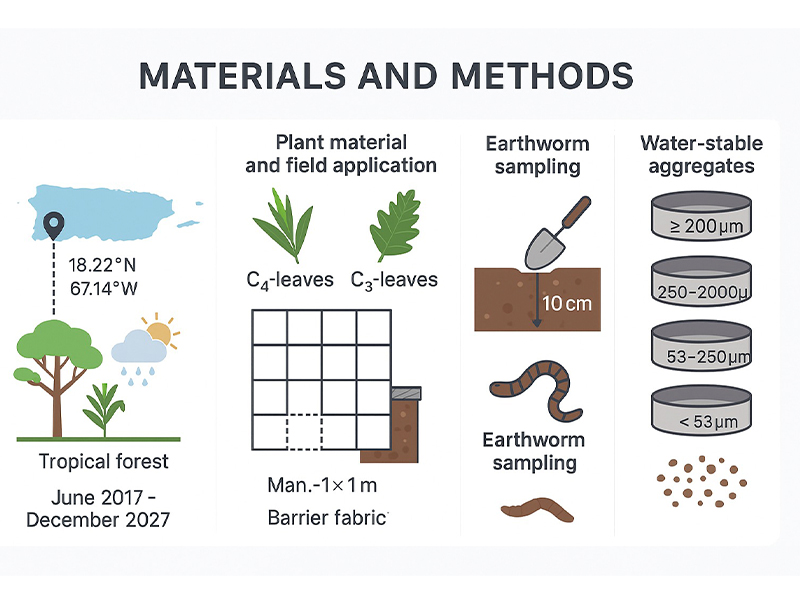
The role of soil micro and macro-organism in the incorporation of carbon to soil aggregates of tropical soils has been understudied. To test soil aggregate formation and carbon incorporation by earthworm activity, we conducted a field experiment within a secondary forest and a microcosm experiment at the University of Puerto Rico in Mayagüez. We used 13C natural abundance in vegetation and the difference in 13C between C3 and C4 plants to track carbon sources in the soil. Maize leaves were utilized to trace the incorporation of C4 carbon within soil aggregates, allowing for a clear distinction between this carbon source and the C3 carbon derived from forest vegetation. Earthworms and soil samples (Typic Haplohumults) were collected at 0-10 cm soil depth. Aggregates size classes were separated by the wet sieving method. In the study site, two earthworm species were found belonging to epigeic and endogeic ecological categories. In a period of 6 months, our field data suggests that endogeic P. corethrurus can reorganize small macroaggregates to form large macroaggregates. Our results suggest that P. corethrurus shows a preference for consuming soil-derived carbon and can translocate it from microaggregates to macroaggregates by restructuring soil aggregates.
Downloads
References
Aira, M., Sampedro, L., Monroy, F. y Domínguez, J. (2008). Detritivorous earthworms directly modify the structure, thus altering the functioning of a microdecomposer food web. Soil Biology and Biochemistry, 40(10), 2511–2516. https://doi.org/10.1016/j.soilbio.2008.06.010
Amador, J. A., Winiarski, K. y Sotomayor-Ramírez, D. (2013). Earthworm communities along a forest-coffee agroecosystem gradient: Preliminary evidence supporting the habitat-dependent feeding hypothesis. Tropical Ecology, 54(3), 365–374.
Aira, M., Sampedro, L., Monroy, F. y Domínguez, J. (2008). Detritivorous earthworms directly modify the structure, thus altering the functioning of a microdecomposer food web. Soil Biology and Biochemistry, 40(10), 2511–2516. https://doi.org/10.1016/j.soilbio.2008.06.010
Amador, J. A., Winiarski, K. y Sotomayor-Ramírez, D. (2013). Earthworm communities along a forest-coffee agroecosystem gradient: Preliminary evidence supporting the habitat-dependent feeding hypothesis. Tropical Ecology, 54(3), 365–374.
Barois, I., Villemin, G., Lavelle, P. y Toutain, F. (1993). Transformation of the soil structure through Pontoscolex corethrurus (Oligochaeta) intestinal tract. Geoderma, 56(1–4), 57–66. https://doi.org/10.1016/0016-7061(93)90100-Y
Beinroth, F. H., Engel, R., Lugo, J., Santiago, C., Ríos, S. y Brannon, G. (2002). Updated taxonomic classification of soils of Puerto Rico (Bull. 303). Agricultural Experiment Station.
Blanchart, E., Albrecht, A., Brown, G., Decaens, T., Duboisset, A., Lavelle, P., Mariani, L. y Roose, E. (2004). Effects of tropical endogeic earthworms on soil erosion. Agriculture, Ecosystems y Environment, 104(2), 303–315. https://doi.org/10.1016/j.agee.2004.01.031
Blanchart, E., Lavelle, P., Braudeau, E., le Bissonnais, Y. y Valentin, C. (1997). Regulation of soil structure by geophagous earthworm activities in humid savannas of Cote d’Ivoire. Soil Biology and Biochemistry, 29(3–4), 431–439. https://doi.org/10.1016/S0038-0717(96)00042-9
Borges, S. (1996). The Terrestrial Oligochaetes of Puerto Rico. Annals of the New York Academy of Sciences, 776, 239–248. https://doi.org/10.1111/j.1749-6632.1996.tb17423.x
Bossuyt, H., Six, J. y Hendrix, P. F. (2004). Rapid incorporation of carbon from fresh residues into newly formed stable microaggregates within earthworm casts. European Journal of Soil Science, 55(2), 393–399. https://doi.org/10.1111/j.1351-0754.2004.00603.x
Bossuyt, H., Six, J. y Hendrix, P. F. (2005). Protection of soil carbon by microaggregates within earthworm casts. Soil Biology y Biochemistry, 37(2), 251–258. https://doi.org/10.1016/j.soilbio.2004.07.035
Bossuyt, H., Six, J. y Hendrix, P. F. (2006). Interactive effects of functionally different earthworm species on aggregation and incorporation and decomposition of newly added residue carbon. Geoderma, 130(1–2), 14–25. https://doi.org/10.1016/j.geoderma.2005.01.005
Dechaine, J., Ruan, H., Sánchez-de León, Y. y Zou, X. (2005). Correlation between earthworms and plant litter decomposition in a tropical wet forest of Puerto Rico. Pedobiologia, 49(6), 601–607. https://doi.org/10.1016/j.pedobi.2005.07.006
Elliott, E. T. (1986). Aggregate Structure and Carbon, Nitrogen, and Phosphorus in Native and Cultivated Soils. Soil Sci .Soc.Am.J., 50(3), 627–633. https://lc.cx/2XBoDq
Fonte, S. J., Kong, A. Y. Y., van Kessel, C., Hendrix, P. F. y Six, J. (2007). Influence of earthworm activity on aggregate-associated carbon and nitrogen dynamics differs with agroecosystem management. Soil Biology and Biochemistry, 39(5), 1014–1022. https://doi.org/10.1016/j.soilbio.2006.11.011
Fonte, S. J., Winsome, T. y Six, J. (2009). Earthworm populations in relation to soil organic matter dynamics and management in California tomato cropping systems. Applied Soil Ecology, 41(2), 206–214. https://doi.org/10.1016/j.apsoil.2008.10.010
González, G., García, E., Cruz, V., Borges, S., Zalamea, M. y Rivera, M. M. (2007). Earthworm communities along an elevation gradient in Northeastern Puerto Rico. European Journal of Soil Biology, 43(SUPPL. 1). https://doi.org/10.1016/j.ejsobi.2007.08.044
González, G. y Zou, X. (1999). Plant and Litter Influences on Earthworm Abundance and Community Structure in a Tropical Wet Forest. Biotropica, 31(3), 486–493. https://www.jstor.org/stable/2663944
Harmsen, E. W., Goyal, M. R. y Torres-Justiniano, S. (2002). Estimating evapotranspiration in Puerto Rico. Journal of Agriculture of the University of Puerto Rico, 86(1–2), 35–54. https://revistas.upr.edu/index.php/jaupr/article/view/3182
Hendrix, P. F., Lachnicht, S. L., Callaham, M. A. y Zou, X. (1999). Stable isotopic studies of earthworm feeding ecology in tropical ecosystems of Puerto Rico. Rapid Communications in Mass Spectrometry, 13(13), 1295–1299. https://doi.org/10.1002/(SICI)1097-0231(19990715)13:13<1295::AID-RCM605>3.0.CO;2-9
Hubers, H., Borges, S. y Alfaro, M. (2003). The oligochaetofauna of the Nipe soils in the Maricao State Forest, Puerto Rico : The 7th international symposium on earthworm ecology · Cardiff · Wales · 2002. Pedobiologia, 47(5–6), 475–478. https://doi.org/10.1078/0031-4056-00216
Jackson, M. L. (2005). Soil Chemical Analysis – Advance Course. https://books.google.com.ec/books?id=VcEOK9QCkVEC&hl=es-419
Jarvis, S., Tisdall, J., Oades, J. M., Six, J., Gregorich, E. y Kögel-Knabner, I. (2012). Landmark papers. European Journal of Soil Science, 63(1), 1–21. https://doi.org/10.1111/j.1365-2389.2011.01408.x
Jastrow, J. D., Boutton, T. y Miller, R. M. (1996). Carbon dynamics of aggregate – associated organic matter estimated by carbon – 13 natural abundance. Soil Sci. Soc. Am. J., 60(3), 801–807. https://doi.org/10.2136/sssaj1996.03615995006000030017x
Jastrow, J. D., Miller, R. M., Matamala, R., Norby, R. J., Boutton, T. W., Rice, C. W. y Owensby, C. E. (2005). Elevated atmospheric carbon dioxide increases soil carbon. Global Change Biology, 11(12), 2057–2064. https://doi.org/10.1111/j.1365-2486.2005.01077.x
Kamau, S., Barrios, E., Karanja, N. K., Ayuke, F. O. y Lehmann, J. (2020). Dominant tree species and earthworms affect soil aggregation and carbon content along a soil degradation gradient in an agricultural landscape. Geoderma, 359. https://doi.org/10.1016/j.geoderma.2019.113983
Lachnicht, S. L., Hendrix, P. F. y Zou, X. (2002). Interactive effects of native and exotic earthworms on resource use and nutrient mineralization in a tropical wet forest soil of Puerto Rico. Biology and Fertility of Soils, 36(1), 43–52. https://doi.org/10.1007/s00374-002-0501-5
Lavelle, P., Blanchart, E., Martin, A., Spain, A. V. y Martin, S. (1992). Impact of Soil Fauna on the properties of Soils in the Humid Tropics. In Myths and Science of Soils of the Tropics. SSSA Spe- cial Publication. (Vol. 29, pp. 29). https://doi.org/10.2136/sssaspecpub29.c9
Le Couteulx, A., Wolf, C., Hallaire, V. y Pérès, G. (2015). Burrowing and casting activities of three endogeic earthworm species affected by organic matter location. Pedobiologia, 58(2–3), 97–103. https://doi.org/10.1016/j.pedobi.2015.04.004
Liu, Z. y Zou, X. (2002). Exotic earthworms accelerate plant litter decomposition in a wet forest. Ecological Applications, 12(5), 1406–1417. https://doi.org/https://doi.org/10.1890/1051-0761(2002)012[1406:EEAPLD]2.0.CO;2
Oades, J. M. (1993). The role of biology in the formation, stabilization and degradation of soil structure. Geoderma, 56(1–4), 377–400. https://doi.org/10.1016/0016-7061(93)90123-3
Oades, J. M. y Waters, A. G. (1991). Aggregate hierarchy in soils. Australian Journal of Soil Research, 29(6), 815–825. https://doi.org/10.1071/SR9910815
O’Leary, M. H. (1981). Carbon isotope fractionation in plants. Phytochemistry, 20(4), 553–567. https://doi.org/10.1016/0031-9422(81)85134-5
Paul, E. A., Harris, D., Collins, H. P., Schulthess, U. y Robertson, G. P. (1999). Evolution of CO2 and soil carbon dynamics in biologically managed, row-crop agroecosystems. Applied Soil Ecology, 11(1), 53–65. https://doi.org/10.1016/S0929-1393(98)00130-9
Paul, S., Flessa, H., Veldkamp, E. y López-Ulloa, M. (2008). Stabilization of recent soil carbon in the humid tropics following land use changes: Evidence from aggregate fractionation and stable isotope analyses. Biogeochemistry, 87(3), 247–263. https://doi.org/10.1007/s10533-008-9182-y
Phillips, D. L. y Gregg, J. W. (2001). Uncertainty in source partitioning using stable isotopes. Oecologia, 127(2), 171–179. https://doi.org/10.1007/s004420000578
Pulleman, M. M., Six, J., Uyl, A., Marinissen, J. C. Y. y Jongmans, A. G. (2005). Earthworms and management affect organic matter incorporation and microaggregate formation in agricultural soils. Applied Soil Ecology, 29(1), 1–15. https://doi.org/10.1016/j.apsoil.2004.10.003
Ravalo, E. J., Goyal, M. R. y Almodóvar, C. R. (1986). Average Monthly and Annual Rainfall Distribution in Puerto Rico. The Journal of Agriculture of the University of Puerto Rico, 70(4), 267–275. https://revistas.upr.edu/index.php/jaupr/article/view/7103
Sánchez-de León, Y., Lugo-Pérez, J., Wise, D. H., Jastrow, J. D. y González-Meler, M. A. (2014). Aggregate formation and carbon sequestration by earthworms in soil from a temperate forest exposed to elevated atmospheric CO2: A microcosm experiment. Soil Biology and Biochemistry, 68, 223–230. https://doi.org/10.1016/j.soilbio.2013.09.023
Sánchez-de León, Y., Wise, D. H., Lugo-Pérez, J., Norby, R. J., James, S. W. y Gonzalez-Meler, M. A. (2018). Endogeic earthworm densities increase in response to higher fine-root production in a forest exposed to elevated CO2. Soil Biology and Biochemistry, 122, 31–38. https://doi.org/10.1016/j.soilbio.2018.03.027
Sánchez-de León, Y., Zou, X. y Borges, S. (2003). Recovery of Native Earthworms in Abandoned Tropical Pastures. 17(4), 999–1006.
SAS Institute Inc. (2015). Introduction to Mixed Modeling Procedures. SAS/STAT 9.2 User’s Guide, Chapter 6, 116–125.
Schmidt, O. (1999). Intrapopulation variation in carbon and nitrogen stable isotope ratios in the earthworm Aporrectodea longa. Ecological Research, 14(4), 317–328. https://doi.org/10.1046/j.1440-1703.1999.00310.x
Six, J., Conant, R. T. y Paustian, K. (2002). Stabilization mechanisms of soil organic matter: Implications for C-saturation of soils. Plant and Soil, 241, 155–176. https://doi.org/10.1023/A:1016125726789
Six, J., Elliott, E. T. y Paustian, K. (2000). Soil macroaggregate turnover and microaggregate formation: A mechanism for C sequestration under no-tillage agriculture. Soil Biology and Biochemistry, 32(14), 2099–2103. https://doi.org/10.1016/S0038-0717(00)00179-6
Six, J., Elliott, E. T., Paustian, K. y Doran, J. W. (1998). Aggregation and soil organic matter accumulation in cultivated and native grassland soils. Soil Science Society of America Journal, 62(5), 1367-1377. https://doi.org/10.2136/sssaj1998.03615995006200050032x
Six, J. y Paustian, K. (2014). Aggregate-associated soil organic matter as an ecosystem property and a measurement tool. Soil Biology and Biochemistry, 68, A4-A9. https://doi.org/10.1016/j.soilbio.2013.06.014
Soil Survey Staff. (2014). Keys to soil taxonomy. Soil Conservation Service, 12, 410.
Tisdall, J. M. y Oades, J. M. (1982). Organic matter and water-stable aggregates in soils. Journal of Soil Science, 33(2), 141–163. https://doi.org/10.1111/j.1365-2389.1982.tb01755.x
Túa-Ayala, G. Z. (2013). Transformación de bosques noveles a sistemas agroforestales en la región húmeda de Puerto Rico: Pasos iniciales. [Master’s Thesis, University of Puerto Rico-Mayagüez]. Retrieved from https://hdl.handle.net/20.500.11801/3558
Whalen, J. K. y Janzen, H. H. (2002). Labeling earthworms uniformly with C-13 and N-15: implications for monitoring nutrient fluxes. Soil Biology and Biochemistry, 34(12), 1913–1918. https://doi.org/10.1016/S0038-0717(02)00207-9
Published
How to Cite
Issue
Section
License
Copyright (c) 2025 Mauricio Renato Morejón Centeno, Rocio Natividad Morejón Lucio, José Nolberto Macías Veliz

This work is licensed under a Creative Commons Attribution-NonCommercial-ShareAlike 4.0 International License.
Licensing Agreement
This journal provides free access to its content through its website following the principle that making research available free of charge to the public supports a larger exchange of global knowledge.
Web content of the journal is distributed under a Attribution-NonCommercial-ShareAlike 4.0 International.
Authors may adopt other non-exclusive license agreements for the distribution of the version of the published work, provided that the initial publication in this journal is indicated. Authors are allowed and recommended to disseminate their work through the internet before and during the submission process, which can produce interesting exchanges and increase citations of the published work.