Application of calcium sulfate to a soil with a high concentration of sodium of natural origin
DOI:
https://doi.org/10.18779/cyt.v16i2.549Keywords:
amendment, macroporosity, penetrability, exchangeable Na, calcium sulfateAbstract
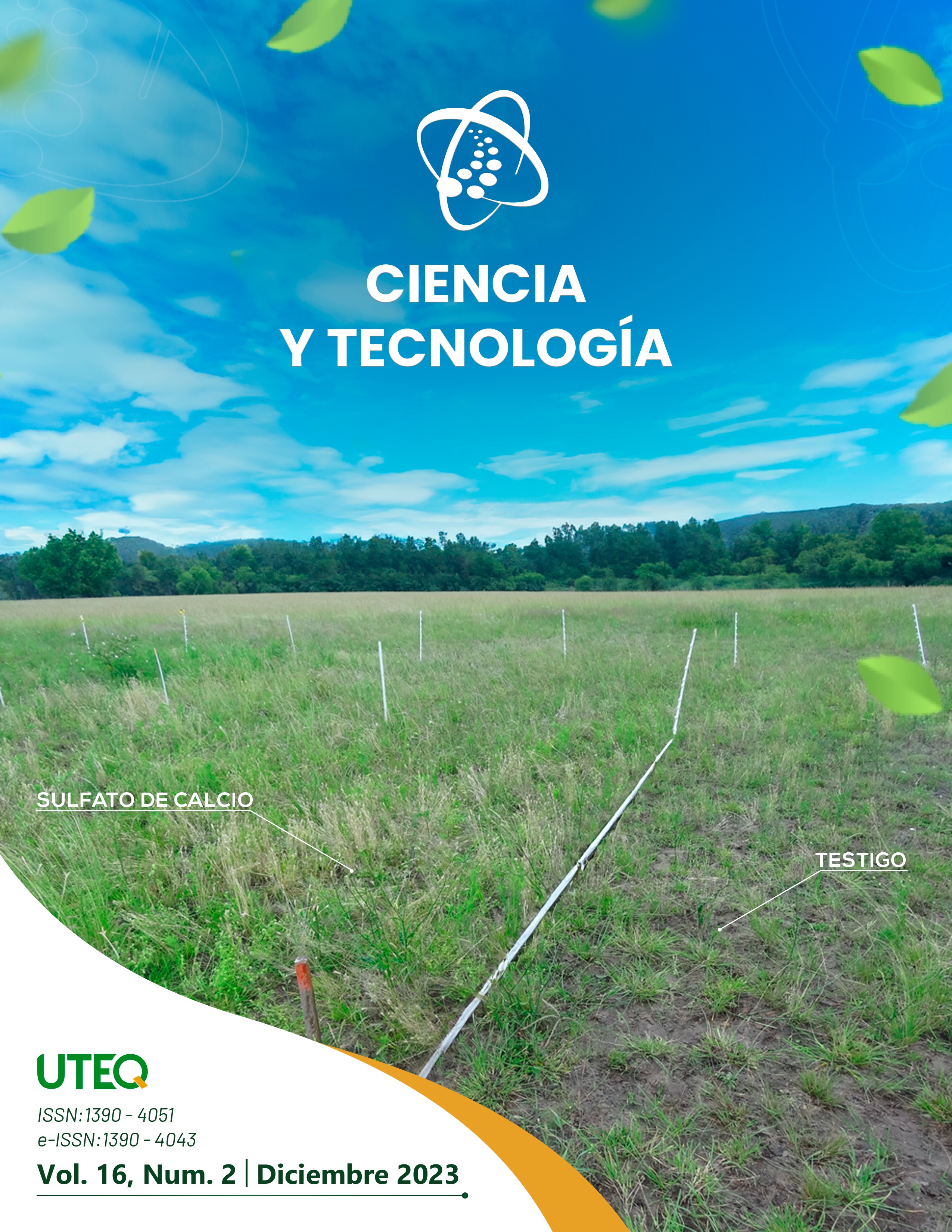
Soils with excess sodium of natural origin increase the concentration of exchangeable Na with depth. These soils are unproductive due loss of macroporosity and the negative effect on plant metabolism. Gypsum improves the properties by displacing excess Na by Ca. To evaluate the effect of gypsum on a soil with excess Na of natural origin and implanted pasture (Festuca arundinacea), was installed two contiguous experiments of plots arranged at random: Experiment 1, four doses (1, 2, 3, 0 Mg ha-1) of two gypsums; and Experiment 2, three doses (0, 0.6 Mg ha-1 of sulfur, 3 Mg ha-1 of three gypsums). After 420 days, in the plots of Experiment 1 where the amendment was applied, the exchangeable Na was reduced by 22% with a parallel increase of 10% of exchangeable Ca, presenting greater penetrability and soil moisture and around 50% higher yield from the pasture. Meanwhile, in Experiment 2 there were similar yields for the amendments, although the absorption of sulfur was 5 % higher by the pastures with gypsum. Concluded that agricultural gypsum is effective for reducing exchangeable Na in studied soil depth, an increasing yield and improving pasture quality. Due natural source of Na cannot be isolated, the effectiveness of the doses and sources of gypsum should be studied a long term.
Downloads
References
Alcaraz, F.J. (2012). Salinidad y Vegetación. Geobotánica: Universidad de Murcia. https://www.um.es/docencia/geobotanica/ficheros/tema18.pdf
Arévalo, E., Bonadeo, E., Lara, F., Amengual, C., Cerruti, A., y Milan C. (2009). Aplicación de calcio y magnesio sobre la producción de alfalfa en suelos “manchoneados” del centro de Córdoba. Argentina: Agromercado: cuadernillo clásico de forrajeras (149), 16 – 17. https://www.produccion-animal.com.ar/produccion_y_manejo_pasturas/pasturas_cultivadas_alfalfa/112-manchoneados_17.pdf
Armstrong, R.D., Eagle, C., y Flood, R. (2015). Improving grain yields on a sodic clay soil in a temperate, medium–rainfall cropping environment. Crop & Pasture Science,66, (5), 492 – 505. https://doi.org/10.1071/CP14210
Bandera, R. (2013). Rehabilitación de suelos salino – sódicos: evaluación de enmiendas y especies forrajeras [tesis de magister, Universidad de Buenos Aires]. http://hdl.handle.net/20.500.12123/5880
Bonadeo, E., Moreno, I., Baranda, A., y Milan, C. (2014). Changes in a sodic soil after gypsum application under dryland conditions. European Scientific Journal, 10 (27), 367 – 377. https://doi.org/10.19044/esj.2014.v10n27p%25p
Brady, N., y Weil, R. (2008). The Nature and Properties of Soils. New Jersey, Estados Unidos: Pearson Education INC.
Chi, C.M., Zhao, C.W., Sun, X.J., y Wang, Z.C. (2012). Reclamation of saline – sodic soil properties and improvement of rice (Oriza sativa L.) growth and yield using desulfurized gypsum in the west of Songnen Plain, northeast China. 2012. Geoderma, 187 – 188, 24 – 30. https://doi.org/10.1016/j.geoderma.2012.04.005
Costa, J.L., y Godz, P. (1999). Aplicación de yeso a un natracuol del sudeste de la pampa deprimida. Ciencia del Suelo, 17 (2), 21 – 27. http://suelos.org.ar/publicaciones/vol_17n2/costa_21-27.pdf
Durán, A., y García, F. (2007). Suelos del Uruguay. Origen, clasificación, manejo y conservación. Volumen I. Montevideo, Uruguay: Editorial Hemisferio Sur.
González, A.P. (Ed.). (2006). Bases para la Conservación de Suelos y Aguas en la Cuenca del Río Paraná. Santa Fe, Argentina: Universidad de Entre Ríos.
Imbellone, P.A., Giménez, J.E., y Panigatti, J.L. (2010). Suelos de la Región Pampeana: Procesos de formación. Buenos Aires, Argentina: Ediciones INTA. https://inta.gob.ar/documentos/suelos-de-la-region-pampeana.-procesos-de-formacion.
Khan, J.M., Jan, M.T., Khan, A.U., Arif, M., y Shafi, M. (2010). Management of saline sodic soils through cultural practices and gypsum. Pakistan Journal of Botany, 42 (6), 4143 – 4155. http://www.pakbs.org/pjbot/
Lebron, I., Suarez, D.L., y Yoshida, T. (2002). Gypsum effect on the aggregate size and geometry of three sodic soils under reclamation. Soil Science Society of American Journal, 66 (1), 92 – 98. https://doi.org/10.2136/sssaj2002.9200
Longo, A., Ferratto, J., Mondino, M., y Grasso, R. (2005). Incorporación de azufre y yeso en suelo salino – sódico: su efecto sobre el rendimiento y calidad de lechuga bajo invernadero. Revista FAVE – Ciencias Agrarias, 4 (1 –2), 31 -36. https://doi.org/10.14409/fa.v4i1/2.1311
Loveday, J. (1976). Relative significance of electrolyte and cation exchange effects when gypsum is applied to a sodic clay soil. Australian Journal of Soil Research, 14 (3), 361 – 371. https://doi.org/10.1071/SR9760361
Martínez-Villavicencio, N., López-Alonzo, C.V., Pérez-Leal, R., y Basurto-Sotelo, M. (2011). Efectos por salinidad en el desarrollo vegetativo. Tecnociencia Chihuahua, 5 (3), 156 – 161. https://vocero.uach.mx/index.php/tecnociencia/article/view/694
Milan, C., y Bonadeo, E. (2017). Efecto de la aplicación de yeso sobre la capacidad productiva de un suelo sódico de alta variabilidad espacial. Ciencia del Suelo (Argentina), 35 (2), 315 – 323. https://ojs.suelos.org.ar/index.php/cds
Polak, G. (2011). Agricultura de precisión para la corrección de ambientes con elevado valor de sodio intercambiable [Tesis de Especialista en Fertilidad de Suelos y Fertilización, Universidad de Buenos Aires]. http://repositoriouba.sisbi.uba.ar/
Provin, T.; Pitt, J.L. (2012). Managing soil salinity. Texas Agrilife Extensión Service Publication, E – 60 (5), 3 – 12. http://soiltesting.tamu.edu/publications/E-60.pdf
Rasouli, F., Pouya, A., y Karimi, N. (2013). Wheat yield and physico-chemical properties of a sodic soil from semi-arid area of Iran as affected by applied gypsum. Geoderma, 193 – 194, 246 – 255. https://doi.org/10.1016/j.geoderma.2012.10.001
Rengasamy, P., y Olsson, K.A. (1991). Sodicity and soil structure. Australian Journal of Soil Research, 29 (6), 935 – 952. https://doi.org/10.1071/SR9910935
Sahin, U., y Anapali, O. (2005). A laboratory study of effects of water dissolved gypsum application on hydraulic conductivity of saline – sodic soil under intermittent ponding conditions. Irish Journal of Agricultural and Food Research, 44 (2), 297 – 303. https://www.jstor.org/stable/25562554
Sharma, M.L. (1971). Physical and physico – chemical changes in the profile of a sodic soil treated with gypsum. Australian Journal of Soil Research, 9 (2), 73 – 82. https://doi.org/10.1071/SR9710073
Yazdanpanah, N., Pazira, E., Neshat, A., Mahmoodabadi, M., y Rodríguez, L. (2013). Reclamation of calcareous saline sodic soil with different amendments (II): Impact on nitrogen, phosphorous and potassium redistribution and on microbial respiration. Agricultural Water Management, 120, 39 – 45. https://doi.org/10.1016/j.agwat.2012.08.017
Published
How to Cite
Issue
Section
License
Copyright (c) 2023 Johana Ballestero, Monica Barbazán, Amabelia del Pino

This work is licensed under a Creative Commons Attribution-NonCommercial-ShareAlike 4.0 International License.
Licensing Agreement
This journal provides free access to its content through its website following the principle that making research available free of charge to the public supports a larger exchange of global knowledge.
Web content of the journal is distributed under a Attribution-NonCommercial-ShareAlike 4.0 International.
Authors may adopt other non-exclusive license agreements for the distribution of the version of the published work, provided that the initial publication in this journal is indicated. Authors are allowed and recommended to disseminate their work through the internet before and during the submission process, which can produce interesting exchanges and increase citations of the published work.