Forraje verde hidropónico de maíz (Zea mays) como alimentación de terneros: una revisión actualizada
DOI:
https://doi.org/10.18779/cyt.v19i2.1225Palabras clave:
nutrición de terneros, forraje hidropónico, digestibilidad, ganancia de peso, sostenibilidadResumen
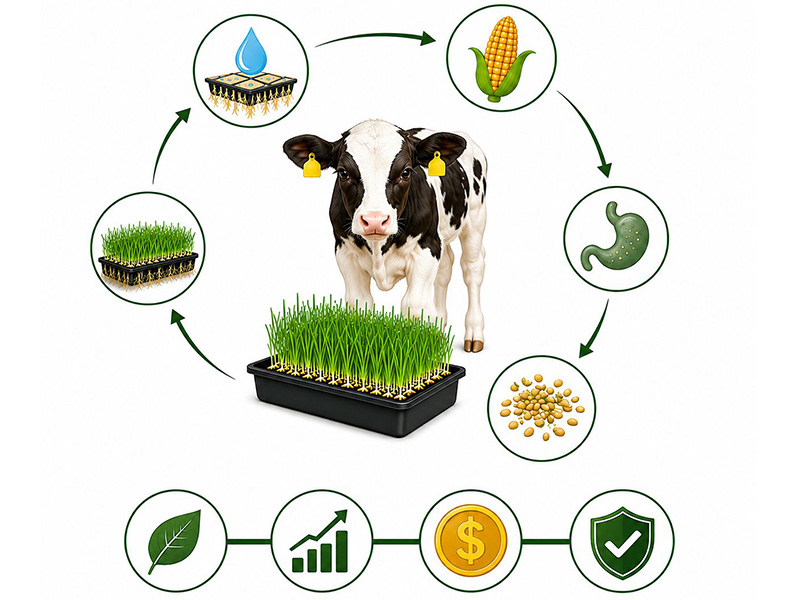
El forraje verde hidropónico (FVH) de maíz se ha planteado como una alternativa alimenticia de interés para terneros y bovinos jóvenes, sobre todo en sistemas donde la disponibilidad de forraje cambia por estacionalidad, costos de alimentación o limitaciones de tierra y agua. El objetivo de esta revisión fue sintetizar, de manera cualitativa, la evidencia publicada entre 2015 y 2025 sobre el uso de FVH de maíz en la alimentación de terneros, considerando variables nutricionales, productivas, metabólicas, económicas y de sostenibilidad. Se empleó una revisión narrativa estructurada con elementos adaptados de PRISMA 2020. La búsqueda consideró bases académicas como Scopus, PubMed, Web of Science y Google Scholar, además de registros complementarios identificados durante la depuración bibliográfica. Se priorizaron estudios experimentales y revisiones relacionadas con FVH de maíz en terneros, búfalos jóvenes, bovinos jóvenes o terneras, excluyendo literatura gris y documentos sin relación directa con la temática. Los resultados muestran que el FVH de maíz puede mejorar la digestibilidad, el aprovechamiento de nutrientes, la ganancia de peso y la eficiencia alimenticia cuando se usa como sustituto parcial de concentrados o forrajes convencionales. También se identifican aportes en parámetros ruminales, metabolitos sanguíneos y costos de alimentación. Sin embargo, la evidencia sigue siendo heterogénea y limitada en evaluaciones ambientales y de largo plazo. Se concluye que el FVH de maíz es una alternativa prometedora, pero requiere mayor estandarización experimental y análisis integrales para recomendar su adopción en sistemas ganaderos de pequeña escala.
Descargas
Citas
Alders, R. G. (2025). The broader symbiotic relationships between animals and humans in low-, middle- and high-income countries. Proceedings of the Nutrition Society, 1–4. https://doi.org/10.1017/S0029665125101201.
Arif, M., Khalaf, Q. A. W., Rehman, A. U., Hussain, S. M., Almohmadi, N. H., Al-Baqami, N. M., Abd El-Hack, M. E., Kamal, M., Tharwat, M., y Swelum, A. A. (2023). Effects of feeding maize hydroponic fodder on growth performance, nitrogen balance, nutrient digestibility, hematology and blood metabolites of water buffalo calves. Open Veterinary Journal, 13(12), 1607–1613. https://doi.org/10.5455/OVJ.2023.v13.i12.10.
Benu, I., Jelantik, I. G. N., Penu, C. L., y Laut, M. M. (2024). Effect of replacing grass silage with hydroponic maize fodder on nutrient intake and digestibility, rumen parameters and blood metabolites of weaned Ongole × Brahman calves. Jurnal Ilmu Ternak dan Veteriner, 29(1), 36–44. https://doi.org/10.14334/jitv.v29i1.3331.
Castillo, C. I., Llantada, P. L. T., Baltazar, C. P., Uy-De Guia, M. R., Amido, R. D., y Del Barrio, A. N. (2023). Nutritional evaluation of hydroponic corn fodder and its effect as substitute for feed concentrates for buffalo calves. The Philippine Agricultural Scientist, 106(4), 369–379. https://doi.org/10.62550/AF011023.
Dadhich, R., Dhuria, R. K., Jain, D., Nehra, R., y Sharma, T. (2019). Effect of feeding of hydroponics maize fodder on nutrient utilisation efficiency in Rathi calves. Veterinary Practitioner, 20(2), 291–294. https://www.cabidigitallibrary.org/doi/pdf/10.5555/20203263145.
Dadhich, R., Dhuria, R. K., Nehra, R., Jain, D., y Sharma, T. (2020). Effect of feeding of hydroponics maize fodder on rumen parameters in Rathi calves. Veterinary Practitioner, 21(1), 142–144. https://www.cabidigitallibrary.org/doi/pdf/10.5555/20210155654.
Dadhich, R., Dhuria, R. K., Jain, D., Nehra, R., y Sharma, T. (2021). Economics of feeding of hydroponics maize fodder in Rathi calves. Veterinary Practitioner, 22(1), 153. https://www.cabidigitallibrary.org/doi/pdf/10.5555/20220220108.
Ertl, P., Steinwidder, A., Schönauer, M., Krimberger, K., Knaus, W., y Zollitsch, W. (2016). Net food production of different livestock: A national analysis for Austria including relative occupation of different land categories / Netto-Lebensmittelproduktion der Nutztierhaltung: Eine nationale Analyse für Österreich inklusive relativer Flächenbeanspruchung. Die Bodenkultur. Journal of Land Management, Food and Environment, 67(2), 91–103. https://doi.org/10.1515/boku-2016-0009.
Joshi, M., Sharma, S. K., y Vaishnava, C. S. (2024). Effect of concurrent feeding of hydroponics maize fodder and probiotic (Saccharomyces cerevisiae) on growth performance in Gir calves. Asian Journal of Dairy and Food Research, 43(3), 566–571. https://doi.org/10.18805/ajdfr.DR-1716.
Kebede, D. (2016). Impact of climate change on livestock productive and reproductive performance. Livestock Research for Rural Development, 28(12). https://lrrd.cipav.org.co/lrrd28/12/kebe28227.htm.
Leroy, F., Abraini, F., Beal, T., Dominguez-Salas, P., Gregorini, P., Manzano, P., Rowntree, J., y van Vliet, S. (2022). Animal board invited review: Animal source foods in healthy, sustainable, and ethical diets - An argument against drastic limitation of livestock in the food system. Animal, 16(3). https://doi.org/10.1016/j.animal.2022.100457.
Rajkumar, G., Dipu, M. T., Lalu, K., Shyama, K., y Banakar, P. S. (2018). Evaluation of hydroponics fodder as a partial feed substitute in the ration of crossbred calves. Indian Journal of Animal Research, 52(12), 1809–1813. https://doi.org/10.18805/ijar.B-3421.
Rueda García, A. M., Fracassi, P., Scherf, B. D., Hamon, M., y Iannotti, L. (2024). Unveiling the nutritional quality of terrestrial animal source foods by species and characteristics of livestock systems. Nutrients, 16(19). https://doi.org/10.3390/nu16193346.
Runting, R. K., King, D., Nolan, M., Navarro, J., Marcos-Martinez, R., Rhodes, J. R., Gao, L., Watson, I., Ash, A., Reside, A. E., Alvarez-Romero, J. G., Wells, J. A., Ritchie, E. G., Hadjikakou, M., Driscoll, D. A., Connor, J. D., Garber, J., y Bryan, B. A. (2024). Balancing livestock production and environmental outcomes in northern Australia’s tropical savanna under global change. Environmental Research Letters, 19. https://doi.org/10.1088/1748-9326/ad6f2d.
Thamo, T., Addai, D., Pannell, D. J., Robertson, M. J., Thomas, D. T., y Young, J. M. (2017). Climate change impacts and farm-level adaptation: Economic analysis of a mixed cropping–livestock system. Agricultural Systems, 150, 99–108. https://doi.org/10.1016/j.agsy.2016.10.013.
van Hal, O., de Boer, I. J. M., Müller, A., de Vries, S., Erb, K. H., Schader, C., Gerrits, W. J. J., y van Zanten, H. H. E. (2019). Upcycling food leftovers and grass resources through livestock: Impact of livestock system and productivity. Journal of Cleaner Production, 219, 485–496. https://doi.org/10.1016/j.jclepro.2019.01.329.
Weindl, I., Lotze-Campen, H., Popp, A., Müller, C., Havlík, P., Herrero, M., Schmitz, C., y Rolinski, S. (2015). Livestock in a changing climate: Production system transitions as an adaptation strategy for agriculture. Environmental Research Letters, 10(9). https://doi.org/10.1088/1748-9326/10/9/094021.
Publicado
Cómo citar
Número
Sección
Licencia
Derechos de autor 2026 Janpier Saul Campozano Parrales, Marco Antonio Alcívar Martínez

Esta obra está bajo una licencia internacional Creative Commons Atribución-NoComercial-CompartirIgual 4.0.
Acuerdo de licencia
Esta revista ofrece acceso gratuito a su contenido a través de su sitio web, siguiendo el principio de que hacer que la investigación esté disponible gratuitamente para el público apoya un mayor intercambio de conocimiento global.
El contenido web de la revista se distribuye bajo la licencia Atribución-NoComercial-CompartirIgual 4.0 Internacional.
Los autores podrán celebrar otros acuerdos de licencia no exclusivos para la distribución de la versión publicada de la obra, siempre que se reconozca la publicación inicial en esta revista. Se permite y recomienda que los autores publiquen sus trabajos en línea antes y durante el proceso de envío, lo que puede generar intercambios interesantes y aumentar las citas del trabajo publicado.