Rizobacterias y Trichodermas antagonistas al control de nematodos fitoparásitos en plátano barraganete (Musa paradisiaca L.)
DOI:
https://doi.org/10.18779/cyt.v18i2.994Palavras-chave:
Nematodos fitopatógenos, biocontrol, sinérgica, producciónResumo
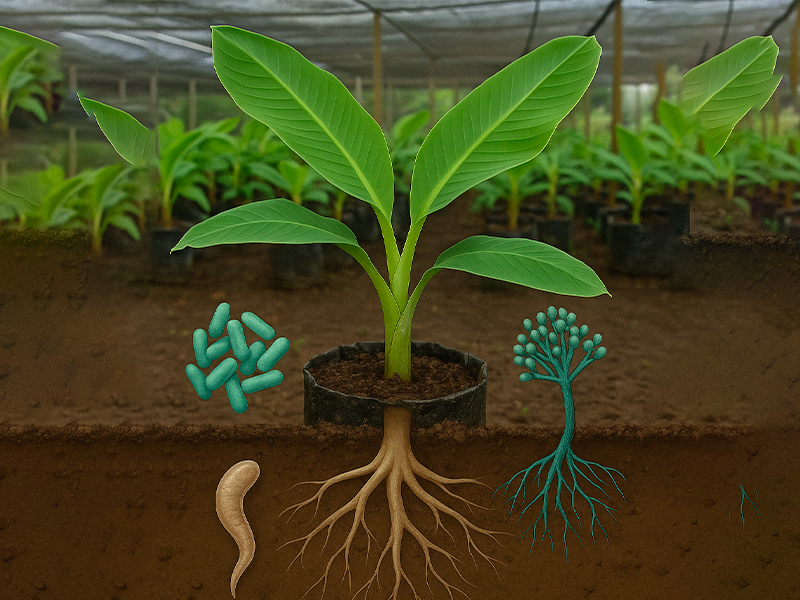
El Carmen es considerada la capital mundial de la producción de plátano barraganete (Musa paradisiaca L.), Sin embargo, la falta de investigaciones limita el desarrollo de este cultivo, este estudio evaluó el efecto de la aplicación sinérgica de Trichoderma spp. y rizobacterias promotoras del crecimiento vegetal como estrategias de biocontrol contra nematodos fitopatógenos. Con el objetivo de mejorar el rendimiento del cultivo, el control y reducción de este patógeno. El experimento se realizó bajo un diseño completamente al azar (DCA) con cinco tratamientos y cuatro repeticiones, midiendo variables de crecimiento y caracterización radicular. Los resultados mostraron una emisión foliar de 3,42 hojas/mes y una densidad poblacional de Radopholus similis de 1.105 individuos. Las plantas tratadas con Trichoderma spp y rizobacterias mostraron un aumento significativo en el número de raíces sanas (15,96) y el porcentaje de raíces funcionales (58,49 %). Además, el tratamiento con rizobacterias incrementó el diámetro del pseudotallo a 1,75 cm y la altura de la planta a 36,31 cm. En el tratamiento químico, se obtuvo el mayor peso de raíces (147,7 g), mientras que en el testigo se observaron las raíces con mayor lesión (13,29) y el menor porcentaje de raíces funcionales (49,44 %). Estos hallazgos destacan el potencial del uso combinado de Trichoderma spp y rizobacterias como una alternativa eficaz para el biocontrol de nematodos y el fortalecimiento del cultivo de plátano barraganete en El Carmen.
Downloads
Referências
Ali Siddiqui, I. y Ehteshamul-Haque, S. (2001). Suppression of the root rot-root knot disease complex by Pseudomonas aeruginosa in tomato: The influence of inoculum density, nematode populations, moisture and other plant-associated bacteria. Plant and Soil, 237(1), 81-89. https://doi.org/10.1023/A:1013313103032
Arévalo Gardini, E., Zúñiga, C. L., Baligar, V. C., Bailey, B. y Canto, M. (2016). Dinámica poblacional de nemátodos asociados al sistema de cultivo tradicional de cacao en la Amazonía peruana. Figshare. https://doi.org/10.6084/m9.figshare.3187695.v2
Avellán-Vásquez, L., Cobeña-Loor, N., Estévez-Chica, S., Zamora-Macías, P., Vivas-Cedeño, J., González-Ramírez, I., y Sánchez-Urdaneta, A. B. (2020). EXPORTACIÓN Y EFICIENCIA DEL USO DE FÓSFORO EN PLÁTANO ‘BARRAGANETE’ (Musa paradisiaca L.). Revista Fitotecnia Mexicana, 43(1). https://doi.org/10.35196/rfm.2020.1.25
Becker, J. O., Zavaleta-Mejía, S. F., Colbert, M.N., Schroth, A. R., Weinhold, J. G., Hancock. y Van Gundy, S. D. (1988). Effects of Rhizobacteria on Root-Knot Nematodes and Gall Formation. Phytopathology, 78(11), 1466-1469. https://doi.org/10.1094/phyto-78-1466
Casas, M., Pérez, J., Piñón, D., Bernal, A., Zardón, M. y Torres, J. (2015). Sesión: Control biológico de plagas con microorganismos. Fitosanidad, 19(2), 101-107. https://www.redalyc.org/pdf/2091/209149784009.pdf
Cobeña-Loor, N. V., Espinosa-Marroquin, J. A., Avellán-Vásquez, L. E., Cedeño-Zambrano, J. R., Vaca-Sotelo, D. A., Chica-Chica, D. M., Rodríguez-Zambrano, B. M., Zambrano-Aveiga, R. H., Sánchez-Urdaneta, A. B. y López-Mejía, F. X. (2020). Nutrición vegetal: exportación y eficiencia del uso de nutrientes en plátano. In Nutrición vegetal: exportación y eficiencia del uso de nutrientes en plátano. https://doi.org/10.17993/ingytec.2020.60
De Queiroz, B. P. V. y De Melo, I. S. (2006). Antagonism of Serratia marcescens towards Phytophthora parasitica and its effects in promoting the growth of citrus. Brazilian Journal of Microbiology, 37(4). https://doi.org/10.1590/S1517-83822006000400008
Etesami, H.. y Maheshwari, D. K. (2018). Use of plant growth promoting rhizobacteria (PGPRs) with multiple plant growth promoting traits in stress agriculture: Action mechanisms and future prospects. Ecotoxicology and Environmental Safety, 156, 225-246. https://doi.org/10.1016/j.ecoenv.2018.03.013
Instituto Nacional de Meteorología e Hidrología (2017) Anuario Meteorológico: No. 53-2013. Instituto Nacional de Meteorología e Hidrología. Quito, Ecuador. 150 p. https://servicios.inamhi.gob.ec/anuarios-metereologicos/
Kálmán, C. D., Nagy, Z., Berényi, A., Kiss, E. y Posta, K. (2024). Investigating PGPR bacteria for their competence to protect hybrid maize from the factor drought stress. Cereal Research Communications, 52(1), 129-150. https://doi.org/10.1007/s42976-023-00388-0
Kolombia, Y. A., Ogundero, O., Olajide, E., Viaene, N., Kumar, P. L., Coyne, D. L. y Bert, W. (2021). Morphological and molecular characterization of Pratylenchus species from yam (Dioscorea spp.) in West Africa. Journal of Nematology, 52(1), 1-25. https://doi.org/10.21307/JOFNEM-2020-126
Kumar, A. R., Kumar, N., Poornima, K. y Soorianathasundaram, K. (2012). Screening of in-vitro derived mutants of banana against nematodes using bio-chemical parameters. African Journal of Biotechnology, 11(88). https://doi.org/10.5897/AJB08.587
Lilley, C. J., Wang, D., Atkinson, H. J. y Urwin, P. E. (2011). Effective delivery of a nematode-repellent peptide using a root-cap-specific promoter. Plant Biotechnology Journal, 9(2), 151–160. https://doi.org/10.1111/j.1467-7652.2010.00542.x
Martínez, B., Infante, D. y Reyes, Y. (2013). Trichoderma spp. y su función en el control de plagas en los cultivos. Protección Vegetal, 28(1), 1-11. http://scielo.sld.cu/scielo.php?script=sci_abstract&pid=S1010-27522013000100001
Maziah, M., Zuraida, A. R., Halimi, M. S., Zulkifli, H. S. y Sreeramanan, S. (2010). Influence of boron on the growth and biochemical changes in plant growth promoting rhizobacteria (PGPR) inoculated banana plantlets. World Journal of Microbiology and Biotechnology, 26(5), 933-944. https://doi.org/10.1007/s11274-009-0256-3
Morel, M., García, S., Castillo, Y., Moya, J. de D., Rengifo, D., Reinoso, T. y Martínez Monegro, N. (2021). Aislamiento y selección de hongos endófitos nativos con potencial antagónico a nematodos fitoparásitos en plantaciones de banano en Valverde y Montecristi. APF, 10(1), 11-24. https://sodiaf.org.do/apf/index.php/apf/article/view/126
Orlando, V., Edwards, S. G., Neilson, R., Prior, T., Roberts, D. y Back, M. (2020a). Comparing the efficiency of six common methods for DNA extraction from root-lesion nematodes (Pratylenchus spp.). Nematology, 23(4), 415-423. https://doi.org/10.1163/15685411-bja10049
Orlando, V., Grove, I. G., Edwards, S. G., Prior, T., Roberts, D., Neilson, R. y Back, M. (2020b). Root-lesion nematodes of potato: Current status of diagnostics, pathogenicity and management. Plant Pathology, 69(3), 405-417. https://doi.org/10.1111/ppa.13144
Palomares-Rius, J. E., Cantalapiedra-Navarrete, C. y Castillo, P. (2014). Cryptic species in plant-parasitic nematodes. Nematology, 16(10), 1105-1118. https://doi.org/10.1163/15685411-00002831
Rodríguez-Romero, A. S., Badosa, E., Montesinos, E., y Jaizme-Vega, M. C. (2008). Growth promotion and biological control of root-knot nematodes in micropropagated banana during the nursery stage by treatment with specific bacterial strains. Annals of Applied Biology, 152(1), 41-48. https://doi.org/10.1111/j.1744-7348.2007.00189.x
Rueda Puente, E. O., Holguín-Peña, R. J., Preciado Rangel, P., Fortis Hernandez, M., Hernández Montiel, L. G. y Ruiz Espinoza, F. H. (2017). Identificación y dinámica poblacional de nemátodos fitoparásitos asociados a la halófita Salicornia bigelovii (Torr.) en el noroeste de México. Revista Mexicana de Ciencias Agrícolas, 6(4), 707-720. https://doi.org/10.29312/remexca.v6i4.613
Santoyo, G., Urtis-Flores, C. A., Loeza-Lara, P. D., Orozco-Mosqueda, M. D. C. y Glick, B. R. (2021). Rhizosphere colonization determinants by plant growth-promoting rhizobacteria (Pgpr). Biology, 10(6), 475. https://doi.org/10.3390/biology10060475
Siddiqui, I. A. y Shaukat, S. S. (2003). Suppression of root-knot disease by Pseudomonas fluorescens CHA0 in tomato: Importance of bacterial secondary metabolite, 2,4-diacetylpholoroglucinol. Soil Biology and Biochemistry, 35(12), 1615-1623. https://doi.org/10.1016/j.soilbio.2003.08.006
Silva-Valenzuela, M., Rojas-Martínez, R. I., Manzanilla-López, R. H., Macías-Rubalcava, M. L., Aranda-Ocampo, S. y Zavaleta-Mejía, E. (2020). Hongos endófitos: Una alternativa biológica para el manejo de nematodos fitoparásitos. Nematropica, 50(1), 101-117. https://journals.flvc.org/nematropica/article/view/126284
Tyskiewicz, R., Nowak, A., Ozimek, E. y Jaroszuk-scisel, J. (2022). Trichoderma: The Current Status of Its Application in Agriculture for the Biocontrol of Fungal Phytopathogens and Stimulation of Plant Growth. International Journal of Molecular Sciences, 23(4), 2329. https://doi.org/10.3390/ijms23042329
Ugando Peñate, M., Sabando García, Á. R., Armas Herrera, R., Higuerey Gómez, Á. A. y Villalón Peñate, A. (2023). Modelización econométrica aplicada y pronósticos de niveles exportables para el plátano barraganete en la provincia de Santo Domingo de los Tsáchilas, Ecuador. Revista de La Universidad Del Zulia, 14(39). https://doi.org/10.46925//rdluz.39.08
Wulandari, S., Netty, S. y Suriyanti, S. (2021). Pengaruh konsentrasi PGPR (Plant Growth Promoting Rhizobacteria) dan pupuk KCl terhadap pertumbuhan dan produksi pada tanaman tomat (Solanum lycopersicum L.). Jurnal AGrotekMAS, 2(3). https://lc.cx/Cn0EUz
Publicado
Como Citar
Edição
Seção
Licença
Copyright (c) 2025 Jefferson Alexander Castillo Castillo, Hayron Canchignia Martínez, Francisco Javier Arteaga Alcívar, Diana Alexandra Álava Cruz

Este trabalho está licenciado sob uma licença Creative Commons Attribution-NonCommercial-ShareAlike 4.0 International License.
Contrato de Licenciamento
Este jornal oferece acesso gratuito ao seu conteúdo por meio de seu site, seguindo o princípio de que disponibilizar pesquisas gratuitamente ao público promove uma grande mudança no conhecimento global.
O conteúdo do site do jornal é distribuído sob a licença Atribuição-NãoComercial-CompartilhaIgual 4.0 Internacional.
Os autores podem adotar outros acordos de licenciamento não exclusivos para a distribuição da versão publicada de seu trabalho, desde que a publicação inicial seja indicada neste periódico. É permitido e recomendado que os autores divulguem seus trabalhos na Internet antes e durante o processo de submissão, ou que possam gerar mudanças interessantes e aumentar as citações dos trabalhos publicados.