Caracterización florística, estructura y diversidad del arbolado urbano del cantón Puerto López, Manabí, Ecuador
DOI:
https://doi.org/10.18779/cyt.v18i2.977Palavras-chave:
Especies arbóreas, espacios verdes, inventarios, índices de diversidadResumo
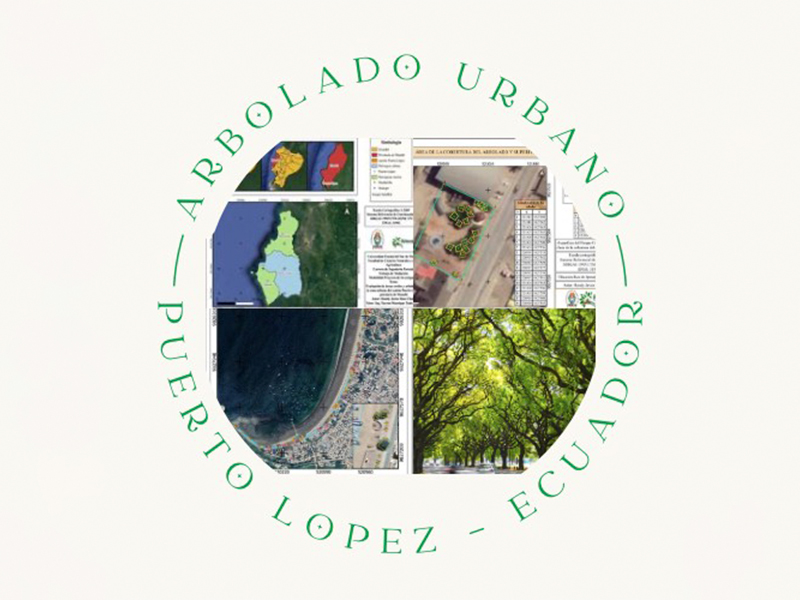
El presente estudio tiene como objetivo caracterizar la composición florística, estructura y diversidad del arbolado urbano del cantón Puerto López, Manabí, Ecuador. Para ello, se realizó un censo forestal en 10 espacios públicos, incluyendo 7 parques y tres espacios verdes. En total, se registraron 16 especies arbóreas distribuidas en 11 familias botánicas, con 279 individuos. La familia Fabaceae destacó como la más representativa en el área de estudio. En cuanto a la estructura horizontal de las especies, se observó una distribución normal en relación con el diámetro de los árboles, destacándose una mayor abundancia en el rango de diámetros de 10 a 30 cm. La estructura vertical del arbolado mostró que el 61 % de los árboles presentaban alturas de 3 a 9 m. Además, se determinó la superficie en m2 de los espacios verdes para calcular el índice verde urbano, obteniendo un valor de 5,70 m2/hab, lo cual se encuentra por debajo de la recomendación de la OMS, siendo de 9 m2/hab. Así mismo, se aplicaron diversos índices de valor ecológico para evaluar la biodiversidad del arbolado. El índice de Foráneo reveló que el 75 % de las áreas verdes presentan especies no nativas. Otros índices como el de Shannon-Wiener (2,07), Pielou (0,52), Simpson (0,62), Berger-Parker (0,59), Margalef (2,66) y Jaccard (19 %), permitieron una evaluación integral de la diversidad, equitatividad y similitud entre especies en el arbolado urbano de la zona estudiada. Estos resultados contribuyen para futuras estrategias de manejo y conservación del verde urbano.
Downloads
Referências
Afanador, G. F. (2018). Diseño de estrategias de manejo silvicultural para la población arbórea urbana del municipio de Saravena departamento de Arauca. [Tesis de Grado, Universidad Nacional Abierta y a Distancia UNAD]. Repositorio Institucional UNAD. https://repository.unad.edu.co/handle/10596/18072
Alanís-Rodríguez, E., Mora-Olivo, A., Molina-Guerra, V. M., Gárate-Escamilla, H. y Sigala Rodríguez, J. Á. (2022). Caracterización del arbolado urbano del centro de Hualahuises, Nuevo León. Revista mexicana de ciencias forestales, 13(73), 29-49. https://doi.org/10.29298/rmcf.v13i73.1271
Blancarte Siqueiros, R. H. (2016). La relación entre las áreas verdes y la calidad de vida en ambientes urbanos. [Tesis de Maestría, Instituto Politécnico Nacional). Victoria de Durango]. https://tinyurl.com/296mjech
Cabrera Verdesoto, C. A., Ponce Macías, C. J., Cantos Cevallos, C., Morán Morán, J. J. y Cabrera Verdezoto, R. P. (2020). Áreas Verdes Y Arbolado En La Zona Urbana Del Cantón Jipijapa. Ciencia y Tecnología, 13(2), 47–53. https://doi.org/10.18779/cyt.v13i2.392
Cabrera-Verdesoto, Macías Cedeño, L. E., Mieles Segura, K. A., Jiménez-González, A. y Manrique Tóala, T. O. (2022). Áreas verdes y arbolado en la zona urbana del cantón Portoviejo, provincia de Manabí, Ecuador. Siembra, 9(1), e3380. https://doi.org/10.29166/siembra.v9i1.3380
Canizales Velázquez, P. A., Alanís Rodríguez, E., Holguín Estrada, V. A., García García, S. y Chávez Costa, A. C. (2020). Caracterización del arbolado urbano de la ciudad de Montemorelos, Nuevo León. Revista mexicana de ciencias forestales, 11(62), 111-135. https://doi.org/10.29298/rmcf.v11i62.768
Cué García, J. L., Chagna, E. J., Palacios, W. A. y Carrión, A. M. (2020). Biodiversidad forestal en dos campus de la Universidad Técnica del Norrte, Ecuador. Revista de las Agrociencias ISSN 2477-8982, (24), 9–28. https://dialnet.unirioja.es/servlet/articulo?codigo=8232822
Cusme Sacón, M. D. y Farfán Valdéz, E. V. (2022). Evaluación del índice verde urbano de la parroquia Calceta para la elaboración de un plan de manejo de áreas verdes [Tesis de Grado, Escuela Superior politécnica Agropecuaria de Manabí Manuel Félix López]. https://repositorio.espam.edu.ec/handle/42000/1795
González Serna, M. y Jiménez, E. M. (2021). Diversidad, estructura y riesgo de los árboles del Tecnológico de Antioquia - Institución Universitaria. Grupo de Investigación INTEGRA, Facultad de Ingeniería, Tecnológico de Antioquia - Institución Universitaria. https://dspace.tdea.edu.co/handle/tdea/1536
González-Kuk, G., Muñoz-Márquez Trujillo, R. A, García-Albarado, J. C. y Gómez-Merino, F. C. (2019). Áreas verdes urbanas en Córdoba, Veracruz. Cantidad, ubicación y acceso: un análisis ortogonal. Revista mexicana de ciencias agrícolas, 10(7), 1565-1578. https://doi.org/10.29312/remexca.v10i7.1907
Instituto Nacional de Estadística y Censos [INEC]. (2012). Índice Verde Urbano 2012. https://www.ecuadorencifras.gob.ec/indice-verde-urbano/
Leal Elizondo, C. E., Leal Elizondo, N., Alanís Rodríguez, E., Pequeño Ledezma, M. Á., Mora-Olivo, A. y Buendía Rodríguez, E. (2018). Estructura, composición y diversidad del arbolado urbano de Linares, Nuevo León. Revista mexicana de ciencias forestales, 9(48), 252-270. https://doi.org/10.29298/rmcf.v8i48.129
Martínez Juárez, G., Rodríguez Trejo, D. A., Granados Sánchez, D., Mohedano Caballero, L. y Villanueva Morales, A. (2022). Descripción del arbolado de alineación de la ciudad de Puebla por grado de marginación y vialidad. Revista mexicana de ciencias forestales, 13(70), 85-111. https://doi.org/10.29298/rmcf.v13i70.830
Morales-Gallegos, L. M., Martinez-Trinidad, T. y Mohedano-Caballero, L. (2021). El espacio ocioso urbano como alternativa para la creación de áreas verdes en Texcoco, México. Revista Cubana de Ciencias Forestales, 9(3), 423-439. http://scielo.sld.cu/scielo.php?script=sci_arttext&pid=S2310-34692021000300423&lng=es&tlng=es.
Morales-Gallegos, L. M., Martínez-Trinidad, T., Hernández-De la Rosa, P., Gómez-Guerrero, A., Alvarado-Rosales, D. y Saavedra-Romero, L. D. L. (2023). Diversidad, estructura y salud del arbolado en áreas verdes de la ciudad de Texcoco, México. Bosque (Valdivia), 44(2), 401-414. https://dx.doi.org/10.4067/s0717-92002023000200401
Moreno, C. E. (2001). Métodos para medir biodiversidad. M yT-Manuales y Tesis SEA. (Vol. 1) Zaragoza, España. 84 pp. https://lc.cx/wLpA4Y
Organización de las Naciones Unidas. [ONU]. (2017). ODS 11: Lograr que las ciudades y los asentamientos humanos sean inclusivos, seguros, resilientes y sostenibles en América Latina y el Caribe. https://www.un.org/sustainabledevelopment/es/cities/
Ortiz, N. L. y Luna, C. V. (2019). Diversidad e indicadores de vegetación del arbolado urbano en la Ciudad de Resistencia, Chaco-Argentina. Agronomía & Ambiente Revista de la Facultad de Agronomía UBA, 39(2): 54-68. https://tinyurl.com/2p6sa5nf
Plan de Desarrollo y Ordenamiento Territorial [PDOT Puerto López]. (2020). Plan de desarrollo turístico del cantón Puerto López 2020-2025.
Saavedra-Romero, L D. L., Hernández-de la Rosa, P., Alvarado-Rosales, D., Martínez-Trinidad, T. y Villa-Castillo, J.. (2019). Diversidad, estructura arbórea e índice de valor de importancia en un bosque urbano de la Ciudad de México. Polibotánica, 47(24), 25-37. https://doi.org/10.18387/polibotanica.47.3
Publicado
Como Citar
Edição
Seção
Licença
Copyright (c) 2025 César Alberto Cabrera Verdesoto, Valeria Lissette Cali Ligua, Randy Javier Ross Chong, Blanca Soledad Indacochea Ganchozo, Tayron Omar Manrique Toala

Este trabalho está licenciado sob uma licença Creative Commons Attribution-NonCommercial-ShareAlike 4.0 International License.
Contrato de Licenciamento
Este jornal oferece acesso gratuito ao seu conteúdo por meio de seu site, seguindo o princípio de que disponibilizar pesquisas gratuitamente ao público promove uma grande mudança no conhecimento global.
O conteúdo do site do jornal é distribuído sob a licença Atribuição-NãoComercial-CompartilhaIgual 4.0 Internacional.
Os autores podem adotar outros acordos de licenciamento não exclusivos para a distribuição da versão publicada de seu trabalho, desde que a publicação inicial seja indicada neste periódico. É permitido e recomendado que os autores divulguem seus trabalhos na Internet antes e durante o processo de submissão, ou que possam gerar mudanças interessantes e aumentar as citações dos trabalhos publicados.