Reference conditions of the salt marsh mangrove estuary in the Guayaquil city
DOI:
https://doi.org/10.18779/cyt.v18i1.893Keywords:
mangrove, ecological crisis, biodiversity, wetlandAbstract
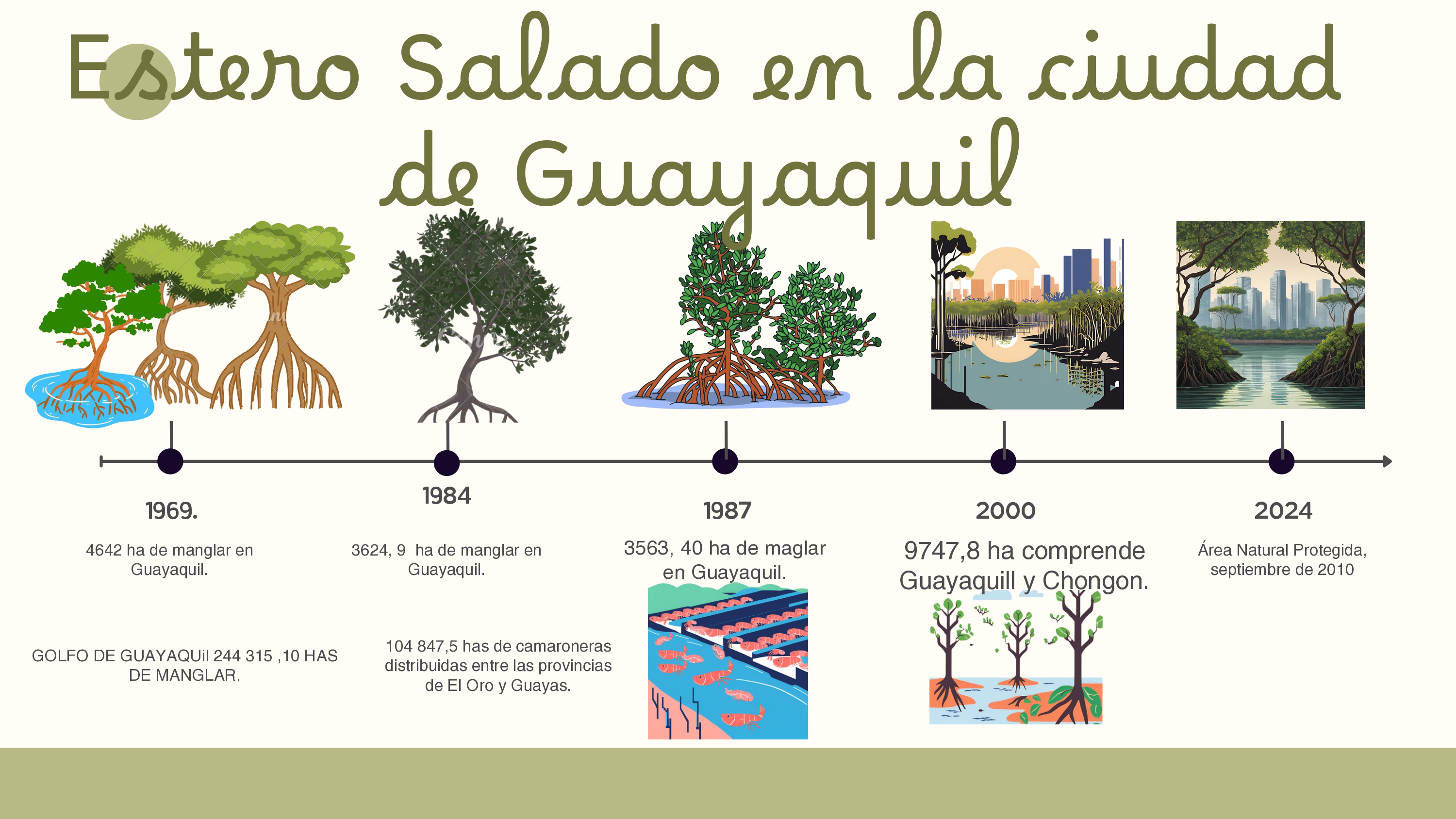
Documents generated in 2012 on the mangrove remnants of the El Salado reserve in the city of Guayaquil - Ecuador, where the component is rescued: Flora with city, were analyzed, as well as other national sources that have produced information on the aforementioned ecosystem. National publications and legal instruments that have been used for the conservation of mangroves were systematically reviewed. The Estero Salado mangrove was delimited into three study areas, the field techniques and the statistics used were presented. The results by study areas are differentiated by their diversity, dominance and abundance. Zone I correspond to the interior part of the city of Guayaquil, with mangroves reduced to strips, on surfaces approximately between 2 to 3 m from the shore, zone II reflected high values with respect to the Importance Value Index (IVI). Zone III is far from human settlements, so it maintains the best forest conditions with dominance of Rhizosphora species. harrisonii and R. mangle. Stress affects the species that are present in 22.5% of the 40 stations analyzed, and insects in 70% in Rhizophora sp. and Laguncularia racemosa. The state of the mangrove strips of the El Salado reserve in the Guayaquil city constitutes the first floristic inventory from more than a decade ago, and the conditions in which it is currently found have not changed, specific political actions need to be implemented for its recovery.
Downloads
References
Cerón-Souza, I., Rivera-Ocasio, E., Medina, E., Jiménez, J. A., McMillan, W.O. y Bermingham, E. (2010). Hybridization and introgression in new world red mangroves, Rhizophora (Rhizophoraceae). American Journal of Botany, 97(6), 945–957. https://doi.org/10.3732/ajb.0900172
Centro de Levantamiento Integrado de Recursos por Sensores Remotos. (1990). Estudio Multitemporal de los Manglares, Camaroneras y Áreas Salinas en la Costa Continental Ecuatoriana, mediante información de sensores remotos. https://www.crc.uri.edu/download/CLIRSEN_1987s.pdf
Díaz-López, A. M., Díaz-Gallegos, J. R., Tovilla-Hernández, C. y Romero-Berny, E. I. (2022). Efecto de la tala selectiva sobre la estructura del manglar en la laguna costera Mar Muerto, Oaxaca-Chiapas, México, BIOCYT Biología Ciencia Y Tecnología. https://doi.org/10.22201/fesi.20072082e.2022.15.83002
Félix, F., F. Garzón, R. Navarrete, F. Hernández, B. Haase, F. Rivera, J. Véliz, L. Arriaga, M. Morales, A. Dahik. y P. Martínez. (2005). Ordenamiento Territorial Costero–Marino y Declaratoria de Áreas Protegidas en Salinas. https://goo.su/cFBDoC
Flores-Aguilar, D., Romero-Córdova, M., Trujillo-Vázquez, V., González- González, A. y Juela, O. (2021). Análisis multitemporal de la superficie ocupada por la cría de camarón (Litopenaeus vannamei) en los manglares del archipiélago
Jambelí, cantón Santa Rosa, Provincia de El Oro, Ecuador. Bosques Latitud Cero, 10(2), 146-160. https://revistas.unl.edu.ec/index.php/bosques/article/view/830
Global Mangrove Watch. (2023). Extensión de manglares en Guayaquil - Ecuador y sus cambios (1996-2020). https://www.globalmangrovewatch.org/
Instituto Oceanográfico y Antártico de la Armada (2023). Reporte meteorológico portuario. https://n9.cl/rts3z
Jorgensen, P.M., Neill D. A. y León-Yánez, S. (1999). Cataloge of the Vascular Plants of Ecuador. Missouri Botanical Garden (Eds). https://n9.cl/yqx2u5
Jorgensen, P. M. C., Ulloa, B., León, S., León-Yánez, S.G., Beck, M., Nee, J.L., Zarucchi, M., Celis, R., Bernal. y Gradstein, R. (2011). Regional Patterns of Vascular Plant Diversity and Endemism. En S. K. Herzog, R. Martínez, P. M. Jørgensen y H. Tiessen (eds.) Climate Change and Biodiversity in the Tropical Andes https://n9.cl/6bpwf7
Josse, C., G. Navarro, P. Comer, R. Evans, D. Faber-Langendo en, M. Fellows, G. Kittel, S. Menard, M. Pyne, M. Reid, K Schulz, K. Snow. y J. Teague. (2003). Ecological systems of Latin America and the Caribbean: A working classification of terrestrial systems. Nature Serve. https://www.natureserve.org/sites/default/files/lacecologicalsystems.pdf
Empresa Municipal de Agua Potable y Alcantarillado EP. (2022). Actualización del estudio y diseño definitivo para la rehabilitación del colector sanitario diametro 2.000mm “Parson Sur” de la ciudad de guayaquil, tramo comprendido desde la calle domingo comin hasta la estación de bombeo la pradera, L= 1.200 m. https://goo.su/muX3
Ministerio del Ambiente del Ecuador. (2012). Proyecto de recuperación de las áreas protegidas de la ciudad de Guayaquil: Estero Salado e Isla Santay. Ministerio del Ambiente. https://www.ambiente.gob.ec/wp-content/uploads/downloads/2020/07/2.ESTERO-SALADO.pdf
Ministerio del Ambiente del Ecuador. (2012a). Sistema de clasificación de los ecosistemas del Ecuador continental. Subsecretaría de Patrimonio Natural. Ministerio del Ambiente. https://www.ambiente.gob.ec/wp-content/uploads/downloads/2012/09/LEYENDA-ECOSISTEMAS_ECUADOR_2.pdf
Ministerio del Ambiente del Ecuador, Organización de las Naciones Unidas para la Alimentación y la Agricultura. (2014). Árboles y Arbustos de los Manglares del Ecuador. Ministerio del Ambiente. https://es.scribd.com/document/661898850/Arboles-y-arbustos-de-los-mangalres-del-Ecuador-MAE-2014
Mueller-Dombois, D. y Ellenberg, H. (1974). Aims and methods of vegetation ecology. Reimpresa. https://n9.cl/icdk6
Quevedo Pinos, O., Terán Verzola, W. y Calderón Vega, F. (2022). Diferencias eco-fisiológicas entre Avicennia germinans y Rhizophora harrisonii Leechm, afectadas por la presión antrópica, Guayaquil – Ecuador. Ciencia y Tecnología, 15(1), 7-18. https://doi.org/10.18779/cyt.v15i1.538
Registro Oficial Suplemento No. 418 de 2024. Ley forestal y de conservación de áreas naturales y vida silvestre. 10 de septiembre de 2004. Codificación No. 17. Congreso Nacional. Ecuador. https://www.ambiente.gob.ec/wp-content/uploads/downloads/2015/06/Ley-Forestal-y-de-Conservacion-de-Areas-Naturales-y-Vida-Silvestre.pdf
Registro Oficial No. 983 de 2017. Código Orgánico Ambiental. 12 abril de 2017. Ecuador. https://goo.su/OUFabrh
Registro oficial No. 286 de 2010. Ampliación de la reserva de producción faunística Estero Salado. 24 de septiembre de (2010). Ecuador. https://derechoecuador.com/registro-oficial-no-286-viernes-24-de-septiembre-de-2010/
Sierra, R. (1999). Propuesta Preliminar de un Sistema de Clasificación de Vegetación para el Ecuador Continental. Ministerio de Medio Ambiente, Proyecto INEFAN / GEF- BIRF y Ecociencia. https://ecociencia.org/propuesta-preliminar-de-un-sistema-de-clasificacion-de-vegetacion-para-el-ecuador-continental/
Walter H. (1977). Zonas de vegetación y clima. Editorial OMEGA. https://n9.cl/24sja9
Zaldívar Jiménez A., J. Herrera Silveira, C. Coronado Molina. y D. Alonzo Parra (2016). Estructura y productividad de los manglares en la reserva de biosfera Ría Celestún, Yucatán,México. Revista Madera y Bosques, 10(3), 25-35. https://doi.org/10.21829/myb.2004.1031264
Zhiminaicela-Cabrera, J., Quevedo-Guerrero, J., Lalangui-Paucar, Y., Mogro-Mendoza, M., Astudillo-Herrera, J. y Barzallo-Encalada, X. (2020). Mapeo multiespectral del impacto de piscinas camaroneras al ecosistema de manglar del Golfo de Guayaquil, Ecuador. Revista Manglar, 17(3), 269-274. https://revistas.untumbes.edu.pe/index.php/manglar/article/view/185
Published
How to Cite
Issue
Section
License
Copyright (c) 2025 Olga Laurmania Quevedo Pinos, Willan Enrique Revelo Ramírez

This work is licensed under a Creative Commons Attribution-NonCommercial-ShareAlike 4.0 International License.
Licensing Agreement
This journal provides free access to its content through its website following the principle that making research available free of charge to the public supports a larger exchange of global knowledge.
Web content of the journal is distributed under a Attribution-NonCommercial-ShareAlike 4.0 International.
Authors may adopt other non-exclusive license agreements for the distribution of the version of the published work, provided that the initial publication in this journal is indicated. Authors are allowed and recommended to disseminate their work through the internet before and during the submission process, which can produce interesting exchanges and increase citations of the published work.