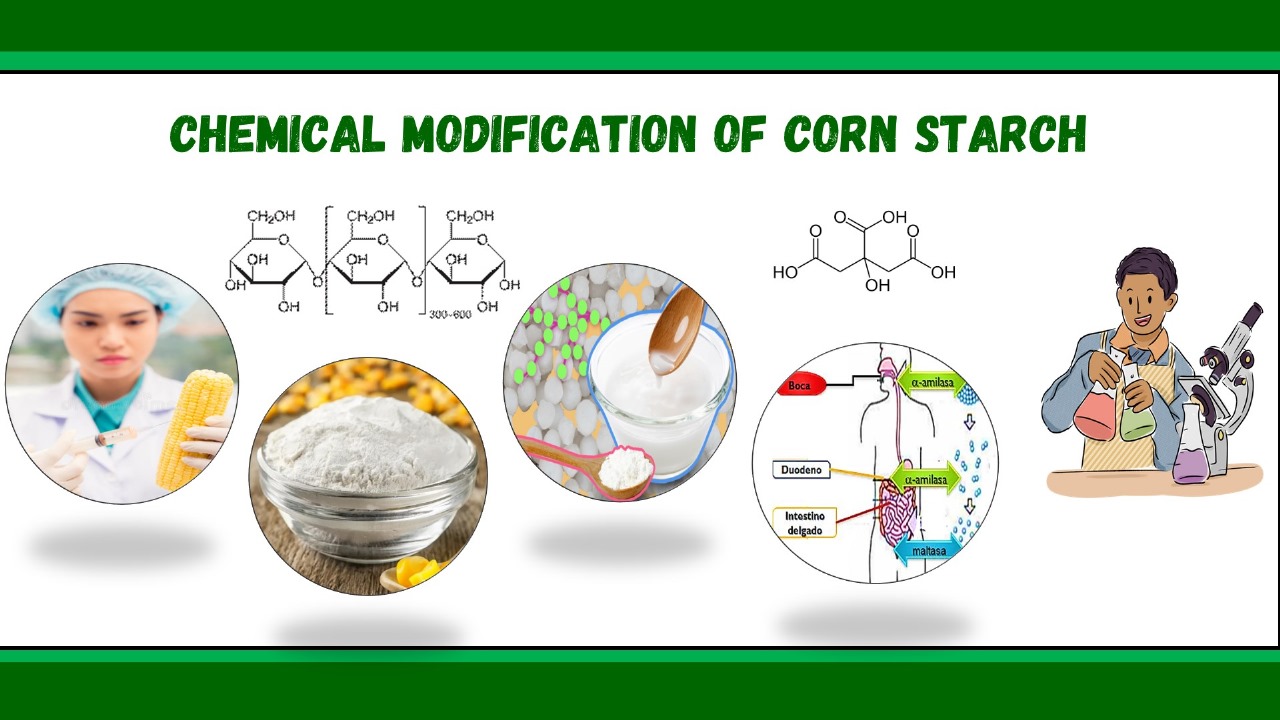
Chemical modification of yellow and purple corn starch: Effect on its resistance to in vitro digestion
DOI:
https://doi.org/10.18779/cyt.v18i1.891Keywords:
corn, starch, modification, amylose, resistanceAbstract
Corn stands out for its large crop volume, high yield and starch content, an important source of energy. Given the need to preserve the health of the consumer and provide various uses for this polysaccharide, the objective of this work was to apply two modification methods (acid: citric acid and OSA: octenyl succinic anhydride) on corn starch of two varieties (yellow and purple), to increase the content of resistant starch (RS) to digestion, and thus, select a treatment that allows improving its prebiotic potential. The extracted starches had a purity between 86,25% and 93,78%, indicating good extraction efficiency. Yellow corn allowed the highest yield in obtaining native and modified starch by acid method and OSA method (47,97% to 56,07%); compared to the yield achieved from purple corn (39,06% to 45,98%). The highest RS content (95,30%) was observed in purple corn starch modified with OSA, and the highest amylose content (AC) was observed in the starch of yellow and purple corn treated with citric acid. in a hot humid environment (37,09 to 41,89%) (p < 0,05); which indicates that, mainly purple corn modified by OSA can act as an additive with great prebiotic potential, useful for designing new functional foods.
Downloads
References
Agama-Acevedo, E., Ottenhof, M. A., Farhat, I. A., Paredes-López, O., Ortíz-Cereceres, J. y Bello-Pérez, L. A. (2005). Aislamiento y caracterización del almidón de maíces pigmentados. Agrociencia, 39(4), 419–429. https://www.redalyc.org/pdf/302/30239406.pdf
Boada, R. y Espinosa, J. (2016). Factors affecting yield potential of open pollinated corn in small farmers’ fields in the Ecuadorian highlands. Siembra, 3(1), 67–82. https://revistadigital.uce.edu.ec/index.php/SIEMBRA/article/view/262/252
Cahyana, Y., Wijaya, E., Halimah, T. S., Marta, H., Suryadi, E. y Kurniati, D. (2019). The effect of different thermal modifications on slowly digestible starch and physicochemical properties of green banana flour (Musa acuminata colla). Food Chemistry, 274, 274–280. https://doi.org/10.1016/j.foodchem.2018.09.004
Chávez, A. M. (2000). Maíz morado peruano (Folleto R.I. N° 04-00). https://repositorio.inia.gob.pe/handle/20.500.12955/996
Erazo, H. M. (2021). Formulación y caracterización de una biopelícula a partir de almidón de maíz morado (Zea mays L.) para el embalaje de alimentos. [Tesis de grado, Escuela Superior Politécnica de Chimborazo] http://dspace.espoch.edu.ec/handle/123456789/16802
Escarpa, A. y González, M. C. (1997). Tecnología del almidón resistente / Technology of resistant starch. Food Science and Technology International, 3(3), 149–161. https://doi.org/10.1177/108201329700300301
Goñi, I., García-Diz, L., Mañas, E. y Saura-Calixto, F. (1996). Analysis of resistant starch: A method for foods and food products. Food Chemistry, 56(4), 445–449. https://www.sciencedirect.com/science/article/abs/pii/0308814695002227
López-Vázquez, A. M. (2021). Propiedades fisicoquímicas y funcionalidad de almidón de maíz cacahuacintle. [Tesis doctoral, Universidad Autónoma Chapingo]. https://repositorio.chapingo.edu.mx/items/a0dbc09a-dbda-4ca4-9d8a-067506844bed
Ruilova, M., Cobos, F. y Gómez, J. (2023). Cultivo de maíz. https://libros.utb.edu.ec/index.php/utb/catalog/book/99
Moscoso-Muñoz, J. E., Gomez-Quispe, O. y Guevara-Carrasco, V. (2020). Contenido de energía metabolizable y energía neta del maíz, subproducto de trigo, harina de soya, harina de pescado y aceitede soya para pollos de carne. Scientia Agropecuaria, 11(3), 335–344. https://doi.org/10.17268/sci.agropecu.2020.03.05
Ojo, M., y Ariahu C. y Chinma E. (2017). Proximate, Functional and Pasting Properties of Cassava Starch and Mushroom (Pleurotus Pulmonarius) Flour Blends. American Journal of Food Science and Technology, 5(1), 11–18. https://www.sciepub.com/AJFST/abstract/6773
Olawoye, B., Fagbohun, O. F., Gbadamosi, S. O. y Akanbi, C. T. (2020). Succinylation improves the slowly digestible starch fraction of cardaba banana starch. A process parameter optimization study. Artificial Intelligence in Agriculture, 4, 219–228. https://doi.org/10.1016/j.aiia.2020.09.004
Organización de las Naciones Unidas para la Alimentación y la Agricultura. (2022). FAOSTAT ANALYTICAL BRIEF 60 Agricultural production statistics 2000-2021 FAOSTAT Analytical Brief 60 FAOSTAT CROPS AND LIVESTOCK PRODUCTION INTRODUCTION. Agricultural Production Statistics 2000-2021, 60, 1–17. https://openknowledge.fao.org/server/api/core/bitstreams/58971ed8-c831-4ee6-ab0a-e47ea66a7e6a/content
Pacheco, M. T., Moreno, F. J., Moreno, R., Villamiel, M. y Hernandez-Hernandez, O. (2019). Morphological, technological and nutritional properties of flours and starches from mashua (Tropaeolum tuberosum) and melloco (Ullucus tuberosus) cultivated in Ecuador. Food Chemistry, 301, 125268. https://doi.org/10.1016/j.foodchem.2019.125268.
Pacheco, M. T., Moreno, F. J. y Villamiel, M. (2019a). Chemical and physicochemical characterization of orange by-products derived from industry. Journal of the Science of Food and Agriculture, 99(2), 868–876. https://doi.org/10.1002/jsfa.9257
Ramos, M. de L., Romero, C. y Bautista, S. (2018). Almidón modificado: Propiedades y usos como recubrimientos comestibles para la conservación de frutas y hortalizas frescas. Revista Iberoamericana de Tecnología Postcosecha, 19(1), 30–44. https://www.redalyc.org/journal/813/81355612003/81355612003.pdf
Solarte-Montúfar, J. G., Díaz-Murangal, A. E., Osorio-Mora, O. y Mejía-España, D. F. (2019). Propiedades Reológicas y Funcionales del Almidón. Procedente de Tres Variedades de Papa Criolla. Informacion Tecnologica, 30(6), 35–44. https://doi.org/10.4067/S0718-07642019000600035
Urango, L. (2018). Componentes del maíz en la nutrición humana. Fondo Editorial Biogénesis, https://revistas.udea.edu.co/index.php/biogenesis/article/view/336229
Uthumporn, U., Zaidul, I. S. M. y Karim, A. A. (2010). Hydrolysis of granular starch at sub-gelatinization temperature using a mixture of amylolytic enzymes. Food and Bioproducts Processing, 88(1), 47–54. https://doi.org/10.1016/j.fbp.2009.10.001
Villarroel Heise, P., Gómez, C., Vera, C. y Torres, J. (2018). Resistant starch: Technological characteristics and physiological interests. Revista Chilena de Nutricion, 45(3), 271–278. https://www.scielo.cl/pdf/rchnut/v45n3/0717-7518-rchnut-45-03-0271.pdf
Zambrano, C. y Zambrano, P. (2020). Efecto de la humedad en dos variedades de maíz sobre los costos de molienda [Tesis de grado, Escuela Superior Politecica Agropecuaria de Manabi Manuel Felix Lopez]. https://repositorio.espam.edu.ec/bitstream/42000/1278/1/TTAI03D.pdf
Published
How to Cite
Issue
Section
License
Copyright (c) 2025 Byron Andrés Rojas Vera, María Teresa Pacheco Tigselema

This work is licensed under a Creative Commons Attribution-NonCommercial-ShareAlike 4.0 International License.
Licensing Agreement
This journal provides free access to its content through its website following the principle that making research available free of charge to the public supports a larger exchange of global knowledge.
Web content of the journal is distributed under a Attribution-NonCommercial-ShareAlike 4.0 International.
Authors may adopt other non-exclusive license agreements for the distribution of the version of the published work, provided that the initial publication in this journal is indicated. Authors are allowed and recommended to disseminate their work through the internet before and during the submission process, which can produce interesting exchanges and increase citations of the published work.