Diagnostic of the use of fire in agricultural activities at the Estancia Vieja site, Portoviejo canton, Manabí, Ecuador
DOI:
https://doi.org/10.18779/cyt.v18i1.828Keywords:
hotspots, forest fires, fire management, agricultural burningAbstract
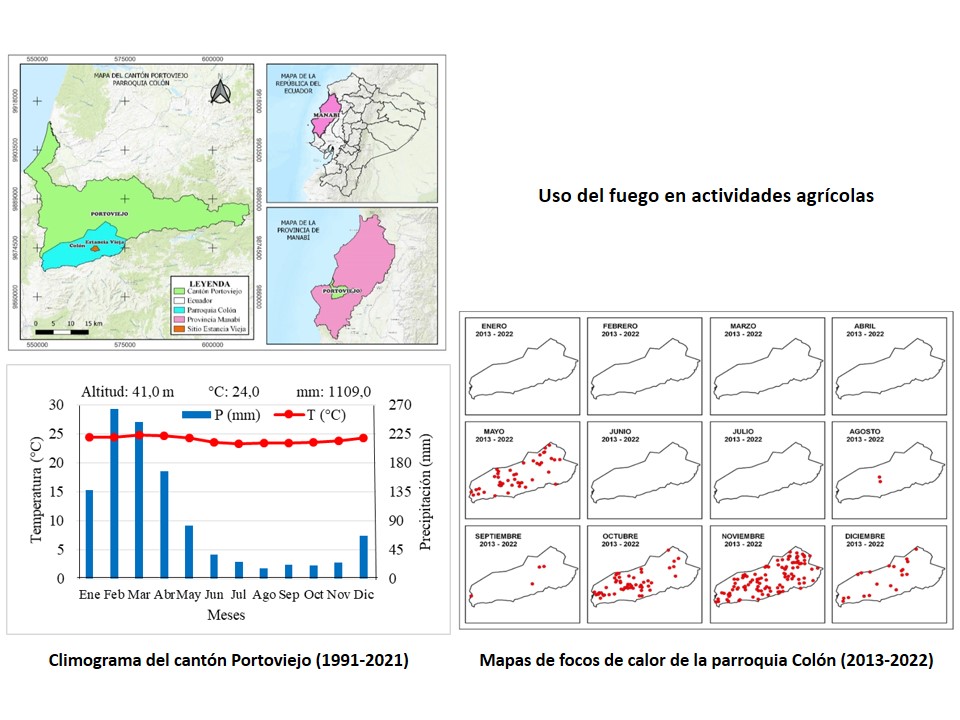
The use of fire by farmers has been a common practice worldwide for decades. The objective of this work was to diagnose the use of fire in agricultural activities at the Estancia Vieja site, Portoviejo canton, Manabí, Ecuador. For the development of the research, a non-experimental, descriptive, cross-sectional design was used. The sample size was calculated with the Decision Analyst STATSTM 2.0 software. The information was obtained by applying a semi-structured questionnaire to 123 agricultural producers. The statistical analysis was performed with the SPSS program (Version 22.0). The hot spots for contrast with the months in which fire is most used were obtained from the Fire Information for Resource Management System. In the locality, the use of fire in agricultural activities is common, mainly for clearing land destined for the implementation of agricultural crops. The respondents showed that they have knowledge about the hours and months in which they should burn in order to achieve the objective of eliminating the greatest amount of crop residues and weeds, as well as about the way to burn these fuels depending on the existing quantity of them and about the prevention measures they observe before burning. This information supports decision-making in the field of integrated fire management. It is suggested that similar research be carried out in other localities but considering the relationship of the use of fire with meteorological conditions, fire behavior and its effects on the environment.
Downloads
References
Agbeshie, A. A., Abugre, S., Atta-Darkwa, T. y Awuah, R. (2022). A review of the effects of forest fire on soil properties. Journal of Forestry Research, 33(5), 1419–1441. https://doi.org/10.1007/s11676-022-01475-4
Alcañiz, M., Outeiro, L., Francos, M. y Úbeda, X. (2018). Effects of prescribed fires on soil properties: A review. Science of the Total Environment, 613–614, 944–957. https://doi.org/10.1016/j.scitotenv.2017.09.144
Aponte, C., De Groot, W. J. y Wotton, B. M. (2016). Forest fires and climate change: causes, consequences and management options. International Journal of Wildland Fire, 25(8), i–ii. https://doi.org/10.1071/WFv25n8_FO
Araya Bravo, J., Duprat Sáez, C. y Parra Olave, M. (2009). Alternativas de reemplazo a las quemas de residuos agrícolas y forestales. In Corporación Nacional Forestal. Ministerio de Agricultura. Gobierno de Chile. https://acortar.link/9YzrxN
Assuncao (de), R., Tetto, A. F. y Batista, A. C. (2017). O uso tradicional do fogo no assentamento Vale Verde, em Gurupi / TO. Espacios, 38(17), 19. https://www.revistaespacios.com/a17v38n17/a17v38n17p19.pdf
Bilbao, B. A., Leal, A. V. y Méndez, C. L. (2010). Indigenous Use of Fire and Forest Loss in Canaima National Park, Venezuela. Assessment of and Tools for Alternative Strategies of Fire Management in Pemón Indigenous Lands. Human Ecology, 38(5), 663–673. https://doi.org/10.1007/s10745-010-9344-0
Bonfim, V. R., Ribeiro, G. A., Silva, E. y Braga, G. M. (2003). Diagnóstico do uso do fogo no entorno do Parque Estadual da Serra do Brigadeiro (PESB), MG. Revista Árvore, 27(1), 87–94. https://doi.org/10.1590/s0100-67622003000100012
Bowman, D. M. J. S., Balch, J., Artaxo, P., Bond, W. J., Cochrane, M. A., D’Antonio, C. M., Defries, R., Johnston, F. H., Keeley, J. E., Krawchuk, M. A., Kull, C. A., Mack, M., Moritz, M. A., Pyne, S., Roos, C. I., Scott, A. C., Sodhi, N. S. y Swetnam, T. W. (2011). The human dimension of fire regimes on Earth. Journal of Biogeography, 38(12), 2223–2236. https://doi.org/10.1111/j.1365-2699.2011.02595.x
Carrión-Paladines, V., Correa-Quezada, L., Valdiviezo Malo, H., Zurita Ruáles, J., Pereddo Tumbaco, A., Zambrano Pisco, M., Lucio Panchi, N., Jiménez Álvarez, L., Benítez, Á. y Loján-Córdova, J. (2024). Exploring the ethnobiological practices of fire in three natural regions of Ecuador, through the integration of traditional knowledge and scientific approaches. Journal of Ethnobiology and Ethnomedicine, 20(1), 60. https://doi.org/10.1186/s13002-024-00699-4
Carrión-Paladines, V., Fries, A., Hinojosa, M. B., Oña, A., Jiménez Álvarez, L., Benítez, Á., López Rodríguez, F. y García-Ruiz, R. (2023). Effects of Low-Severity Fire on Soil Physico-Chemical Properties in an Andean Páramo in Southern Ecuador. Fire, 6(447), 1–20. https://www.mdpi.com/2571-6255/6/12/447
Chinamatira, L., Mtetwa, S. y Nyamadzawo, G. (2016). Causes of wildland fires, associated socio-economic impacts and challenges with policing, in Chakari resettlement area, Kadoma, Zimbabwe. Fire Science Reviews, 5(1), 1–11. https://doi.org/10.1186/s40038-016-0010-5
CLIMATE-DATA.ORG. (2021). Clima de Portoviejo (Ecuador): Datos y gráficos del tiempo y clima. https://acortar.link/8cKbWE
Consorcio para el Desarrollo Sostenible de la Ecorregión Andina. (2023). Gestión integral del manejo del fuego, una perspectiva clave para la adaptación al cambio climático. CONDESAN. https://acortar.link/rQdq64
Díaz, S. C., Quezada, L. C., Álvarez, L. J. y Córdova, J. L. (2023). Indigenous use of fire in the paramo ecosystem of southern Ecuador: a case study using remote sensing methods and ancestral knowledge of the Kichwa Saraguro people. Fire Ecology, 1–18. https://doi.org/10.1186/s42408-022-00164-1
Edwards, R. B., Naylor, R. L., Higgins, M. M. y Falcon, W. P. (2020). Causes of Indonesia’s forest fires. World Development, 127. https://doi.org/10.1016/j.worlddev.2019.104717
Faúndez Pinilla, J., Castillo Soto, M. y Navarro Cerrillo, R. M. (2023). Impactos de los incendios forestales de magnitud en áreas silvestres protegidas de Chile Central. Bosque, 44(1), 83–95. https://doi.org/10.4067/S0717-92002023000100083
Fulé, P. Z., Ramos-Gómez, M., Cortés-Montãno, C. y Miller, A. M. (2011). Fire regime in a Mexican forest under indigenous resource management. Ecological Applications, 21(3), 764–775. https://doi.org/10.1890/10-0523.1
Huertas-Herrera, A., Baptiste-Ballera, B. L., Toro-Manríquez, M. y Huertas-Ramírez, H. (2019). Manejo de la quema de pastizales de sabana inundable: Una mirada del pueblo originario Sáliva en Colombia. Chungará (Arica) Revista de Antropología Chilena, 51(1), 167–176. https://doi.org/10.4067/S0717-73562018005002401
Huffman, M. R. (2013). The many elements of traditional fire knowledge: Synthesis, classification, and aids to cross-cultural problem solving in firedependent systems around the world. Ecology and Society, 18(4). https://doi.org/10.5751/ES-05843-180403
IBM Corp. (2013). IBM SPSS Statistics for Windows, Version 22.0. Armonk, NY: IBM Corp. https://www.ibm.com/support/pages/downloading-ibm-spss-statistics-22
Kelly, L. T., Giljohann, K. M., Duane, A., Aquilué, N., Archibald, S., Batllori, E., Bennett, A. F., Buckland, S. T., Canelles, Q., Clarke, M. F., Fortin, M. J., Hermoso, V., Herrando, S., Keane, R. E., Lake, F. K., McCarthy, M. A., Morán-Ordóñez, A., Parr, C. L., Pausas, J. G., … Brotons, L. (2020). Fire and biodiversity in the Anthropocene. Science, 370(6519). https://doi.org/10.1126/science.abb0355
Manrique Toala, T. O. y Ramos Rodríguez, M. P. (2022a). Uso del fuego en áreas de vocación forestal de Sancán y Membrillal, cantón Jipijapa, Manabí, Ecuador. Revista Alcance, 1(5). https://doi.org/10.47230/ra.v1i5.15
Manrique-Toala, T., Ramos-Rodríguez, M., De La Cruz-Rosales, G., Tigua-Pinela, Y. y Pincay-Ortega, S. (2022b). Uso del fuego en tierras de vocación forestal del cantón Jipijapa, Manabí, Ecuador. Bosques Latitud Cero, 12(2), 40–51. https://doi.org/10.54753/blc.v12i2.1600
Martínez-Torres, H. L., Castillo, A., Ramírez, M. I. y Pérez-Salicrup, D. R. (2016). The importance of the traditional fire knowledge system in a subtropical montane socio-ecosystem in a protected natural area. International Journal of Wildland Fire, 25(9), 911–921. https://doi.org/10.1071/WF15181
Martínez Torres, H. L. y Pérez Salicrup, D. R. (2018). El papel del campesinado ante la regulación de los incendios forestales en México: Consecuencias inesperadas. Perspectivas Rurales Nueva Época, 16(30), 71–89. https://doi.org/10.15359/prne.16-31.5
Minervini, M. G., Morrás, H. J. M. y Taboada, M. Á. (2018). Efectos del fuego en la matriz del suelo. Consecuencias sobre las propiedades físicas y mineralógicas. Ecología Austral, 28, 012–027. https://doi.org/10.25260/ea.18.28.1.0.127
Ministerio del Ambiente, Agua y Transición Ecológica. (2023). Prevención y control de incendios una prioridad nacional. MAATE. https://acortar.link/zcwDtA
Monzón-Alvarado, C., Waylen, P. y Keys, E. (2014). Fire management and climate variability: Challenges in designing environmental regulations. Land Use Policy, 39, 12–21. https://doi.org/10.1016/j.landusepol.2014.03.003
NASA. (2023). Fire Information for Resource Management System (FIRMS). National Aeronautics and Space Administration. https://acortar.link/uTmolG
Oliveira (de), E., Conceição Colaço, M., Fernandes, P. M. y Sequeira, A. C. (2024). Fuego tradicional en Portugal. ¿Aún existe? Revista Incendios y Riesgos Naturales, 12, 34-36. https://revistarirn.org/revista
Pyne, S. J. (2021). The Pyrocene: How We Created an Age of Fire, and What Happens Next. University of California Press.
Raish, C., González-Cabán, A. y Condie, C. J. (2005). The importance of traditional fire use and management practices for contemporary land managers in the American southwest. Environmental Hazards, 6(2), 115–122. https://doi.org/10.1016/j.hazards.2005.10.004
Ramos, M. P., Baque, M. J., Jiménez, A., Pionce, G. A. y Manrique, T. O. (2018). Programa de comunicación sobre prevención de incendios forestales en el cantón Paján, Manabí, Ecuador. Perspectivas Rurales Nueva Época, 16(30), 91–115. http://doi.org/10.15359/prne.16-31.6
Ramos-Rodríguez, M., Cedeño-Cedeño, D., Batista, A., Jiménez-González, A., Manrique-Toala, T. y Tetto, A. (2021). Usos tradicionales del fuego en la parroqia Ayacucho cantòn Santa ana, provicia Manabì, Ecuador. Revista Forestal Mesoamericana Kurù, 18(43), 41–52. https://revistas.tec.ac.cr/index.php/kuru/article/view/5807
Ramos-Rodríguez, M. P., Alcívar-Cobeña, A., Cedeño-Luna, N. A. y Manrique-Toala, T. O. (2022). Usos tradicionales del fuego en las actividades agrícolas de la parroquia Convento, cantón Chone, Manabí, Ecuador. Revista Cubana de Ciencias Forestales, 10(2), 319–335. https://doi.org/10.6084/m9.figshare.21750497.v1
Ramos Rodríguez, M. P. y Molina Terrén, D. M. (2023). Usos tradicionales del fuego en localidades de Manabí, Ecuador. Revista Incendios y Riesgos Naturales, 9, 29–31. https://acortar.link/xE9c0m
Ramos Rodríguez, M. P., Acosta Tufiño, J. M., Vivar González, J. C., Manrique Toala, T. O. y Jimenez González, A. (2024). Comportamiento del fuego en quemas controladas en tierras de vocación forestal en Sancán, Manabí, Ecuador. Revista Cubana de Ciencias Forestales, 12(1), 2–21. https://acortar.link/4KpoU4
Russell, A., Fontana, N., Hoecker, T., Kamanu, A., Majumder, R., Stephens, J., Young, A. M., Cravens, A. E., Giardina, C., Hiers, K., Littell, J. y Terando, A. (2024). A fire-use decision model to improve the United States’ wildfire management and support climate change adaptation. Cell Reports Sustainability, 1(6), 100125. https://doi.org/10.1016/j.crsus.2024.100125
Shakesby, R. A., Bento, C. P. M., Ferreira, C. S. S., Ferreira, A. J. D., Stoof, C. R., Urbanek, E. y Walsh, R. P. D. (2015). Impacts of prescribed fire on soil loss and soil quality: An assessment based on an experimentally-burned catchment in central Portugal. Catena, 128, 278–293. https://doi.org/10.1016/j.catena.2013.03.012
Souza-Alonso, P., Saiz, G., García, R. A., Pauchard, A., Ferreira, A. y Merino, A. (2022). Post-fire ecological restoration in Latin American forest ecosystems: Insights and lessons from the last two decades. Forest Ecology and Management, 509. https://doi.org/10.1016/j.foreco.2022.120083
Stewart, O. C. (2014). Barriers to understanding the influence of use of fire by aborigines on vegetation. Fire Ecology, 10(2), 4–9. https://doi.org/10.1007/BF03400627
Tubay Moreira, M. F., Macas Pisco, F. G., Urquiza Mendoza, L. I. y Briones Caicedo, W. R. (2024). Interacción social y la comunicación intercultural en la Comuna Chigüilpe, cantón Santo Domingo. Revista Científica Ciencia y Tecnología, 24(41). https://doi.org/10.47189/rcct.v24i41.679
Vera Aviles, D., Orrala Icaza, M., Mendoza Hernández, C. y Sabando Ávila, F. (2023). Labranza mecanizada y fertilización del suelo: efectos sobre el comportamiento agronómico y productividad del cultivo de maíz (Zea mays L.). Ciencia y Tecnología, 16(1), 1–11. https://doi.org/10.18779/cyt.v16i1.650
Wanchuk, M. R., Mcgranahan, D. A., Sedivec, K. K., Swanson, K. C. y Hovick, T. J. (2024). Prescribed fire increases forage mineral content in grazed rangeland. International Journal of Wildland Fire, 33(7), 1–9. https://doi.org/10.1071/WF24009
Published
How to Cite
Issue
Section
License
Copyright (c) 2025 Vielka Monserrate Quijije Briones, Marcos Pedro Ramos Rodríguez, Daniel Gustavo Villavicencio Valdez, Tayron Omar Manrique Toala

This work is licensed under a Creative Commons Attribution-NonCommercial-ShareAlike 4.0 International License.
Licensing Agreement
This journal provides free access to its content through its website following the principle that making research available free of charge to the public supports a larger exchange of global knowledge.
Web content of the journal is distributed under a Attribution-NonCommercial-ShareAlike 4.0 International.
Authors may adopt other non-exclusive license agreements for the distribution of the version of the published work, provided that the initial publication in this journal is indicated. Authors are allowed and recommended to disseminate their work through the internet before and during the submission process, which can produce interesting exchanges and increase citations of the published work.