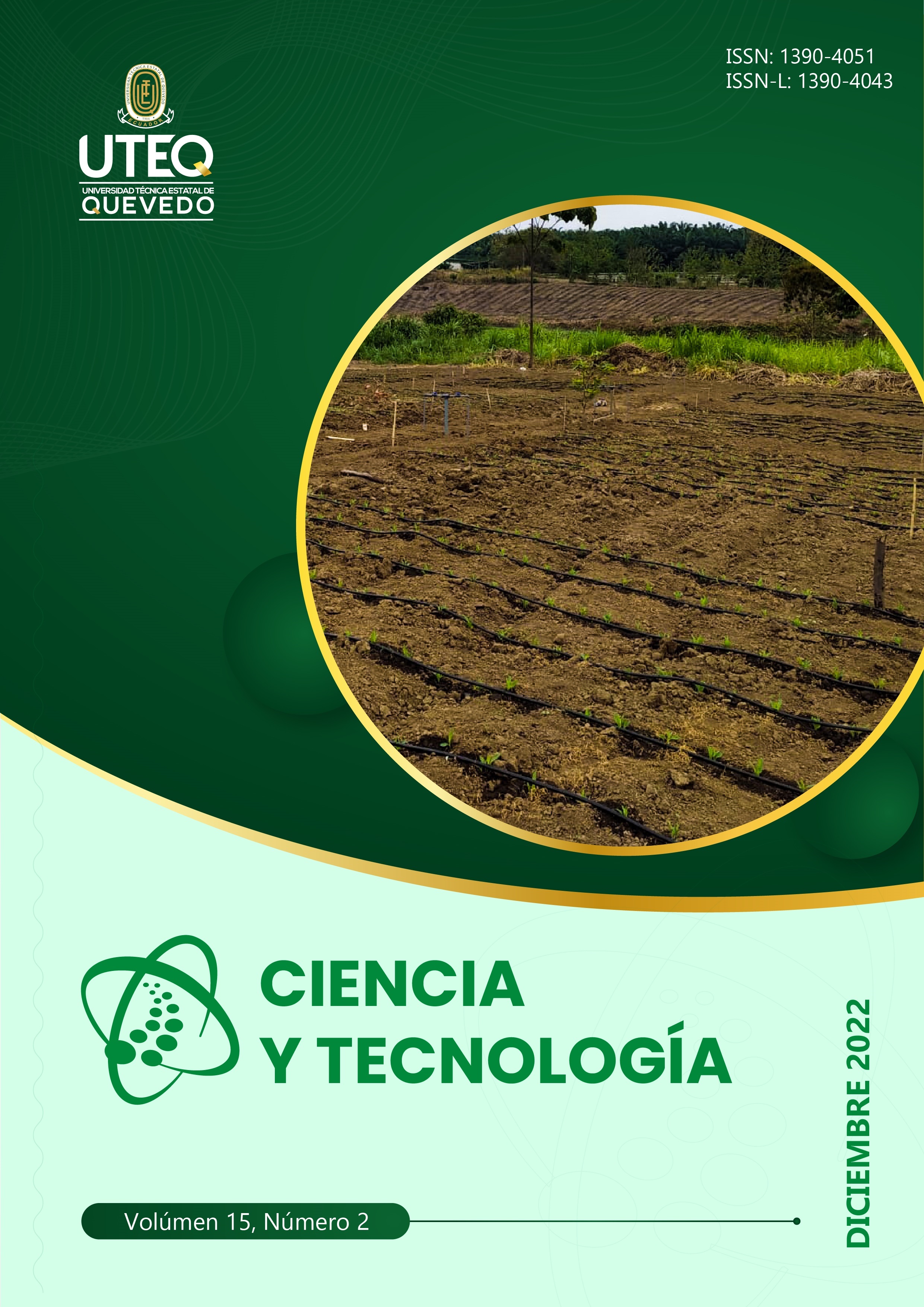
Agronomic response and incidence of Mildiu in turnip crops (Brassica napus L.) with the inoculation of Azotobacter sp and Azospirillum brasilense
DOI:
https://doi.org/10.18779/cyt.v15i2.579Keywords:
Bacteria, biostimulants, biofertilizers, bioproductsAbstract
The benefits of using beneficial bacteria in agriculture are numerous, among them, it helps to improve the yield of crops, inhibits the development of phytopathogens, induces defensive responses in plants and increases their protection against microorganisms, etc. The main objective of this investigation was to evaluate the effect of different bacterial concentrations of Azotobacter sp and Azospirillum brasilense on the growth, development and control of Mildius caused by Peronospora brassicae Gaumann. The experimental design that was used in the investigation was a complete design at random with 8 treatments untest experimental and four repetitions. The turnip seeds were soaked for 2 hours in each of the treatments before planting afterwards, the treatments were applied at 10, 20 and 30 days. To see the differences between the treatments, Tukey's test was implemented (p=< 0.05). The results determined that seeds soaked in bacteria did not represent significant differences (p>=0.05) in the plant emergence parameter. With regard to growth and production parameters such as: height of the plant, length and diameter of the root, fresh and dry biomass of the seedlings and radicles and yield, it was observed that the treatments inoculated with Azotobacter sp and Azospirillum brasilense were one concentration of 1x10⁹ CFU mL-1 presented the best averages if they are significant (p=< 0.05) with respect to the experimental test. The incidence of Mildiu was lower in treatments with the application of Azospirillum brasilense in doses of 1x10⁹ CFU mL-1.
Downloads
References
Abasolo, F., Ojeda-Silvera, C., Cervantes, J., Villacreses, E., Aviles, D., Mendoza, E. y Mazón-Suástegui, J.M. (2020). Respuesta agronómica del Nabo (Brassica napus L.) a la aplicación de medicamentos homeopáticos. Terra Latinoamericana, 38(1), 183-198.
Aisha, H. A., Shafeek, M. R., Mahmoud, R. A., y El Desuki., M. (2014). Effect of various levels of organic fertilizer and humic acid on the growth and roots quality of turnip plants (Brassica rapa). Current Science International, 3(1), 7-14.
Alonso, R. U. y Díaz, E. R. (2019). Evaluación del efecto de tres tratamientos de fertilización (más un testigo DAP) en el desarrollo aéreo y radicular de colinos de café variedad castillo. Revista Matices Tecnológicas, 10 (1), 6-37.
Barahona, Á. F. R., & Torres, I. D. A. (2011). Efecto del Contenido de Humedad sobre Propiedades Físicas de la Semilla de Vitabosa (Mucuna deeringiana). Revista Facultad Nacional de Agronomía Medellín, 64(1), 5961-5971.
Batista, C., Barros, L., Carvalho, A. M. y Ferreira, I. C. (2011). Nutritional and nutraceutical potential of rape (Brassica napus L. var. napus) and “tronchuda” cabbage (Brassica oleraceae L. var. costata) inflorescences. Food and Chemical Toxicology, 49(6), 1208-1214.
Chong-Qui, J. P. (2019). Evaluación de tres tipos de compost en el rendimiento del cultivo de nabo (Brassica rapa L.) [Bachelor's thesis, Universidad Técnica Estatal de Quevedo, Los Ríos, Ecuador].
Conversa, G., Lazzizera, C., Bonasia, A., La Rotonda, P., & Elia, A. (2020). Nutritional characterization of two rare landraces of turnip (Brassica rapa. var. rapa) tops and their on-farm conservation in Foggia province. Sustainability, 12(9), 3842.
Devi, M., R. S. Spehia, M. Sandeep, A. Mogta, and A. Verma. 2018. Influence of integrated nutrient management on growth and yield of cauliflower (Brassica oleraceae) var. botrytis) and soil nutrient status. Int. J. Chem. Stud. 6: 2988-2991.
Henríquez Díaz, L. G., Salgado-Valle, Y., Ramírez-Arrebato, M., Reyes-Pérez, J., Rodríguez Pedroso, A. T., Ruiz Sánchez, M., y Hernández-Montiel, L. G. (2020). Efecto de Quitomax en el control del mildiú velloso en pepino (Cucumis sativus L.). Ecosistemas Recursos Agropecuarios, 7(2), e2479.
Martínez Blanco, B., Antonio Vejar, V., Bello-Martínez, J., et al. 2020. Bacterias promotoras de crecimiento vegetal para incrementar la producción de Lactuca sativa L. en campo. Revista mexicana de ciencias agrícolas, 11(2): 449-452.
Mohammed, A. E., You, M. P., & Barbetti, M. J. (2018). Temperature and plant age drive downy mildew disease epidemics on oilseed Brassica napus and B. juncea. European Journal of Plant Pathology, 151(3), 703-711.
Ojeda-Silvera, C. M., B. Murillo-Amador, A. Nieto-Garibay, E. Troyo-Diéguez, F. H. Ruíz-Espinoza, y J. L. García-Hernández. 2015. Emergencia y crecimiento de plántulas de variedades de albahaca (Ocimum basilicum L.) sometidas a estrés hídrico. Ecosistemas Recur. Agropecuarios. 2(5):151-161.
Reyes, L. M., Jiménez, C. E. A., Montiel, M. G. C., Galdámez, J. G., Cabrera, J. A. M., Aguilar, F. B. M., ... & Padilla, E. G. (2018). Biofertilización y fertilización química en maíz (Zea mays l.) en Villaflores, Chiapas, México. Siembra, 5(1), 26-37.
Roy Chowdhury, A., A. Bagchi, and C. Sengupta. 2016. Isolation and characterization of plant growth promoting rhizobacteria (PGPR) from agricultural field and their potential role on germination and growth of spinach (Spinacia oleracea L.) plants. Int. J. Curr. Agric. Sci. 6: 128-131.
Runno-Paurson, E., Lääniste, P., Eremeev, V., Kaurilind, E., Hõrak, H., Niinemets, Ü., & Metspalu, L. (2019). Evaluation of downy mildew (Hyaloperonospora brassicae) infection severity on different cruciferous oilseed crops. In Rural development 2019: research and innovation for bioeconomy (RD2019): proceedings of the 9th international scientific conference, September 26-28, 2019, Agriculture Academy of Vytautas Magnus University, 2019, p. 329-335.
Sánchez, A. R. Á., Álvarez, E. M. C., Reyes-Pérez, J. J., Casacó, A. R. B., Freile, M. F. M., Véliz, M. B. C., & Alvarado, W. H. S. (2021). Crecimiento, producción y estado fitosanitario de plantas de nabo (brassica napus l.) a la aplicación de quitosano y bacterias promotoras del crecimiento vegetal. Ciencia Latina Revista Científica Multidisciplinar, 5(6), 11392-11406.
Sánchez, A. R. Á., Álvarez, E. M. C., Reyes-Pérez, J. J., Casacó, A. R. B., Freile, M. F. M., Véliz, M. B. C., & Alvarado, W. H. S. (2021). Crecimiento, producción y estado fitosanitario de plantas de nabo (brassica napus l.) a la aplicación de quitosano y bacterias promotoras del crecimiento vegetal. Ciencia Latina Revista Científica Multidisciplinar, 5(6), 11392-11406.
Vásconez, R. D., J. E. Mossot, A. G. Shagñay, E. M.Tenorio, V. P. C. Utreras, y I. D. Suquillo. 2020. Evaluación de Bacillus spp. como rizobacterias promotoras del crecimiento vegetal (RPCV) en brócoli (Brassica oleracea var. italica) y lechuga (Lactuca sativa). Cienc. Tecnol. Agropecuaria. 21(3): 1-16.
Yildirim, E., M. Turan, A. Dursun, M. Ekinci, R. Kul, K. F. Parlakova, D. M. Figen, and N. Kitir. 2016. Integrated use of nitrogen fertilization and microbial inoculation: change in the growth and chemical composition of white cabbage. Commun. Soil Sci. Plant Anal. 47: 1-2245-2260. doi: https://doi.org/10.1080/00103624.2016.1228955.
Published
How to Cite
Issue
Section
License
Licensing Agreement
This journal provides free access to its content through its website following the principle that making research available free of charge to the public supports a larger exchange of global knowledge.
Web content of the journal is distributed under a Attribution-NonCommercial-ShareAlike 4.0 International.
Authors may adopt other non-exclusive license agreements for the distribution of the version of the published work, provided that the initial publication in this journal is indicated. Authors are allowed and recommended to disseminate their work through the internet before and during the submission process, which can produce interesting exchanges and increase citations of the published work.