Selection of Cocoa Genotypes (Theobroma cacao L) Resistant to Witch Broom Disease (Moniliopththora perniciosa) in Los Ríos, Ecuador
DOI:
https://doi.org/10.18779/cyt.v10i1.197Keywords:
THEOBROMA CACAO, RESISTANCE, DISEASE, GENOTYPE.Abstract
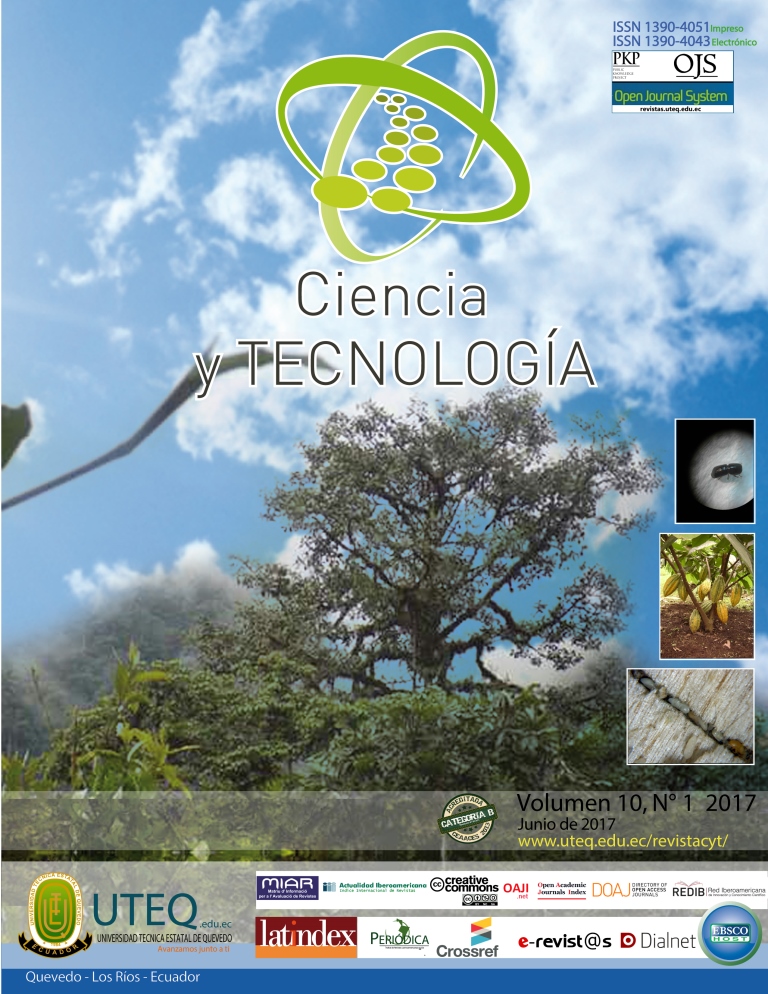
The Cocoa and Coffee Improvement Program at INIAP EET-Pichilingue has been studying, for several years, higher cocoa genotypes (Theobroma cacao L.) characterized by genetic resistance to major diseases, especially to witch broom (Moniliophthora perniciosa), which is the main limiting factor for its cultivation in several Central and South American countries. The objective of the research was to identify and select those cocoa clones having a low incidence of witch broom disease. 21 genotypes were tested: (14) resulting from Amazonian x Amazonian and (4) from Amazonian x National crossings. Among the population derived from National vs. National crosses, no genotypes showing resistance to the disease were found. In addition, INIAPT 074 was selected from the cross between CCN 51 x B 60 and TIP 1 and TAP 6 were used as control clones. The following features were evaluated: Number of healthy pod (MS), Fresh weight (PF), Number of diseased pod (ME), Number of vegetative brooms (EBveg), Number of bearing brooms (EBcojin) and Number of cherimoya fruits (Fchir). A Principal Components Analysis and a cluster analysis were performed using the Ward method and a dendrogram was constructed to determine the similarity between productive and sanitary characteristics. Was determined that the genotypes resulting from the Amazonian x Amazonian crossing: INIAPT 527, INIAPT 560 and INIAPT 526 presented lower incidence of witch broom, and identified themselves as sources of genetic resistance to Moniliophthora perniciosa.
Downloads
Downloads
Published
How to Cite
Issue
Section
License

This work is licensed under a Creative Commons Attribution-NonCommercial-ShareAlike 4.0 International License.
Licensing Agreement
This journal provides free access to its content through its website following the principle that making research available free of charge to the public supports a larger exchange of global knowledge.
Web content of the journal is distributed under a Attribution-NonCommercial-ShareAlike 4.0 International.
Authors may adopt other non-exclusive license agreements for the distribution of the version of the published work, provided that the initial publication in this journal is indicated. Authors are allowed and recommended to disseminate their work through the internet before and during the submission process, which can produce interesting exchanges and increase citations of the published work.