Effect of Ascophyllum nodosum on growth and yield of carrot (Daucus carota L.)
DOI:
https://doi.org/10.18779/cyt.v19i2.1250Keywords:
algae, agriculture, biostimulant, sustainabilityAbstract
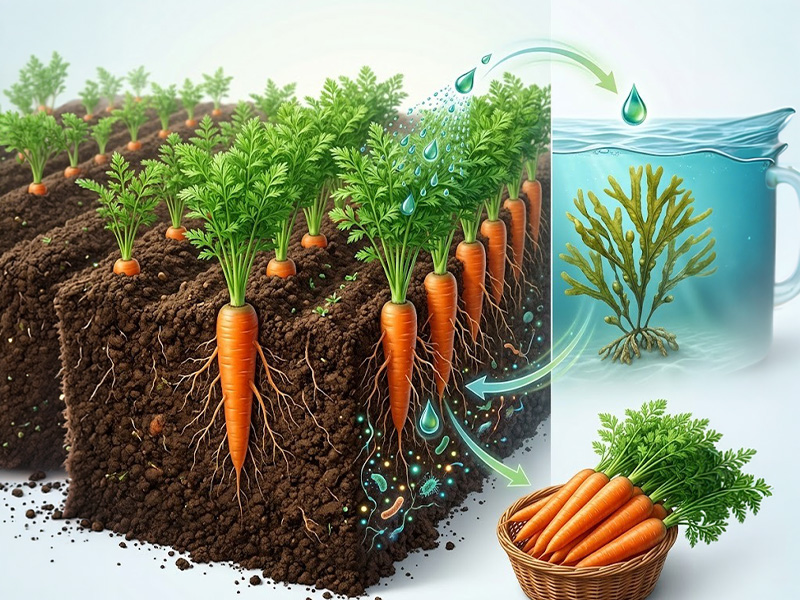
Carrots (Daucus carota L.) are a very important vegetable in Ecuador. They are mainly grown in the Sierra region, where moderate temperatures, constant humidity, and loose, deep soils favor the development of good-quality roots. On the Ecuadorian coast, carrots are grown less frequently due to higher temperatures, higher relative humidity, and sandy soils, conditions that can limit development and yield. Against these challenges, biostimulants made from Ascophyllum nodosum (L.) seaweed have become a promising alternative for improving crop development and promoting more sustainable agricultural practices. Their application contributes to improving plant nutrition by promoting the assimilation and optimization of the use of nutrients available in the soil. In this regard, the effect of four concentrations of a commercial extract of Ascophyllum nodosum (100, 75, 50, and 25 %) was evaluated on growth and production variables of carrot crops (Chantenay Red core variety) under conditions in the Costa region. A completely randomized block design (CRBD) was used, with six treatments and minimal fertilization. The results showed a positive and significant effect (p<0.001) on plant development and root yield, with the 50 % and 75 % concentrations producing the highest values in the variables evaluated. These results suggest that the A. nodosum-based biostimulant can improve carrot growth and yield under conditions on the Ecuadorian coast and with limited fertilization.
Downloads
References
Ali, O., Ramsubhag, A. y Jayarama extract in tomato and sweet pepper crops in a tropical environme n, J. (2019). Biostimulatory activities of Ascophyllum nodosum nt. PLoS One, 14(5). https://url-shortener.me/DCG1.
Di Rienzo, J. A., Casanoves, F., Balzarini, M. G., Gonzalez, L., Tablada, M. y Robledo, C. W. (2020). [Software de cómputo]. Centro de transferencia InfoStat, FCA, Universidad Nacional de Córdoba. http://www.infostat.com.ar.
Espinosa-Antón, A. A., Hernández-Herrera, R. M., y González-González, M. (2020). Extractos bioactivos de algas marinas como bioestimulantes del crecimiento y la protección de las plantas. Biotecnología Vegetal, 20(4), 257-282. https://url-shortener.me/DCFI.
González, G., Vanegas, J., y Vergara, A. (2010). Manual de zanahoria mínimamente procesada: Variedades Chantenay y Baby. https://goo.su/8zPKYh.
Halfhide, T., y Boodoo, M. (2020). Microalgal Harvesting considering Moringa and Watermelon Seeds as Natural Flocculants. Farm and Business-The Journal of the Caribbean Agro-Economic Society, 12(1), 20-26. http://dx.doi.org/10.22004/ag.econ.307708.
Hassan, S. M., Ashour, M., Sakai, N., Zhang, L., Hassanien, H. A., Gaber, A. y Ammar, G. (2021). Impact of seaweed liquid extract biostimulant on growth, yield, and chemical composition of cucumber (Cucumis sativus). Agriculture, 11(4), 320. https://doi.org/10.3390/agriculture11040320.
Hidangmayum, A. y Sharma, R. (2017). Effect of different concentrations of commercial seaweed liquid extract of Ascophyllum nodosum as a plant biostimulant on growth, yield, and biochemical constituents of onion (Allium cepa L.). Journal of Pharmacognosy and Phytochemistry, 6(4), 658–663. https://urlshortener.me/3E81.
Huespe, D., Solaro, C. y Ponce, J. P. (2022). Ensayo comparativo de rendimiento de Zanahoria (Daucus carota L.) para dos fechas diferentes de cosecha en la Región Semiárida Pampeana. Semiárida, 32(2), 57-64. https://doi.org/10.19137/semiarida.2022(02).57-64.
INAMHI. (2025). Estación Meteorológica Pichilingue [Datos meteorológicos]. Instituto Nacional de Meteorología e Hidrología (INAMHI). https://inamhi.gob.ec/info/.
Kumari, S., Sehrawat, K. D., Phogat, D., Sehrawat, A. R., Chaudhary, R., Sushkova, S. N., Voloshina, M.S., Rajput, V.D., Shmaraeva, A.N. y Shende, S. S. (2023). Ascophyllum nodosum (L.) Le Jolis, a pivotal biostimulant toward sustainable agriculture: A comprehensive review. Agriculture, 13(6), 1179. https://doi.org/10.3390/agriculture13061179.
Mutum, L., Janda, T., Darkó, É., Szalai, G., Hamow, K. Á. y Molnár, Z. (2023). Outcome of Microalgae Biomass Application on Seed Germination and Hormonal Activity in Winter Wheat Leaves. Agronomy, 13(4), 1088. https://doi.org/10.3390/agronomy13041088.
Nagraj, G. S., Jaiswal, S., Harper, N. y Jaiswal, A. K. (2020). Carrot. Nutritional Composition and Antioxidant Properties of Fruits and Vegetables, 323–337. https://doi.org/10.1016/B978-0-12-812780-3.00020-9.
Organización de las Naciones Unidas para la Alimentación y la Agricultura. (2023). Cultivos y productos de ganadería. https://url-shortener.me/3DZV. (Consultado el 12 de septiembre de 2025).
Pereira, L., Morrison, L., Shukla, P. S. y Critchley, A. T. (2020). A concise review of the brown macroalga Ascophyllum nodosum (Linnaeus) Le Jolis. Journal of Applied Phycology, 32, 3561-3584. https://doi.org/10.1007/s10811-020-02246-6.
Rodríguez-Izquierdo, L., Chinea-Horta, A., Falcón-Rodríguez, A. y Ramos-León, J. Z. (2021). Crecimiento y relación fuente-demanda en plantas de zanahoria bioestimuladas con Quitomax® y Pectimorf®. Cultivos Tropicales, 42(4), 1-21. https://url-shortener.me/DCIK.
Sovarel, G., Maior, L., Ivan, G. y Acatrinei, I. (2017). Behavior of some carrot cultivars (Daucus carota L.) during 2016, in Vidra area. Current Trends in Natural Sciences, 6(11), 53–57. https://url-shortener.me/DCJ8.
Shukla, P. S., Mantin, E. G., Adil, M., Bajpai, S., Critchley, A. T. y Prithiviraj, B. (2019). Ascophyllum nodosum-based biostimulants: Sustainable applications in agriculture for the stimulation of plant growth, stress tolerance, and disease management. Frontiers in Plant Science, 10, 655. https://doi.org/10.3389/fpls.2019.00655.
Sovarel, G., Maior, L., Ivan, G. y Acatrinei, I. (2017). Behavior of some carrot cultivars (Daucus carota L.) during 2016, in Vidra area. Current Trends in Natural Sciences, 6(11), 53–57. https://url-shortener.me/DCJ8 .
Supraja, K. V., Behera, B. y Balasubramanian, P. (2020). Efficacy of microalgal extracts as biostimulants through seed treatment and foliar spray for tomato cultivation. Industrial Crops and Products, 151, 112453. https://doi.org/10.1016/j.indcrop.2020.112453.
Tian, S. L., Khan, A., Zheng, W. N., Song, L., Liu, J. H., Wang, X. Q. y Li, L. (2022). Effects of Chlorella extracts on growth of Capsicum annuum L. seedlings. Scientific Reports, 12(1), 15455. https://doi.org/10.1038/s41598-022-19846-6.
Wang, M., Yin, Z., Sun, W., Zhong, Q., Zhang, Y. y Zeng, M. (2023). Microalgae play a structuring role in food: Effect of spirulina platensis on the rheological, gelling characteristics, and mechanical properties of soy protein isolate hydrogel. Food Hydrocolloids, 136, 108244. https://doi.org/10.1016/j.foodhyd.2022.108244.
Published
How to Cite
Issue
Section
License
Copyright (c) 2026 Daniela Alexandra Martinez Vargas, Carlos Andrés Bolaños Carriel, Ana Ruth Álvarez Sánchez, Yordy Ariel Arcos Palma, Alex Darling Bravo Sánchez

This work is licensed under a Creative Commons Attribution-NonCommercial-ShareAlike 4.0 International License.
Licensing Agreement
This journal provides free access to its content through its website following the principle that making research available free of charge to the public supports a larger exchange of global knowledge.
Web content of the journal is distributed under a Attribution-NonCommercial-ShareAlike 4.0 International.
Authors may adopt other non-exclusive license agreements for the distribution of the version of the published work, provided that the initial publication in this journal is indicated. Authors are allowed and recommended to disseminate their work through the internet before and during the submission process, which can produce interesting exchanges and increase citations of the published work.