Effect of Trichoderma harzianum on the suppression of Pratylenchus spp. in banana (Musa paradisiaca L.) variety Gran William
DOI:
https://doi.org/10.18779/cyt.v19i2.1223Keywords:
nematodes, conidia, biological control, mycoparasiteAbstract
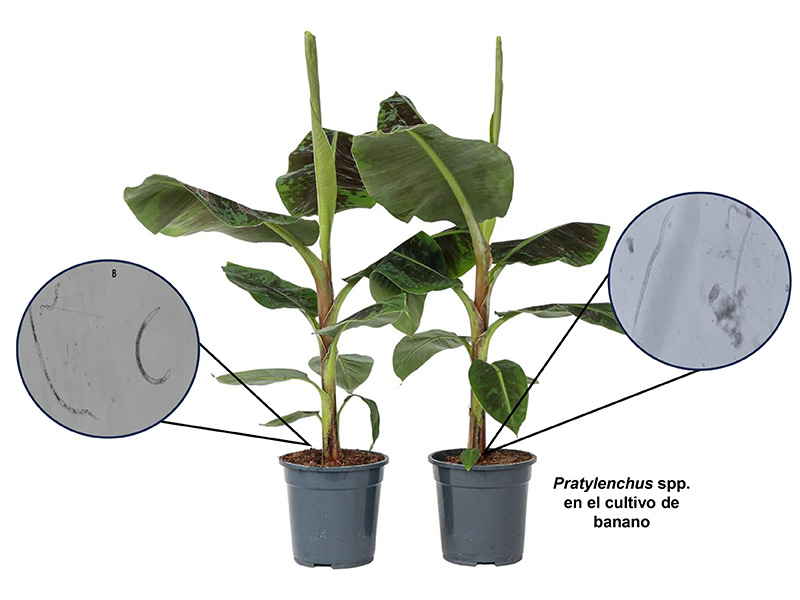
Nematodes are one of the main plant parasitic agents responsible for the greatest losses in banana plantations. The Trichoderma genus has been proposed as a biological alternative for controlling pathogenic organisms. This research was conducted at the "La María" Campus of the Universidad Técnica Estatal de Quevedo. The objective was to evaluate the effect of Trichoderma harzianum on the Pratylenchus spp. population in banana Gran William variety. A completely randomized design (CRD) was used with six treatments and three replications: T1 (T. harzianum 1×10 4 conidia mL -1), T2 (T. harzianum 1×10 / 6 conidia mL -1), T3 (T. harzianum 1×10 / 8 conidia mL-1), T4 (T. harzianum 1×10 /10 conidia mL-1), T5 (chemical control with nematicide) and T6 (control without application). The results demonstrated that treatments with T. harzianum at the highest concentrations (T3 and T4), as well as chemical control (T5), were effective in reducing nematode decreasing the net reproductive rate. In addition, a significant effect was observed on morphological variables root length and total weight. Chemical treatment (T5) was most effective in reducing nonfunctional roots and decreasing Pratylenchus spp., followed by treatment with T. harzianum at a concentration of 1 × 10 / 10 conidia mL-1 (T4). This demonstrated the potential of T. harzianum as an effective biological alternative to chemical nematicides, contributing to nematode management in banana crops.
Downloads
References
Abdulla, G. A., Saleh, H. M., y Al-Hakeem, A. M. (2023). Effects of Trichoderma harzianum and Trichoderma Asperellum against egg of meloidogyne incognita under laboratory condition. IOP Conference Series: Earth and Environmental Science, 1213(1). https://doi.org/10.1088/1755-1315/1213/1/012011.
Ahmad, G., Khan, A., Ansari, S., Khan, A. A., Elhakem, A., Sami, R., y Mohamed, H. I. (2022). Management of root-knot nematode infection by using fly ash and Trichoderma harzianum in Capsicum annum plants by modulating growth, yield, photosynthetic pigments, biochemical substances, and secondary metabolite profiles. Notulae Botanicae Horti Agrobotanici Cluj-Napoca, 50(1). https://doi.org/10.15835/nbha50112591.
Alinc, A., Peri, E., Torta, L., y Colazza, S. (2021). Trichoderma harzianum strain T22 modulates direct defense of tomato plants in response to Nezara viridula feeding activity. Journal of Chemical Ecology, 47(4), 455-462. https://doi.org/10.1007/s10886-021-01260-3.
Arboleda-Riascos, C. E., Riascos-Ortiz, D. H., Varón De Agudelo, F., Mosquera-Espinosa, A. T., Oliveira, C. M. G., y Muñoz-Flórez, J. E. (2022). Pratylenchus araucensis (Rhabditida: Pratylenchidae) a Widely Distributed Nematode in Musa spp. From Colombia. Journal of Nematology, 54(1). https://doi.org/10.2478/jofnem-2022-0057.
Beteta Alvarado, V. M., Diaz Dumont, J. R., Oré Cierto, L. E., Loarte Aliaga, W. C., Garcia Curo, G., Diaz Tito, L. P., y Malpartida Gutiérrez, J. N. (2022). El compostaje de cáscara de Musa paradisiaca L. para la producción de biogás y biometano como estrategia de preservación de la salud ambiental. Boletin de Malariologia y Salud Ambiental, 62(5), 1048-1054. https://docs.bvsalud.org/biblioref/2023/05/1428436/594-1733-1-pb.pdf.
Bucki, P., Qing, X., Castillo, P., Gamliel, A., Dobrinin, S., Alon, T., y Braun Miyara, S. (2020). The genus Pratylenchus (Nematoda: Pratylenchidae) in Israel: From taxonomy to control practices. Plants, 9(11), 1475. https://doi.org/10.3390/plants9111475.
Castillo-Arévalo, T. (2022a). Alternativas biológicas y químicas para el manejo de Fitonematodos en cultivo de plátano AAB (Musa paradisiaca L.) en Rivas, Nicaragua. Revista Universitaria del Caribe, 28(01), 95–102. https://doi.org/10.5377/ruc.v28i01.14449.
Castillo-Arévalo, T. (2022b). Evaluación in vitro de hongos Hypocreales para el control de Pratylenchus ssp, Scutellonema ssp y Helicotylenchus ssp. Revista Universitaria del Caribe, 29(02). https://doi.org/10.5377/ruc.v29i02.15253.
Castillo Castillo, A., Martínez, H. C., Arteaga Alcívar, F. J., y Álava Cruz, D. A. (2025). Rizobacterias y Trichodermas antagonistas al control de nematodos fitoparásitos en plátano barraganete (Musa paradisiaca L.). Revista Ciencia y Tecnología,18(2), 38-47. https://doi.org/10.18779/cyt.v18i2.994.
Cuzco Jiménez, V. del C., Luna Romero, Ángel E., Carvajal Romero, H. R., y Cervantes Alava, A. R. (2021). Análisis de tendencia de la exportación de banano (Musa AAA) en el Ecuador, periodo 1995-2020.Revista Científica Agroecosistemas,9(2), 99–106.https://aes.ucf.edu.cu/index.php/aes/article/view/475.
d’Errico, G., Greco, N., Viñale,F., Marra, R., Stillittano, V., Davino, S. W., Woo, S. L., y D’Addabbo, T. (2022). Synergistic Effects of Trichoderma harzianum, 1,3 Dichloropropene and Organic Matter in Controlling the Root-Knot Nematode Meloidogyne incognita on Tomato. Plants, 11(21), 2890. https://doi.org/10.3390/plants11212890.
de Oliveira, C. M., Oshiquiri, L. H., Almeida, N. O., Steindorf, A. S., da Rocha, M. R., Georg, R. C., y Ulhoa, C. J. (2023). Trichoderma harzianum transcriptome in response to the nematode Pratylenchus brachyurus. Biological Control, 183. https://doi.org/10.1016/j.biocontrol.2023.105245.
de Souza Junior, F. J. C. (2023). The root-lesion nematode (Pratylenchus zeae) parasitising mandacaru cactus in Northeast of Brazil. Australasian Plant Disease Notes, 18(1). https://doi.org/10.1007/s13314-023-00510-5.
e Silva, M. T. R., e Silva, B. de A., Alberton, O., Schwengber, R. P., y Dias-Arieira, C. R. (2022). Rhizophagus clarus controls Meloidogyne javanica and enhances the activity of defense-related enzymes in tomato. Horticultura Brasileira, 40(2). https://doi.org/10.1590/s0102-0536-20220205.
Esteves, I., Maleita, C., Pato, T., Abrantes, I., y Cunha, M. J. (2019). In vitro reproduction of Pratylenchus neglectus on carrot discs and investigation of its interaction with Meloidogyne hispanica on potato. European Journal of Plant Pathology, 153(3), 957-963. https://doi.org/10.1007/s10658-018-1582-9.
Ganeshan, K., Vetrivelkalai, P., Bhagawati, B., Gupta, N., Devrajan, K., Raveendran, M., y Balachandar, D. (2021). Endophytic fungi as potential bio-control agents against root knot nematode, Meloidogyne incognita in banana. Current Journal of Applied Science and Technology, 40(29), 7–18. https://doi.org/10.9734/cjast/2021/v40i2931536.
González-León, Y., Ortega-Bernal, J., Anducho-Reyes, M. A., y Mercado-Flores, Y. (2022). Bacillus subtilis y Trichoderma: características generales y su aplicación en la agricultura. TIP Revista Especializada En Ciencias Químico-Biológicas, 25(1), 1–14. https://doi.org/10.22201/fesz.23958723e.2022.520.
Guo, R., Li, G., Zhang, Z., y Peng, X. (2022). Structures and biological activities of secondary metabolites from Trichoderma harzianum. Marine drugs. 20(11), 701. https://doi.org/10.3390/md20110701.
Kassam, R., Kranti, K. V. V. S., Yadav, J., Chatterjee, M., Chawla, G., Kundu, A., Hada, A., Thokala, P. D., Shukla, L., Mishra, J., Rana, V. S., Mukhopadhyay,R., Phani, V., y Rao, U. (2023). Exploration of rhizosphere-dwelling nematophagous Trichoderma spp. using novel ‘bait technique’ with root-knot nematode Meloidogyne incognita. Biological Control, 186. https://doi.org/10.1016/j.biocontrol.2023.105327.
López Martínez, T. de los Á., Páramo Aguilera, L. A., y Delgado Silva, H. D. (2022). Reproducción masiva de hongos Trichodermas previamente identificados de suelos Nicaragüenses en diferentes sustratos orgánicos. Nexo Revista Científica, 35(03), 700-712. https://doi.org/10.5377/nexo.v35i03.15000.
Moo-Koh, F. A., Cristóbal-Alejo, J., Andrés, M. F., Martín, J., Reyes, F., Tun-Suárez, J. M., y Gamboa-Angulo, M. (2022). In Vitro assessment of organic and residual fractions of nematicidal culture filtrates from thirteen tropical Trichoderma strains and metabolic profiles of most-active. Journal of Fungi, 8(1), 82. https://www.mdpi.com/2309-608X/8/1/82.
Nafady, N. A., Sultan, R., El-Zawahry, A. M., Mostafa, Y. S., Alamri, S., Mostafa, R. G., Hashem, M., y Hassan, E. A. (2022). Effective and Promising strategy in management of tomato root-knot nematodes by Trichoderma harzianum and arbuscular mycorrhizae. Agronomy, 12(2). https://doi.org/10.3390/agronomy12020315.
Nomura, R.B.G., Lopes-Caitar, V.S., Hishinuma-Silva, S. M., Zamboni Machado, A. C., Conrado Meyer, M., y Marcelino-Guimarães, F. C. (2024). Pratylenchus brachyurus: status and perspectives in Brazilian agriculture. Trop. plant pathol. 49, 573–589. https://doi.org/10.1007/s40858-024-00669-x.
Piedra-Bonilla, E., y Echeverría, Y. (2024). Changes in the adaptive capacity of livelihood vulnerability to climate change in ecuador’s tropical commodity crops: banana and cocoa. En: Florez, H.,Leon, M. (eds) Applied Informatics. ICAI 2023. Communications in Computer and Information Science, vol 1874. Springer, Cham. https://doi.org/10.1007/978-3-031-46813-1_24.
Sandoval-Ruiz, R., Gómez-Alpízar, L., Humphreys-Pereira, D. A., y Flores-Chaves, L.(2022). Molecular identification of root-lesion nematodes, Pratylenchus spp. in agricultural crops from Costa Rica. Agronomia Mesoamericana, 34(1). https://doi.org/10.15517/am.v34i1.49445.
Sanó, L., Oliveira, L. L. B. de, Leão, M. D. M., Santos, J. E. de Á. D, Medeiros, S. C. de, Schneider, F., Sousa, A. B. O. de, Taniguchi, C. A. K., Muniz, C. R., Grangeiro, T. B., y Silva, C. de F. B. da. (2022). Trichoderma longibrachiatum as a biostimulant of micropropagated banana seedlings under acclimatization. Plant Physiology and Biochemistry, 190, 184-192. https://doi.org/10.1016/j.plaphy.2022.09.008.
Singh, P., Singh, R., Madhu,G. S., y Singh, V. P. (2023). Seed biopriming with Trichoderma harzianum for Growth promotion and drought tolerance in rice (Oryza sativus). Agricultural Research, 12(2), 157-162. https://doi.org/10.1007/s40003-022-00641-8.
Soto-Valenzuela, J. O., Álvarez-Vera, M. S., Vázquez Vásquez, J. E., y Ricardo Ricardo, G. B. (2024). Evaluación físico, químico y microbiológico del suelo en cultivos de Musa paradisiaca Cavendish y Elaeis guineensis Jac. Provincia de los Ríos. Alfa Revista De Investigación En Ciencias Agronómicas Y Veterinarias, 8(22), 110-125. https://doi.org/10.33996/revistaalfa.v8i22.252.
Subash, M, y Perumalsamy, M. (2024). Green degumming of banana pseudostem fibers for yarn manufacturing in textile industries. Biomass Conversion and Biorefinery, 14(4), 5285-5294. https://doi.org/10.1007/s13399-022-02850-1.
Published
How to Cite
Issue
Section
License
Copyright (c) 2026 Juan Bautista Troncozo Correa, Mauro Danilo Palacios Moran, Víctor Jorge García Gallirgos, Willington Paul Alcívar Macias

This work is licensed under a Creative Commons Attribution-NonCommercial-ShareAlike 4.0 International License.
Licensing Agreement
This journal provides free access to its content through its website following the principle that making research available free of charge to the public supports a larger exchange of global knowledge.
Web content of the journal is distributed under a Attribution-NonCommercial-ShareAlike 4.0 International.
Authors may adopt other non-exclusive license agreements for the distribution of the version of the published work, provided that the initial publication in this journal is indicated. Authors are allowed and recommended to disseminate their work through the internet before and during the submission process, which can produce interesting exchanges and increase citations of the published work.