Effect of microbial transglutaminase (Streptomyces mobaraensis) on the restructuring of cooked tuna (Thunnus albacares) fragments
DOI:
https://doi.org/10.18779/cyt.v19i1.1171Keywords:
Food enzymes, protein utilization, marine by-products, physicochemical properties, food sustainabilityAbstract
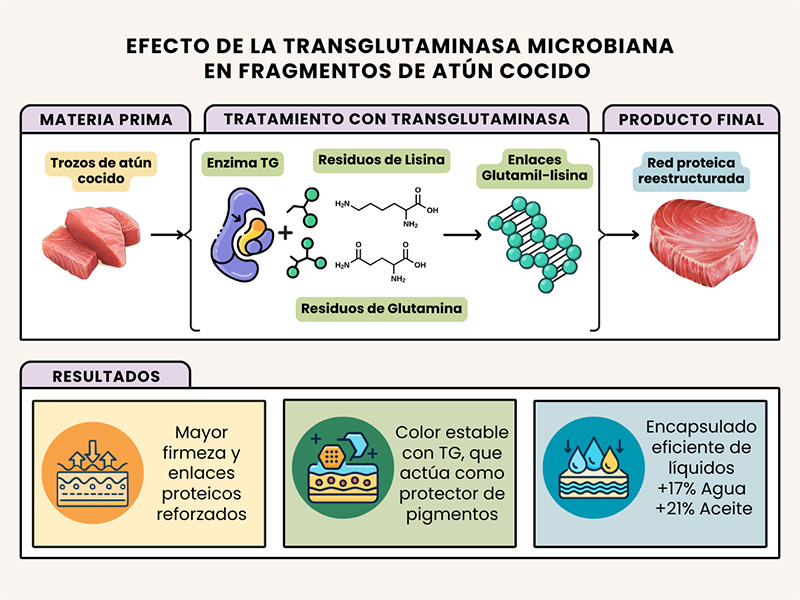
Industrial fish processing, especially tuna, generates large volumes of by-products such as meat fragments which, despite their high nutritional value, present technological limitations for optimal utilization. This study evaluated the use of microbial transglutaminase as a restructuring agent to improve the functional properties of the cooked tuna fragments. The effect of different enzyme concentrations (0.5 % and 1.0 %) on the physicochemical properties of restructured tuna fragments was analyzed over a 7-day period of refrigerated storage. The experimental design included four treatments (Control without fragmentation, fragments without enzyme, and fragments treated with 0.5 % and 1.0 % TG). Analyses included texture profile, instrumental color stability, and liquid retention capacity. The results demonstrated substantial improvements in multiple functional properties. In textural terms, the enzyme significantly increased hardness, cohesiveness, and gumminess compared to untreated fragments. Simultaneously, water and oil retention capacity showed progressive increases with enzyme concentration, reaching maximum values with the 1.0 % treatment (88.87 +- 0.01 % for water and 87.13 +- 0.01 % for oil). Additionally, transglutaminase reduced chromatic alterations associated with muscle tissue fragmentation, preserving visual stability during storage. The 0.5 % concentration was identified as the most optimal, providing significant improvements in all evaluated properties, while higher concentrations offered marginal benefits. These findings establish a solid technological basis for development of restructured products, confirming the effectiveness of microbial transglutaminase.
Downloads
References
Aguilar-Zárete, P., Aguilar-Zárete, M., Carrillo Inungaray, M. L., y Portilla Rivera, O. M. (2012). Importancia de la producción de transglutaminasa microbiana para su aplicación en alimentos. Revista Científica de la Universidad Autónoma de Coahuila, 4(8), 1-17. https://bit.ly/4pDMjXJ
Añorve, A. A., Escalona-Buendía, H. B., Luna-Rodríguez, L., Pérez-Chabela, M. L., Ponce-Alquicira, E., Soriano-Santos, J., y Vargas-Romero, J. M. (2019). Reestructurados de pescado: una buena alternativa de proteína utilizando especies de bajo valor comercial o recortes. Nacameh, 13(1), 12-24. https://dialnet.unirioja.es/servlet/articulo?codigo=7103351
Ardiansyah, A., Sahubawa, L., y Ustadi. (2020). Restructuring steak from flakes of yellowfin tuna meat using low salt microbial transglutaminase (MTGase). IOP Conf. Series: Earth and Environmental Science, 404, 1-9. https://doi.org/10.1088/1755-1315/404/1/012073
Arteaga, M., Merchán, D., Mend Ochoa, M. (2022). Residuos de pescado: impacto ambiental y utilización. Pro Sciences: Revista de Producción. Ciencias E Investigación, 6(42), 445-452. https://doi.org/10.29018/issn.2588-1000vol6iss42.2022pp445-452
Barbut, S. (2024). Measuring water holding capacity in poultry meat. Poultry Science, 103(5)1-8. https://doi.org/10.1016/j.psj.2024.103577
Benjakul, S., Visessangua, W., Phatchrat, S., y Tanaka, M. (2007). Chitosan affects transglutaminase-induced surimi gelation. Journal of Food Biochemistry, 27(1), 53-66. https://doi.org/10.1111/j.1745-4514.2003.tb00266.x
Bourne, M. C. (2002). Chapter 1 - Texture, Viscosity, and Food. En Elsevier eBooks (pp. 1-32). https://doi.org/10.1016/b978-012119062-0/50001-2
Del Mar. (2021). Manual de procesos para la elaboración de conservas de atún. Documento interno. Manta, Ecuador.
Erdem, N., Babaoglu, A. S., Pocan, H. B., y Karakaya, M. (2020). The effect of transglutaminase on some quality properties of beef, chicken, and turkey meatballs. Journal Of Food Processing and Preservation, 44(3), 1-8. https://doi.org/10.1111/jfpp.14815
Kaic, A., Janjecí, Z., Zgur, S., Sikic, M., y Potocnik, K. (2021). Physicochemical and sensory attributes of intact and restructured chicken breast meat supplemented with transglutaminase. Animals, 11(9), 1-8. https://doi.org/10.3390/ani11092641
Kolotylo, V., Piwowarek, K., y Kieliszek, M. (2023). Microbiological transglutaminase: biotechnological application in the food industry. Open Life Science, 18(1), 1-22. https://doi.org/10.1515/biol-2022-0737
Kuraishi, C., Yamazaki, K., y Susa, Y. (2001). Transglutaminase: its utilization in the food industry. Food Reviews International, 17(2), 221-246. https://doi.org/10.1081/fri-100001258
Le, N. P., Tran, T. T. T., Ton, N. M. N., y Le, V. V. M. (2023). Effects of transglutaminase treatment on cooking quality, textural properties, and overall acceptability of high fibre pasta incorporated with pennywort residue. International Food Research Journal, 30(6), 1572-1581. https://doi.org/10.47836/ifrj.30.6.19
Panuncio, A., Cardeza, L., Quintero, M., Solé, M. L., Barrios, S., y Gámbaro, A. (2013). Efecto de la incorporación de transglutaminasa microbiana en las propiedades sensoriales de hamburguesas de desmenuzado de merluza (Merluccius hubbsi). INNOTEC, 8, 39-43. https://www.redalyc.org/articulo.oa?id=606166713005
Pietrazik, Z., Jarmoluka, A., y Shand, P. J. (2007). Effect of non-meat proteins on hydration and textural properties of pork meat gels enhanced with microbial transglutaminase. LWT - Food Science and Technology, 40 (5). 915-920. https://doi.org/10.1016/j.lwt.2006.03.003
Rodríguez Castillejos, G. C., Téllez, S. J., Vázquez Vázquez, M., Lois, J., y Ramírez de León, J. A. (2013). Producción de transglutaminasa microbiana y sus aplicaciones potenciales en México. En Plaza y Valdés (Eds.), Avances de ciencia y tecnología alimentaria en México (pp. 557-577). Plaza y Valdés, S. A. de C. V. https://bit.ly/4nesTad
Setiadi, Sah, W. I., y Alisha, N. (2018). The Influences of transglutaminase enzyme dosage on the meat characteristic from restructuring the animal and vegetable protein sources. EDP Sciences, 67, 1-6. https://doi.org/10.1051/e3sconf/20186703043
Valdés Restrepo, M., Delgado Ospina, J., Londoño-Hernández, L., y Rodríguez Restrepo, R. A. (2023). Sistema de medición del color como parámetro de calidad en la industria de alimentos. Temas Agrarios, 28(1), 69-81. https://doi.org/10.21897/rta.v28i1.3200
Valencia, E., González, S., Quevedo, R., y Leal, M. (2015). Aplicación de la enzima transglutaminasa en salmón, reineta y pulpo. Información Tecnológica, 26(3), 3-8. https://doi.org/10.4067/S0718-07642015000300002
Vasic, K., Knez, Z, y Leitgeb, M. (2023). Transglutaminase in foods and biotechnology. Internacional Journal of Molecular Sciences, 24(15), 1-23. https://www.mdpi.com/1422-0067/24/15/12402
Published
How to Cite
Issue
Section
License
Copyright (c) 2026 Josselyn Nicole Mieles Quiñónez, José Luis Coloma Hurel

This work is licensed under a Creative Commons Attribution-NonCommercial-ShareAlike 4.0 International License.
Licensing Agreement
This journal provides free access to its content through its website following the principle that making research available free of charge to the public supports a larger exchange of global knowledge.
Web content of the journal is distributed under a Attribution-NonCommercial-ShareAlike 4.0 International.
Authors may adopt other non-exclusive license agreements for the distribution of the version of the published work, provided that the initial publication in this journal is indicated. Authors are allowed and recommended to disseminate their work through the internet before and during the submission process, which can produce interesting exchanges and increase citations of the published work.