Production of coffee varieties and clones (Coffea canephora) under subtropical conditions in Guasaganda - Ecuador
DOI:
https://doi.org/10.18779/cyt.v18i2.1032Keywords:
yield, crop, seasons, agroecosystemAbstract
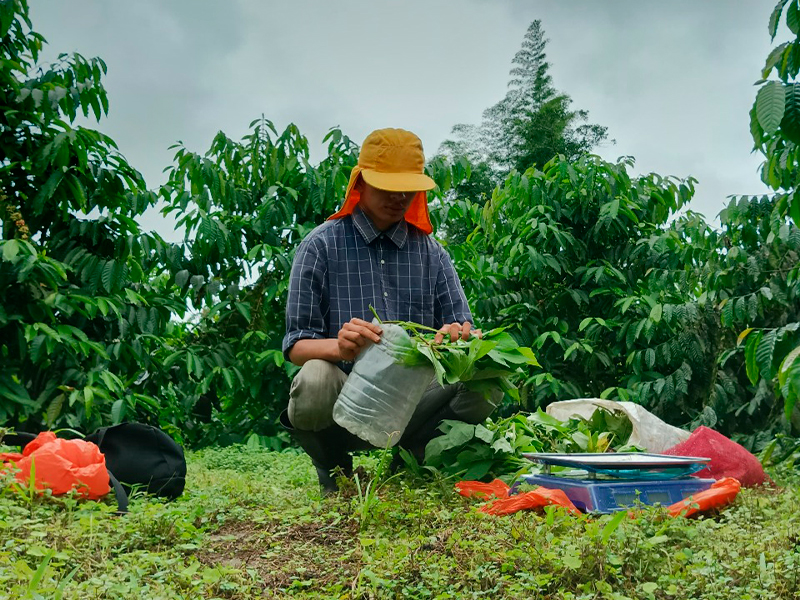
Coffea canephora, known as robusta coffee, is an important species in the world coffee industry, valued for its caffeine content and its adaptability to diverse climatic conditions. The Technical University of Cotopaxi - Ecuador through the project “Promotion of Integral Coffee Production in the Province of Cotopaxi” evaluated the production of varieties and clones of robusta coffee (Coffea canephora P) under subtropical conditions in the parish of Guasaganda, province of Cotopaxi - Ecuador in the experimental center Sacha Wiwa. Two experimental lots were established, lot 1 with the varieties Ecorobusta, Napopayamino and Coniolón and lot 2 with the clones COF-06; COF-01; COF-02; EET-375611; NP-2024; NP-3051. Each lot was studied differently, in a randomized complete block design (DBCA) with four replications, for the analysis of means the Tukey's multiple range test was used at 5 % probability. The varieties and clones were evaluated in the rainy and dry seasons of 2022 and 2023. In lot 1, the variety with the highest production was Ecorobusta with 9,121.78, 17,548.39 and 13,979.12 g/plant; in lot 2, the clones that stood out in the dry and rainy seasons were COF-06 with 535.50 and 53,010.00 g/plant and clone EET-375611 with 6,842.50 and 16,071.00 g/plant. These varieties and clones have adapted to the agroclimatic conditions of the area, so it is recommended to disseminate them among farmers.
Downloads
References
Arzube Mayorga, M., Orrala Borbor, N., León Mejía, Ángel. y Ramírez Flores, L. (2017). Comportamiento productivo de clones de café robusta (Coffea canephora P) en Manglaralto, Ecuador. Revista Cientifica y Tecnologica UPSE, 4(1), 34-38. https://surli.cc/gykfio
Campuzano-Duque, L. y Wohlgemuth Blair, M. (2022). Estrategias para el mejoramiento del café robusta (Coffea canephora) como nuevo cultivo en Colombia. Agriculture, 12(10). https://doi.org/10.3390/agriculture12101576
Chilán Villafuerte, W., Duicela Guambi, L., Pinargote Alonso, P. y Salcedo Benítez, J. (2025). Competitividad de los cafés robustas especiales por origen y métodos de beneficio, en Ecuador: 2016-2022. Desarrollo Agropecuario, Tecnológico, Empresarial y Humanista (DATEH), 7(1). https://surli.cc/upxqcr
COFENAC. (2012). Mejoramiento genético y desarrollo de tecnologías para la producción de café robusta, en el trópcio seco del litoral ecuatoriano . Consejo Cafetalero Nacional , Dublinsa , Portoviejo.
Di Rienzo, J., Casanoves, F., Balzarini, M., Gonzalez, L., Tablada, M. y Robledo, C. (2020). InfoStat verisón 2020 Centro de transferencia. Universidad Nacional de Córdoba, Argentina. http://www.infbostat.com.ar
Duicela Guambi, L., Guamán Aguilar, J., Farfán Talledo, D. y Chilán Villafuerte, W. (2020). Poscosecha y calidad del café robusta. Calceta, cantón Bolívar, Manabí: Humus. https://reducafe.com/wp-content/uploads/2022/08/Libro-Poscosecha-y-calidad.pdf
Ministerio de Agricultura y Ganadería (2021). Informe de rendimientos de café grano oro. Ministerio de Agricultura y Ganadería (MAG). https://surli.cc/xibjle
Motato-Alarcón, N., Orrala-Borobor, N., Castro, L. y Duicela-Guambi, L. (2018). Plan de Investigación y Desarrollo Cafetalero: Café, Caficultura y Caficultores. Red Universitaria de Investigación y Desarrollo Cafetalero (REDUCAFÉ), Manta.
Plaza Avellán, L., Loor Solórzano, R., Guerrero Castillo, H. y Duicela Guambi, L. (2015). Caracterización fenotípica del germoplasma de Coffea canephora Pierre base para su mejoramiento en Ecuador. ESPAMCIENCIA, 6(1), 7-13. https://surli.cc/ihbawf
Preedy, V. y Patel, V. (2025). Coffee In Health and Disease prevention (2ª ed.). Elsevier Inc. https://surli.cc/bwtcxm
SIPA. (2024). Rendimientos objetivos de café. Ministerio de Agricultura y Ganadería , Sistema de Información Pública Agropecuaria del Ecuador, Quito. https://surli.cc/ntpwqx
Tezara Fernández, W., Mendoza Cortez, P., Loyaga Guerrero, W., Reynel Chila, V. y Bolaños Ortega, M. (2020). Capacidad fotosintética de 15 clones de café robusta (Coffea canephora) en Esmeraldas, Ecuador. ESPAMCIENCIA, 11(2), 57-67. https://doi.org/10.51260/revista_espamciencia.v11i2.206
Toapanta Añarumba, J., Quinatoa Lozada, E., Luna Murillo, R. y Macias Pettao, R. (2023). Producción de café (Coffea canephora P) en el subtrópico ecuatoriano en respuesta a diferentes niveles de fertilización inorgánica-orgánica. Revista Multidisciplinar Ciencia Latina, 7(1), 2750-2761. https://doi.org/https://doi.org/10.37811/cl_rcm.v7i1.4623
Tomalá, J. (2017). Análisis económico de la producción de café robusta (Coffea canephora P) en el centro de prácticas Manglaralto a partir del primer año de producción. [Tesis de grado, Universidad Estatal Península de Santa Elena] https://surli.cc/jsjepk
Zambrano-Flores, F., Loor-Solorzano, R., Plaza-Avellán, L., Jaimez-Arellano, R., Guerrero- Castillo, H., Casanova-Mendoza, T., López, D. y Rodriguez-Zamora, G. (2018). Relación entre productividad y calidad integral del grano en selecciones avanzadas de café robusta (Coffea canephora) en Ecuador. Agrociencia, 52(4), 593-607. https://www.agrociencia-colpos.org/index.php/agrociencia/article/view/1691/1691
Published
How to Cite
Issue
Section
License
Copyright (c) 2025 Oscar Joel Moreira Angulo, Ricardo Augusto Luna Murillo, Ana Lucia Espinoza Coronel, Veronica Alexandra Chuquitarco Esmeraldas

This work is licensed under a Creative Commons Attribution-NonCommercial-ShareAlike 4.0 International License.
Licensing Agreement
This journal provides free access to its content through its website following the principle that making research available free of charge to the public supports a larger exchange of global knowledge.
Web content of the journal is distributed under a Attribution-NonCommercial-ShareAlike 4.0 International.
Authors may adopt other non-exclusive license agreements for the distribution of the version of the published work, provided that the initial publication in this journal is indicated. Authors are allowed and recommended to disseminate their work through the internet before and during the submission process, which can produce interesting exchanges and increase citations of the published work.