Formación de agregados del suelo y almacenamiento de carbono por lombrices de tierra endogéicas en un Ultisol
DOI:
https://doi.org/10.18779/cyt.v18i2.846Palabras clave:
Bioturbación, carbono orgánico del suelo, materia orgánica, isotopo, suelos tropicalesResumen
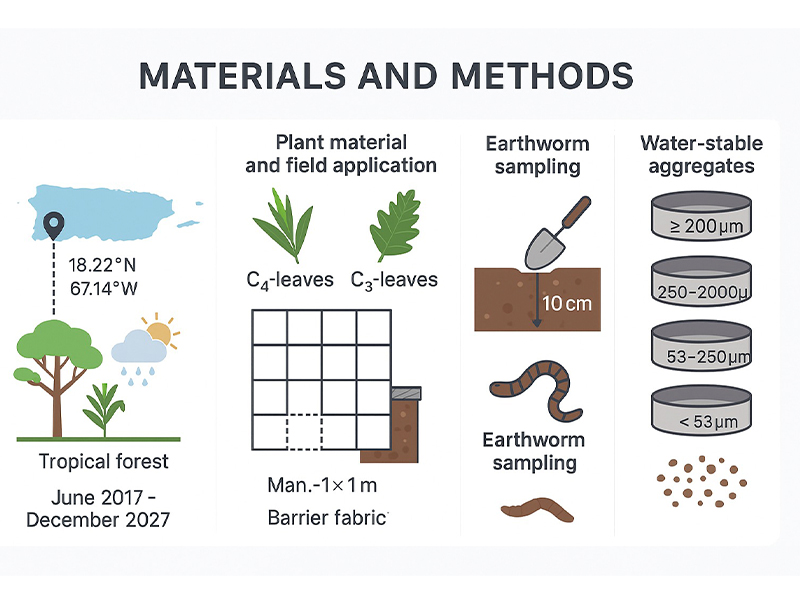
El rol de los micro y macroorganismos del suelo en la incorporación de carbono a los agregados del suelo ha sido poco estudiado en los suelos tropicales. Para evaluar la formación de agregados del suelo y la incorporación de carbono mediante la actividad de las lombrices de tierra, realizamos un experimento de campo en un bosque secundario en la Universidad de Puerto Rico en Mayagüez. Utilizamos la abundancia natural de C13 en la vegetación y la diferencia del isótopo de 13C entre plantas C3 y C4 para rastrear las fuentes de carbono dentro de los agregados del suelo. Se utilizaron hojas de maíz para rastrear la incorporación de carbono C4 en los agregados del suelo, permitiendo una clara distinción entre esta fuente de carbono y el carbono C3 derivado de la vegetación del bosque. Se colectaron muestras de lombrices de tierra y suelo (Typic Haplohumults) a una profundidad de 0-10 cm. Las clases de tamaño de los agregados se separaron por el método de tamizado húmedo. En el sitio de estudio se encontraron dos especies de lombrices de tierra pertenecientes a las categorías ecológicas epigéicas y endogéicas. En un período de 6 meses, nuestros resultados sugieren que la especie endogéica P. corethrurus puede reorganizar pequeños macroagregados para formar grandes macroagregados. Nuestros resultados sugieren que P. corethrurus muestra una preferencia por consumir carbono derivado del suelo y puede translocarlo desde los microagregados a los macroagregados mediante la reestructuración de los agregados del suelo.
Descargas
Citas
Aira, M., Sampedro, L., Monroy, F. y Domínguez, J. (2008). Detritivorous earthworms directly modify the structure, thus altering the functioning of a microdecomposer food web. Soil Biology and Biochemistry, 40(10), 2511–2516. https://doi.org/10.1016/j.soilbio.2008.06.010
Amador, J. A., Winiarski, K. y Sotomayor-Ramírez, D. (2013). Earthworm communities along a forest-coffee agroecosystem gradient: Preliminary evidence supporting the habitat-dependent feeding hypothesis. Tropical Ecology, 54(3), 365–374.
Aira, M., Sampedro, L., Monroy, F. y Domínguez, J. (2008). Detritivorous earthworms directly modify the structure, thus altering the functioning of a microdecomposer food web. Soil Biology and Biochemistry, 40(10), 2511–2516. https://doi.org/10.1016/j.soilbio.2008.06.010
Amador, J. A., Winiarski, K. y Sotomayor-Ramírez, D. (2013). Earthworm communities along a forest-coffee agroecosystem gradient: Preliminary evidence supporting the habitat-dependent feeding hypothesis. Tropical Ecology, 54(3), 365–374.
Barois, I., Villemin, G., Lavelle, P. y Toutain, F. (1993). Transformation of the soil structure through Pontoscolex corethrurus (Oligochaeta) intestinal tract. Geoderma, 56(1–4), 57–66. https://doi.org/10.1016/0016-7061(93)90100-Y
Beinroth, F. H., Engel, R., Lugo, J., Santiago, C., Ríos, S. y Brannon, G. (2002). Updated taxonomic classification of soils of Puerto Rico (Bull. 303). Agricultural Experiment Station.
Blanchart, E., Albrecht, A., Brown, G., Decaens, T., Duboisset, A., Lavelle, P., Mariani, L. y Roose, E. (2004). Effects of tropical endogeic earthworms on soil erosion. Agriculture, Ecosystems y Environment, 104(2), 303–315. https://doi.org/10.1016/j.agee.2004.01.031
Blanchart, E., Lavelle, P., Braudeau, E., le Bissonnais, Y. y Valentin, C. (1997). Regulation of soil structure by geophagous earthworm activities in humid savannas of Cote d’Ivoire. Soil Biology and Biochemistry, 29(3–4), 431–439. https://doi.org/10.1016/S0038-0717(96)00042-9
Borges, S. (1996). The Terrestrial Oligochaetes of Puerto Rico. Annals of the New York Academy of Sciences, 776, 239–248. https://doi.org/10.1111/j.1749-6632.1996.tb17423.x
Bossuyt, H., Six, J. y Hendrix, P. F. (2004). Rapid incorporation of carbon from fresh residues into newly formed stable microaggregates within earthworm casts. European Journal of Soil Science, 55(2), 393–399. https://doi.org/10.1111/j.1351-0754.2004.00603.x
Bossuyt, H., Six, J. y Hendrix, P. F. (2005). Protection of soil carbon by microaggregates within earthworm casts. Soil Biology y Biochemistry, 37(2), 251–258. https://doi.org/10.1016/j.soilbio.2004.07.035
Bossuyt, H., Six, J. y Hendrix, P. F. (2006). Interactive effects of functionally different earthworm species on aggregation and incorporation and decomposition of newly added residue carbon. Geoderma, 130(1–2), 14–25. https://doi.org/10.1016/j.geoderma.2005.01.005
Dechaine, J., Ruan, H., Sánchez-de León, Y. y Zou, X. (2005). Correlation between earthworms and plant litter decomposition in a tropical wet forest of Puerto Rico. Pedobiologia, 49(6), 601–607. https://doi.org/10.1016/j.pedobi.2005.07.006
Elliott, E. T. (1986). Aggregate Structure and Carbon, Nitrogen, and Phosphorus in Native and Cultivated Soils. Soil Sci .Soc.Am.J., 50(3), 627–633. https://lc.cx/2XBoDq
Fonte, S. J., Kong, A. Y. Y., van Kessel, C., Hendrix, P. F. y Six, J. (2007). Influence of earthworm activity on aggregate-associated carbon and nitrogen dynamics differs with agroecosystem management. Soil Biology and Biochemistry, 39(5), 1014–1022. https://doi.org/10.1016/j.soilbio.2006.11.011
Fonte, S. J., Winsome, T. y Six, J. (2009). Earthworm populations in relation to soil organic matter dynamics and management in California tomato cropping systems. Applied Soil Ecology, 41(2), 206–214. https://doi.org/10.1016/j.apsoil.2008.10.010
González, G., García, E., Cruz, V., Borges, S., Zalamea, M. y Rivera, M. M. (2007). Earthworm communities along an elevation gradient in Northeastern Puerto Rico. European Journal of Soil Biology, 43(SUPPL. 1). https://doi.org/10.1016/j.ejsobi.2007.08.044
González, G. y Zou, X. (1999). Plant and Litter Influences on Earthworm Abundance and Community Structure in a Tropical Wet Forest. Biotropica, 31(3), 486–493. https://www.jstor.org/stable/2663944
Harmsen, E. W., Goyal, M. R. y Torres-Justiniano, S. (2002). Estimating evapotranspiration in Puerto Rico. Journal of Agriculture of the University of Puerto Rico, 86(1–2), 35–54. https://revistas.upr.edu/index.php/jaupr/article/view/3182
Hendrix, P. F., Lachnicht, S. L., Callaham, M. A. y Zou, X. (1999). Stable isotopic studies of earthworm feeding ecology in tropical ecosystems of Puerto Rico. Rapid Communications in Mass Spectrometry, 13(13), 1295–1299. https://doi.org/10.1002/(SICI)1097-0231(19990715)13:13<1295::AID-RCM605>3.0.CO;2-9
Hubers, H., Borges, S. y Alfaro, M. (2003). The oligochaetofauna of the Nipe soils in the Maricao State Forest, Puerto Rico : The 7th international symposium on earthworm ecology · Cardiff · Wales · 2002. Pedobiologia, 47(5–6), 475–478. https://doi.org/10.1078/0031-4056-00216
Jackson, M. L. (2005). Soil Chemical Analysis – Advance Course. https://books.google.com.ec/books?id=VcEOK9QCkVEC&hl=es-419
Jarvis, S., Tisdall, J., Oades, J. M., Six, J., Gregorich, E. y Kögel-Knabner, I. (2012). Landmark papers. European Journal of Soil Science, 63(1), 1–21. https://doi.org/10.1111/j.1365-2389.2011.01408.x
Jastrow, J. D., Boutton, T. y Miller, R. M. (1996). Carbon dynamics of aggregate – associated organic matter estimated by carbon – 13 natural abundance. Soil Sci. Soc. Am. J., 60(3), 801–807. https://doi.org/10.2136/sssaj1996.03615995006000030017x
Jastrow, J. D., Miller, R. M., Matamala, R., Norby, R. J., Boutton, T. W., Rice, C. W. y Owensby, C. E. (2005). Elevated atmospheric carbon dioxide increases soil carbon. Global Change Biology, 11(12), 2057–2064. https://doi.org/10.1111/j.1365-2486.2005.01077.x
Kamau, S., Barrios, E., Karanja, N. K., Ayuke, F. O. y Lehmann, J. (2020). Dominant tree species and earthworms affect soil aggregation and carbon content along a soil degradation gradient in an agricultural landscape. Geoderma, 359. https://doi.org/10.1016/j.geoderma.2019.113983
Lachnicht, S. L., Hendrix, P. F. y Zou, X. (2002). Interactive effects of native and exotic earthworms on resource use and nutrient mineralization in a tropical wet forest soil of Puerto Rico. Biology and Fertility of Soils, 36(1), 43–52. https://doi.org/10.1007/s00374-002-0501-5
Lavelle, P., Blanchart, E., Martin, A., Spain, A. V. y Martin, S. (1992). Impact of Soil Fauna on the properties of Soils in the Humid Tropics. In Myths and Science of Soils of the Tropics. SSSA Spe- cial Publication. (Vol. 29, pp. 29). https://doi.org/10.2136/sssaspecpub29.c9
Le Couteulx, A., Wolf, C., Hallaire, V. y Pérès, G. (2015). Burrowing and casting activities of three endogeic earthworm species affected by organic matter location. Pedobiologia, 58(2–3), 97–103. https://doi.org/10.1016/j.pedobi.2015.04.004
Liu, Z. y Zou, X. (2002). Exotic earthworms accelerate plant litter decomposition in a wet forest. Ecological Applications, 12(5), 1406–1417. https://doi.org/https://doi.org/10.1890/1051-0761(2002)012[1406:EEAPLD]2.0.CO;2
Oades, J. M. (1993). The role of biology in the formation, stabilization and degradation of soil structure. Geoderma, 56(1–4), 377–400. https://doi.org/10.1016/0016-7061(93)90123-3
Oades, J. M. y Waters, A. G. (1991). Aggregate hierarchy in soils. Australian Journal of Soil Research, 29(6), 815–825. https://doi.org/10.1071/SR9910815
O’Leary, M. H. (1981). Carbon isotope fractionation in plants. Phytochemistry, 20(4), 553–567. https://doi.org/10.1016/0031-9422(81)85134-5
Paul, E. A., Harris, D., Collins, H. P., Schulthess, U. y Robertson, G. P. (1999). Evolution of CO2 and soil carbon dynamics in biologically managed, row-crop agroecosystems. Applied Soil Ecology, 11(1), 53–65. https://doi.org/10.1016/S0929-1393(98)00130-9
Paul, S., Flessa, H., Veldkamp, E. y López-Ulloa, M. (2008). Stabilization of recent soil carbon in the humid tropics following land use changes: Evidence from aggregate fractionation and stable isotope analyses. Biogeochemistry, 87(3), 247–263. https://doi.org/10.1007/s10533-008-9182-y
Phillips, D. L. y Gregg, J. W. (2001). Uncertainty in source partitioning using stable isotopes. Oecologia, 127(2), 171–179. https://doi.org/10.1007/s004420000578
Pulleman, M. M., Six, J., Uyl, A., Marinissen, J. C. Y. y Jongmans, A. G. (2005). Earthworms and management affect organic matter incorporation and microaggregate formation in agricultural soils. Applied Soil Ecology, 29(1), 1–15. https://doi.org/10.1016/j.apsoil.2004.10.003
Ravalo, E. J., Goyal, M. R. y Almodóvar, C. R. (1986). Average Monthly and Annual Rainfall Distribution in Puerto Rico. The Journal of Agriculture of the University of Puerto Rico, 70(4), 267–275. https://revistas.upr.edu/index.php/jaupr/article/view/7103
Sánchez-de León, Y., Lugo-Pérez, J., Wise, D. H., Jastrow, J. D. y González-Meler, M. A. (2014). Aggregate formation and carbon sequestration by earthworms in soil from a temperate forest exposed to elevated atmospheric CO2: A microcosm experiment. Soil Biology and Biochemistry, 68, 223–230. https://doi.org/10.1016/j.soilbio.2013.09.023
Sánchez-de León, Y., Wise, D. H., Lugo-Pérez, J., Norby, R. J., James, S. W. y Gonzalez-Meler, M. A. (2018). Endogeic earthworm densities increase in response to higher fine-root production in a forest exposed to elevated CO2. Soil Biology and Biochemistry, 122, 31–38. https://doi.org/10.1016/j.soilbio.2018.03.027
Sánchez-de León, Y., Zou, X. y Borges, S. (2003). Recovery of Native Earthworms in Abandoned Tropical Pastures. 17(4), 999–1006.
SAS Institute Inc. (2015). Introduction to Mixed Modeling Procedures. SAS/STAT 9.2 User’s Guide, Chapter 6, 116–125.
Schmidt, O. (1999). Intrapopulation variation in carbon and nitrogen stable isotope ratios in the earthworm Aporrectodea longa. Ecological Research, 14(4), 317–328. https://doi.org/10.1046/j.1440-1703.1999.00310.x
Six, J., Conant, R. T. y Paustian, K. (2002). Stabilization mechanisms of soil organic matter: Implications for C-saturation of soils. Plant and Soil, 241, 155–176. https://doi.org/10.1023/A:1016125726789
Six, J., Elliott, E. T. y Paustian, K. (2000). Soil macroaggregate turnover and microaggregate formation: A mechanism for C sequestration under no-tillage agriculture. Soil Biology and Biochemistry, 32(14), 2099–2103. https://doi.org/10.1016/S0038-0717(00)00179-6
Six, J., Elliott, E. T., Paustian, K. y Doran, J. W. (1998). Aggregation and soil organic matter accumulation in cultivated and native grassland soils. Soil Science Society of America Journal, 62(5), 1367-1377. https://doi.org/10.2136/sssaj1998.03615995006200050032x
Six, J. y Paustian, K. (2014). Aggregate-associated soil organic matter as an ecosystem property and a measurement tool. Soil Biology and Biochemistry, 68, A4-A9. https://doi.org/10.1016/j.soilbio.2013.06.014
Soil Survey Staff. (2014). Keys to soil taxonomy. Soil Conservation Service, 12, 410.
Tisdall, J. M. y Oades, J. M. (1982). Organic matter and water-stable aggregates in soils. Journal of Soil Science, 33(2), 141–163. https://doi.org/10.1111/j.1365-2389.1982.tb01755.x
Túa-Ayala, G. Z. (2013). Transformación de bosques noveles a sistemas agroforestales en la región húmeda de Puerto Rico: Pasos iniciales. [Master’s Thesis, University of Puerto Rico-Mayagüez]. Retrieved from https://hdl.handle.net/20.500.11801/3558
Whalen, J. K. y Janzen, H. H. (2002). Labeling earthworms uniformly with C-13 and N-15: implications for monitoring nutrient fluxes. Soil Biology and Biochemistry, 34(12), 1913–1918. https://doi.org/10.1016/S0038-0717(02)00207-9
Descargas
Publicado
Cómo citar
Número
Sección
Licencia
Derechos de autor 2025 Mauricio Renato Morejón Centeno, Rocio Natividad Morejón Lucio, José Nolberto Macías Veliz

Esta obra está bajo una licencia internacional Creative Commons Atribución-NoComercial-CompartirIgual 4.0.
Acuerdo de licencia
Esta revista ofrece acceso gratuito a su contenido a través de su sitio web, siguiendo el principio de que hacer que la investigación esté disponible gratuitamente para el público apoya un mayor intercambio de conocimiento global.
El contenido web de la revista se distribuye bajo la licencia Atribución-NoComercial-CompartirIgual 4.0 Internacional.
Los autores podrán celebrar otros acuerdos de licencia no exclusivos para la distribución de la versión publicada de la obra, siempre que se reconozca la publicación inicial en esta revista. Se permite y recomienda que los autores publiquen sus trabajos en línea antes y durante el proceso de envío, lo que puede generar intercambios interesantes y aumentar las citas del trabajo publicado.